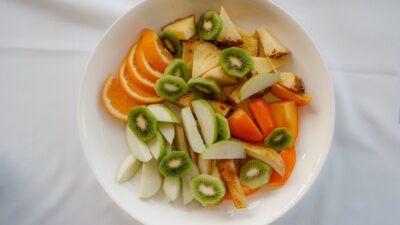
Lychee is suitable for diabetes in moderate portions. Fresh lychee contains 16 g carbohydrate with 1 g fiber per cup (about 10 small lychees) and 66 calories. Glycemic index around 50 — moderate. Lychee provides exceptional vitamin C (135% DV per cup), copper, and B vitamins. Limit to ½ cup per serving (~8 g carb) or 5-6 lychees. Important safety note: avoid unripe lychees — they contain hypoglycin A and methylenecyclopropylglycine (MCPG) which can cause severe hypoglycemia. Outbreaks in lychee-growing regions of India and Bangladesh have caused hundreds of deaths in children eating unripe lychees on empty stomachs. Adults are at lower risk but should avoid unripe lychees. For adults with diabetes on insulin or sulfonylureas, theoretical interaction concern. Only eat fully ripe lychees. Canned lychees often have heavy syrup adding substantial carbs — fresh has 16 g carb per cup, canned in light syrup 32 g, heavy syrup 40+ g. Choose fresh when available (May-July season in U.S.), in juice or no-sugar-added if canned, or frozen as intermediate option. Preparation: score and peel red-pink skin (comes off easily on ripe fruit), eat flesh, remove central pit. Refrigerate fresh up to 1 week. Diabetes-friendly applications include 5-6 fresh lychees as snack with nuts, in mixed tropical fruit salad (small portions), garnish for Thai curry, in Asian-inspired salads with grilled chicken, frozen for smoothies.
Nutrition Comparison
| Form (per cup) | Calories | Carbs (g) | Fiber (g) | Sugar (g) |
|---|---|---|---|---|
| Fresh lychee | 66 | 16 | 1 | 15 |
| Canned in juice | 110 | 27 | 1 | 23 |
| Canned light syrup | 130 | 32 | 1 | 30 |
| Canned heavy syrup | 165 | 43 | 1 | 41 |
| Lychee 5-6 fresh | 33 | 8 | 0.5 | 7 |
| Dried lychee (1 oz) | 80 | 20 | 1 | 18 |
| Lychee juice (8 oz) | 130 | 33 | 0 | 30 |
Unripe Lychee Toxicity
- Hypoglycin A and MCPG compounds in unripe fruit.
- Inhibit gluconeogenesis (glucose production from non-carbs).
- Severe hypoglycemia and encephalopathy possible.
- Most dangerous in children with empty stomachs (low glycogen).
- Indian/Bangladesh outbreaks: hundreds of child deaths historically.
- Adults at lower risk but should still avoid unripe.
- Eating ripe lychees with food is safe.
- Toxin destroyed by ripening — ripe fruit is safe.
- Don’t eat large amounts on empty stomach.
- For diabetes patients on insulin/sulfonylureas: theoretical extra concern; eat with meals.
Selection and Preparation
- Choose lychees with bright red-pink skin (yellow tinge okay).
- Slight give when pressed — like a ripe peach.
- Avoid green tints (unripe — toxicity risk).
- Avoid brown spots or dry skin.
- Refrigerate fresh up to 1 week.
- Score skin with knife; peel off (comes off easily on ripe fruit).
- Eat flesh; remove central pit.
- Best eaten fresh within 1-2 days of purchase.
- Frozen lychees available year-round at Asian markets.
Diabetes-Friendly Applications
- 5-6 fresh lychees as snack with nuts or cheese.
- Mixed tropical fruit salad with small portions.
- Garnish for Thai curry.
- Asian-style salad with grilled chicken, lychee, cucumber.
- Frozen lychees in smoothies (small portion).
- Lychee and avocado salad with lime.
- Asian-inspired chicken stir-fry with lychee (small portion).
- Lychee with cottage cheese for breakfast.
- Lychee garnish on Vietnamese pho.
- Lychee in green tea infusion (no sugar added).
- Lychee with mango and pineapple in moderation (mixed tropical fruit cup).
What to Limit
- Canned lychees in heavy syrup.
- Lychee juice — concentrated sugar.
- Dried lychees — concentrated; small portions only.
- Lychee ice cream and sorbet.
- Lychee martinis and cocktails (sugar + alcohol).
- Large portions at one sitting.
- Lychee jam and preserves.
- Lychee-flavored bubble tea (often very high sugar).
Health Benefits
- Exceptional vitamin C — 135% DV per cup.
- Copper — modest contribution.
- B vitamins (B6, riboflavin).
- Polyphenols and antioxidants.
- Possible mild anti-inflammatory effects.
- Hydration support.
- Some traditional Chinese medicine uses.
Buying Considerations
- Fresh lychees: May-July season in U.S.
- Available at Asian markets, larger supermarkets, farmers markets.
- Cost: $4-8 per pound fresh.
- Frozen lychees: year-round at Asian markets.
- Canned lychees: most accessible; check syrup content.
- Imported from China, Vietnam, Mexico, Australia.
- Some U.S.-grown (California, Florida, Hawaii).
Similar Fruits to Consider
- Longan — similar but more common in Asia; same family.
- Rambutan — Southeast Asian relative; similar but with hairy red skin.
- Mangosteen — different family but similar tropical sweetness.
- All have similar diabetes considerations: moderate carbs, small portions.
The Bottom Line
Lychee is suitable for diabetes in moderate portions. Fresh lychee contains 16 g carbohydrate with 1 g fiber per cup (about 10 small lychees) and 66 calories. Glycemic index around 50 — moderate. Lychee provides exceptional vitamin C (135% DV per cup), copper, and B vitamins. Limit to ½ cup per serving (~8 g carb) or 5-6 lychees. Important safety note: avoid unripe lychees — they contain hypoglycin A and methylenecyclopropylglycine which can cause severe hypoglycemia and encephalopathy. Outbreaks in lychee-growing regions of India and Bangladesh have caused hundreds of deaths in children eating unripe lychees on empty stomachs. Toxin destroyed by ripening — ripe fruit is safe. For adults with diabetes on insulin or sulfonylureas, theoretical extra concern; eat with meals. Canned lychees often have heavy syrup substantially increasing carbs: fresh 16 g carb per cup, canned light syrup 32 g, heavy syrup 40+ g. Choose fresh when available (May-July season), in juice or no-sugar-added if canned, or frozen as intermediate option. Selection: bright red-pink skin (yellow tinge okay), slight give when pressed; avoid green tints (unripe toxicity), brown spots, or dry skin. Preparation: score and peel red-pink skin, eat flesh, remove central pit. Diabetes-friendly applications include 5-6 fresh lychees as snack with nuts, mixed tropical fruit salad with small portions, garnish for Thai curry, Asian-style salad with grilled chicken, frozen lychees in smoothies, lychee and avocado salad with lime. Avoid canned in heavy syrup, lychee juice, dried lychees, lychee ice cream and sorbet, lychee cocktails, and lychee-flavored bubble tea (often very high sugar). Available May-July fresh at Asian markets and larger supermarkets; cost $4-8 per pound; frozen and canned year-round. For adults with type 2 diabetes, lychee provides tropical flavor variety in moderate portions when ripeness is verified — never eat unripe. See our broader diabetes diet guide for context.