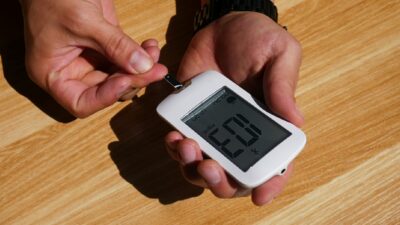
Thyroid disorders are unusually common in people with diabetes — about 25 to 30 percent of type 1 diabetes and 10 to 15 percent of type 2 diabetes, compared with roughly 5 percent in the general population. Hypothyroidism is the most frequent; hyperthyroidism is less common but more disruptive to glucose control. Both ends of the spectrum affect insulin requirements, glycemic variability, and cardiovascular risk, which is why screening with TSH is part of routine diabetes care.
Why Diabetes and Thyroid Disease Cluster
Two mechanisms link the two conditions:
- Shared autoimmunity (mainly T1D): Type 1 diabetes is an autoimmune disease, and patients are at higher risk for other organ-specific autoimmune conditions including Hashimoto’s thyroiditis, Graves’ disease, celiac disease, Addison’s disease, and pernicious anemia. The cluster is termed autoimmune polyendocrine syndrome.
- Shared metabolic dysregulation (mainly T2D): Insulin resistance, obesity, and inflammation share pathways with subclinical hypothyroidism. Adipose tissue produces inflammatory cytokines that affect thyroid hormone signaling.
How Common Is Thyroid Disease in Diabetes?
| Population | Thyroid Dysfunction Rate |
|---|---|
| General adult population | ~5% |
| Type 1 diabetes | ~25 to 30% (mostly Hashimoto’s) |
| Type 2 diabetes | ~10 to 15% (mostly hypothyroidism) |
| Women with diabetes > 60 years | ~20 to 30% |
| Children with type 1 diabetes | ~10 to 20% develop Hashimoto’s within 10 years |
| Pregnant women with type 1 diabetes | ~25% have postpartum thyroiditis |
Types of Thyroid Disease Seen in Diabetes
| Condition | Mechanism | Effect on Diabetes |
|---|---|---|
| Hashimoto’s thyroiditis (hypothyroidism) | Autoimmune destruction of thyroid; anti-TPO antibodies | Hypoglycemia risk, dyslipidemia, weight gain |
| Graves’ disease (hyperthyroidism) | TSH-receptor antibodies stimulate thyroid | Higher insulin needs, hyperglycemia, DKA risk |
| Subclinical hypothyroidism | Mildly elevated TSH, normal free T4 | May worsen glycemic control; treatment debated |
| Subclinical hyperthyroidism | Suppressed TSH, normal free T4 | Atrial fibrillation, bone loss |
| Postpartum thyroiditis | Transient hyperthyroidism then hypothyroidism | Glucose swings; often resolves |
| Thyroid nodules / goiter | Structural; sometimes functional | Variable; needs imaging |
How Hypothyroidism Affects Diabetes
- Slows gastric emptying and carbohydrate absorption → unpredictable postprandial glucose
- Reduces insulin clearance → higher risk of late hypoglycemia
- Raises LDL cholesterol and total cholesterol
- Causes weight gain and fatigue, which complicate diabetes self-care
- Worsens diabetic peripheral neuropathy in some patients
- Increases cardiovascular risk independently
How Hyperthyroidism Affects Diabetes
- Speeds gastric emptying → rapid postprandial glucose spikes
- Increases hepatic gluconeogenesis → fasting hyperglycemia
- Raises insulin requirements 30 to 50 percent
- Can precipitate diabetic ketoacidosis (DKA) in undiagnosed type 1 diabetes
- Can mimic hypoglycemia symptoms (tremor, palpitations, sweating)
- Increases atrial fibrillation risk, which compounds diabetes cardiovascular risk
Symptoms — Hypo vs Hyper
| Symptom | Hypothyroidism | Hyperthyroidism |
|---|---|---|
| Energy | Fatigue, sluggishness | Restless, hyperactive |
| Weight | Gain despite normal eating | Loss despite normal eating |
| Temperature | Cold intolerance | Heat intolerance, sweating |
| Heart rate | Slow (bradycardia) | Fast (tachycardia), palpitations |
| Mood | Depression, slowed thinking | Anxiety, irritability |
| Skin/hair | Dry skin, hair thinning | Warm moist skin, fine hair |
| Bowel | Constipation | Frequent stools, diarrhea |
| Menstruation | Heavy, irregular | Light, irregular |
| Neuromuscular | Muscle cramps, slowed reflexes | Tremor, brisk reflexes |
Screening Recommendations
| Group | Recommendation |
|---|---|
| Type 1 diabetes (all ages) | TSH at diagnosis; recheck every 1 to 2 years or with symptoms |
| Type 1 diabetes with positive anti-TPO antibodies | TSH annually |
| Type 2 diabetes | TSH at diagnosis if symptoms; otherwise periodic (every 1 to 2 years) |
| Women with diabetes considering pregnancy | TSH before conception |
| Pregnant women with type 1 diabetes | TSH each trimester |
| Postpartum women with type 1 diabetes | TSH at 6 weeks and 6 months |
| Older adults with new atrial fibrillation | TSH |
Tests That Define the Picture
- TSH — most sensitive single test for both hypo- and hyperthyroidism
- Free T4 — confirms thyroid hormone availability
- Free T3 — useful in hyperthyroidism workup
- Anti-thyroid peroxidase (anti-TPO) antibodies — positive in ~90 percent of Hashimoto’s
- Anti-thyroglobulin (anti-Tg) antibodies — also seen in Hashimoto’s
- Anti-TSH receptor antibodies (TRAb) — diagnostic for Graves’
- Thyroid ultrasound — for nodules or goiter
- Radioactive iodine uptake scan — differentiates Graves’ from thyroiditis
Treatment Considerations in Diabetes
- Hypothyroidism: Levothyroxine is first-line. Take on empty stomach, 30 to 60 minutes before food and 4 hours apart from calcium, iron, metformin, and fiber supplements.
- Hyperthyroidism: Methimazole (first-line in non-pregnant adults), propylthiouracil (PTU; pregnancy first trimester), radioactive iodine, or thyroidectomy. Beta-blockers control symptoms acutely.
- After treatment: Glycemic targets often need revisiting. After hyperthyroidism is controlled, insulin needs may drop sharply, increasing hypoglycemia risk.
- Subclinical hypothyroidism: Treatment in diabetes is debated; many endocrinologists treat if TSH > 10 mIU/L or if cardiovascular risk is high.
Drug Interactions to Know
| Medication | Effect on Thyroid Treatment |
|---|---|
| Metformin | Can lower TSH; may slightly alter levothyroxine absorption |
| Calcium, iron supplements | Reduce levothyroxine absorption; separate by 4 hours |
| Proton-pump inhibitors | May reduce levothyroxine absorption |
| Sucralfate, antacids | Reduce levothyroxine absorption |
| SGLT2 inhibitors | No direct thyroid interaction |
| Beta-blockers | Useful for hyperthyroid symptoms; can blunt hypoglycemia awareness |
| Amiodarone | Can cause both hypo- and hyperthyroidism |
Special Situations
- Pregnancy with type 1 diabetes: Thyroid antibodies are common; untreated hypothyroidism raises miscarriage, preeclampsia, and developmental delay risk.
- Adolescents with type 1 diabetes: Up to 1 in 5 develop Hashimoto’s by 10 years; annual screening is standard.
- Type 2 diabetes with newly diagnosed atrial fibrillation: Always check TSH; hyperthyroidism is reversible cause.
- Hashimoto’s encephalopathy: rare; presents with confusion, seizures; responds to steroids.
Why This Matters for Glucose Control
Untreated thyroid dysfunction is one of the most common reversible causes of glycemic instability. Anyone whose A1C trajectory changes unexpectedly, especially with new fatigue, weight change, or hair changes, should have TSH checked. See our complications hub for the broader picture and our A1C levels guide for glycemic targets.
Related Reading
For specific conditions, see Hashimoto and type 1 diabetes, hypothyroidism and diabetes, thyroid and blood sugar, and Graves disease and diabetes. American Thyroid Association resources are at thyroid.org.
The Bottom Line
Thyroid disorders are several times more common in diabetes than in the general population, especially Hashimoto’s hypothyroidism in type 1 diabetes. Either direction of thyroid dysfunction destabilizes glucose control and raises cardiovascular risk. TSH screening is part of standard care at type 1 diabetes diagnosis and reasonable every 1 to 2 years in type 2 diabetes or with any new symptoms. Levothyroxine, methimazole, and other treatments are highly effective when started promptly — and they restore glucose stability that may have been blamed on diabetes alone. Talk to an endocrinologist if your TSH is abnormal or your diabetes control has shifted unexpectedly.