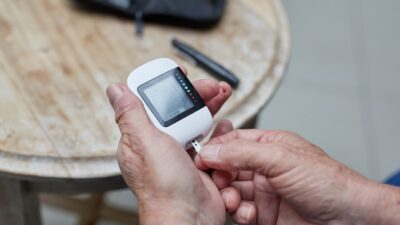
A glucose test strip is a small disposable sensor that reacts with the glucose in a drop of blood to produce an electrical signal your meter converts into a number. Modern strips are fast (5 seconds), need very little blood (usually 0.3 to 0.6 microliters), and are accurate enough to guide insulin dosing decisions when stored and used correctly.
How a Test Strip Works
Most strips use one of two enzymes immobilized on the reagent pad:
- Glucose oxidase (GOx) — reacts with glucose and oxygen to produce hydrogen peroxide, which is measured electrochemically.
- Glucose dehydrogenase (GDH) — reacts with glucose without needing oxygen, which makes it more stable at high altitude and in patients on supplemental oxygen. Older variants (GDH-PQQ) cross-reacted with maltose and other sugars; current strips use GDH-FAD or GDH-NAD chemistry that is glucose-specific.
The reaction generates a small current proportional to the amount of glucose in the sample. The meter measures the current, applies correction factors for temperature and strip lot, and displays a plasma-equivalent glucose value.
How Accurate Are Modern Strips?
The FDA requires cleared home glucose meters to meet the ISO 15197:2013 standard:
- 95 percent of readings within ±15 mg/dL of a lab reference when glucose is under 100 mg/dL
- 95 percent of readings within ±15 percent when glucose is 100 mg/dL or above
- 99 percent of readings within a broader consensus error grid
Independent testing sometimes finds individual strip lots falling outside these limits, so running control-solution checks on a new strip batch is a reasonable habit — particularly if you are using the readings to dose insulin.
Factors That Affect Accuracy
| Factor | Effect | How to Avoid |
|---|---|---|
| Sample too small | Reads falsely low or gives an error | Apply enough blood; meters warn if the sample is insufficient |
| Food or lotion on finger | Can falsely raise glucose | Wash hands or use an alcohol swab and dry before lancing |
| Expired or moisture-damaged strips | Any direction of error; unpredictable | Keep vial capped; note open date; discard at 3 to 6 months |
| Extreme temperature | Falsely high or low readings; strip failure | Store between 50°F and 95°F; do not leave in a hot car |
| High altitude | Some older GOx strips read low | Use a GDH-FAD strip for altitudes above 10,000 feet if specified |
| Dehydration, shock | Capillary blood glucose may read lower than venous | Confirm with lab draw if clinically unstable |
| Very high hematocrit | Can read falsely low | Choose a strip rated for the expected hematocrit range |
| High-dose vitamin C, acetaminophen, dopamine | Can interfere with some strip chemistries | Check the package insert for interferences |
How to Use a Strip Correctly
- Wash and thoroughly dry your hands. If water is unavailable, alcohol-wipe and let dry completely.
- Insert a fresh strip into the meter; wait for the blood-drop icon.
- Lance the side of a fingertip (hurts less than the pad); build up a drop.
- Touch the strip tip to the drop; the strip wicks the sample — do not smear the blood onto the strip.
- Wait 5 seconds; read the number; discard the strip.
- Log the value — modern meters sync to a phone app and to your care team if you authorize sharing.
Storage and Shelf Life
- Keep strips in the original vial; never transfer to another container.
- Close the cap tightly immediately after removing a strip — moisture kills the enzyme.
- Write the date you opened the vial. Use within 3 to 6 months per the manufacturer’s label, and always before the printed expiration.
- Store at room temperature (50°F to 95°F / 10°C to 35°C); do not refrigerate or freeze.
- Do not store in a bathroom or kitchen where humidity fluctuates.
- Check the vial’s desiccant; if it has changed color, the strips may be compromised.
Control Solution and Meter Calibration
Most brands sell a glucose control solution — a liquid with a known glucose value — to verify that a strip batch and meter are working together correctly. Test with control solution when:
- You open a new vial of strips
- You drop the meter
- A reading surprises you or does not match how you feel
- After changing a meter battery
If the control reading falls outside the acceptable range printed on the vial, do not use the strip batch until you resolve the issue.
When Test Strips Make Sense vs a CGM
- Test strips are sufficient for: type 2 diabetes managed with oral medications only; gestational diabetes with stable readings; infrequent troubleshooting.
- A CGM is often better for: anyone on intensive insulin therapy, recurrent overnight lows, hypoglycemia unawareness, high A1C variability, pregnancy with pre-existing diabetes, and most people with type 1 diabetes.
Even CGM users typically keep test strips as a backup for sensor failures and to confirm readings at low or suspicious values. For broader context, see our guides on detection of prediabetes and A1C levels.
Cost and Insurance
Brand-name strips in the United States typically run $0.30 to $1 per strip; store-brand (Relion, generic) strips are often under $0.30. Medicare Part B and most commercial plans cover a prescribed quantity per month with a preferred meter. If cost is a barrier, ask your pharmacist about generic equivalents, store-brand meters, and manufacturer coupon programs.
The Bottom Line
A glucose test strip is a small chemistry experiment you run against yourself in 5 seconds. Modern strips are accurate enough to guide real clinical decisions, but only if you store them sealed, use them before they expire, and test technique matters — clean finger, adequate drop, side-of-finger lance, correct meter-strip pairing. If you use strips daily, keep a fresh box on hand and consider whether a continuous glucose monitor would give you a fuller picture.