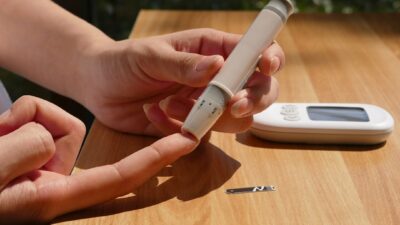
An insulin pen needle is the small, disposable, screw-on needle that attaches to an insulin pen for each injection. Modern pen needles are 4 mm to 12.7 mm long and 28G to 32G in gauge, with the 4 mm Nano (32G) now the recommended first-line size for adults and children of all body sizes. Single use is essential — reuse causes pain, lipohypertrophy, and possible infection. Most insurance plans cover 100 needles per 30 days.
How Pen Needles Work
A pen needle has three parts:
- Hub — the threaded plastic base that screws onto the pen
- Needle shaft — the actual stainless steel tube that pierces the skin
- Outer and inner caps — protect the needle before use
The user removes the protective tab, screws the needle onto the pen, removes both caps, primes the pen with an airshot, injects, and then disposes of the needle in an FDA-approved sharps container.
Needle Length — What Each Size Does
| Length | Common Use | Skin Pinch? | Pros | Cons |
|---|---|---|---|---|
| 4 mm (Nano) | First-line for adults and children | Not required | Least pain, low IM-injection risk, simple technique | None significant |
| 5 mm | Backup if 4 mm not available | Not required for most | Slightly faster flow than 4 mm | Marginally more risk in very lean |
| 6 mm | Once standard; now optional | Recommended in lean adults | Familiar to long-term users | Higher IM injection risk if not pinched |
| 8 mm | Rare; legacy use | Required in most | Reaches deep SC in obese | IM injection risk; more pain |
| 12.7 mm | Largely obsolete | Mandatory in all | None vs shorter needles | Highest IM risk; outdated |
Needle Gauge — Thickness Matters
| Gauge | Diameter | Common Lengths | Pain Level |
|---|---|---|---|
| 28G | 0.36 mm | 12.7 mm | Most noticeable |
| 29G | 0.33 mm | 12.7 mm | Noticeable |
| 30G | 0.30 mm | 8 mm | Moderate |
| 31G | 0.25 mm | 5 mm, 6 mm, 8 mm | Mild |
| 32G | 0.23 mm | 4 mm, 5 mm | Mildest |
Higher gauge means thinner needle and less pain. Thinner needles flow insulin slightly more slowly, so users delivering larger doses (above 40 to 60 units) may notice they need to hold the pen against the skin for a second or two longer to complete the dose.
Major Brands
| Brand | Maker | Available Sizes | Notable Features |
|---|---|---|---|
| BD Ultra-Fine Nano | Becton Dickinson | 4 mm 32G, 5 mm 31G, 8 mm 31G | PentaPoint geometry for smoother insertion |
| Owen Mumford Unifine Pentips | Owen Mumford | 4 mm 32G, 5 mm 31G, 6 mm 31G, 8 mm 31G, 12 mm 29G | Five-bevel tip; Pentips Plus has built-in disposal |
| NovoFine Plus | Novo Nordisk | 4 mm 32G, 6 mm 32G, 8 mm 30G | Optimized for FlexPen and FlexTouch flow rates |
| Sol-Care | Sol-Millennium | 4 mm 32G, 5 mm 31G, 8 mm 31G | Lower-cost alternative |
| Clever Choice ComfortEZ | Simple Diagnostics | 4 mm 32G, 5 mm 31G, 8 mm 31G | Common cost-share option |
Why Single Use Matters
- Tip damage — electron microscopy shows visible bending and burrs after one use; subsequent injections push through skin less cleanly
- Pain — patient surveys show pain ratings double or triple after 3 to 5 uses of the same needle
- Lipohypertrophy — dulled needles create more tissue trauma and contribute to fatty lumps over time
- Air gap — leaving the needle attached lets air enter the cartridge between injections, causing under-dosing on the next dose
- Insulin crystallization — residual insulin in the needle can dry and block flow
- Contamination — bacteria on skin can be drawn into the cartridge, raising infection risk
Injection Technique with a 4 mm Needle
- Wash hands and prepare the pen (warm to room temperature, prime with 1 to 2 unit airshot)
- Screw on a new 4 mm pen needle and remove both caps
- Choose the injection site (abdomen, upper outer thigh, back of upper arm, or upper buttock)
- Clean with alcohol wipe; let dry fully
- Insert the needle perpendicular (90 degrees) to the skin — no pinch needed for most
- Press the dose button slowly until the counter reads 0
- Hold the needle in place for 5 to 10 seconds
- Withdraw at the same 90-degree angle
- Replace the outer cap using a one-handed scoop, unscrew the needle, and drop into the sharps container
Side Effects and Complications
- Bruising — small capillary bleed; usually resolves in days
- Pinpoint bleeding — normal; press with gauze briefly
- Redness and itching — usually mild and self-limited
- Lipohypertrophy — fatty lumps from poor rotation or reuse
- Needlestick injury — careful capping technique reduces risk
- Broken needle — extremely rare with quality brands
- Infection — very rare with single use; more common with reuse
Cost and Insurance
| Item | Typical Cost (US) |
|---|---|
| BD Ultra-Fine Nano 4 mm (100 ct) | $25 to $45 retail; $5 to $30 with insurance |
| Owen Mumford Unifine 4 mm (100 ct) | $20 to $40 retail |
| NovoFine Plus 4 mm (100 ct) | $25 to $40 retail |
| Generic store brand 4 mm (100 ct) | $15 to $25 retail |
| Sharps container (1.4 quart) | $5 to $15 |
Medicare Part B covers pen needles for insulin users at no cost when supplied through a Durable Medical Equipment supplier. Commercial insurance usually covers 100 needles per 30 days under the pharmacy benefit.
Sharps Disposal
- Use only FDA-approved sharps containers — never glass, never thin plastic
- Fill to the marked fill line; do not overfill
- Take sealed containers to pharmacy take-back programs, mail-back services (BD Ecoflo, Stericycle), or community drop-off sites
- Do not flush, recycle, or place loose in household trash
- State laws vary — check your local guidance
Related Reading
For full injection walk-through see our guide on how to use an insulin pen and the broader how to give an insulin injection guide. For pen selection see insulin injection pens and reusable insulin pens. For broader context see insulin therapy and all treatment options.
External Resources
The American Diabetes Association Standards of Care 2024 includes injection technique guidance, and the FDA publishes pen needle device approvals and safety alerts.
The Bottom Line
Insulin pen needles are small, disposable, single-use needles that attach to any standard insulin pen. The 4 mm Nano 32G needle is now the recommended first-line choice for adults and children of all body sizes — it reaches subcutaneous fat reliably without a skin pinch and minimizes intramuscular injection risk. Major brands (BD, Owen Mumford, Novo Nordisk) are interchangeable on any pen. Single use is critical; reuse causes pain, lipohypertrophy, and possible infection. Insurance typically covers 100 needles per 30 days, matching one needle per injection for most insulin users. If you have ongoing pain, persistent lumps, or difficulty completing your dose, talk to your clinician or diabetes educator about technique and needle size.