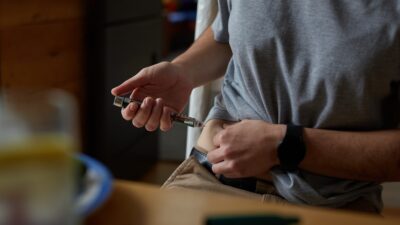
The Tandem Mobi insulin pump is the smallest durable automated insulin delivery (AID) system on the U.S. market, holding 200 units of U-100 insulin in a body roughly half the size of the Tandem t:slim X2. Cleared by the FDA in 2024, Mobi is iPhone-controlled, pairs with the Dexcom G7 continuous glucose monitor (CGM), and runs Tandem’s Control-IQ algorithm for hybrid closed-loop dosing.
What Makes the Tandem Mobi Different
Most insulin pumps are about the size of a deck of cards. The Mobi is closer to the size of a car key fob — about 1.95 by 2.1 by 0.6 inches — and weighs roughly 1 ounce with a full cartridge. It is small enough to clip to a bra band, slip into a coin pocket, or hide under a shirt cuff.
Despite the size, Mobi is a full AID pump. The same Control-IQ algorithm that runs on the t:slim X2 lives inside Mobi, predicting glucose 30 minutes ahead from Dexcom G7 readings and automatically adjusting basal rates and delivering correction boluses up to once per hour. People with type 1 diabetes (T1D) and insulin-dependent type 2 diabetes (T2D) who want the smallest possible footprint without giving up automation are the typical candidates.
Specs and Features at a Glance
| Feature | Tandem Mobi |
|---|---|
| Reservoir capacity | 200 units of U-100 insulin |
| Cartridge | Tandem Fillrite (prefill outside pump body) |
| Tubing length options | 5 inches or 8 inches |
| Algorithm | Control-IQ hybrid closed-loop |
| CGM integration | Dexcom G7 |
| Controller | iPhone (Tandem Mobi app); Android in development |
| On-pump control | Single quick-bolus button |
| Battery | Rechargeable, wireless Qi charging |
| Watertight rating | IP28 (8 ft for 60 min) |
| Approved age | 6 years and older |
| Approximate cash price | $3,000 to $4,000 (pump only) |
How Control-IQ Works on Mobi
Control-IQ uses Dexcom G7 CGM data to predict your blood sugar 30 minutes into the future. If predicted glucose is heading low, the pump reduces or suspends basal insulin. If predicted glucose is heading high, the pump increases basal and can deliver an automatic correction bolus once per hour. There are also Sleep Activity and Exercise Activity modes that shift target ranges.
The algorithm does not eliminate the need to bolus for meals — you still announce carbohydrates through the bolus calculator — but it smooths out the overnight and between-meal glucose curves that drive much of the burden of T1D management. Time-in-range improvements with Control-IQ have been documented in pivotal trials and confirmed by the treatment guidance referenced in the ADA Standards of Care.
Who Tandem Mobi Is Best Suited For
- Adults with T1D who prioritize discretion and want a pump that disappears under everyday clothing.
- Active people whose previous pumps caught on doorways, gym equipment, or seatbelts.
- Children ages 6 and up whose parents want the smallest possible pump body for school and sports.
- iPhone users comfortable controlling dosing through an app.
- People who already use Dexcom G7 or are willing to switch CGMs.
Mobi may not be the best fit if you need more than 200 units of insulin per cartridge fill, prefer an Android phone today, or rely on a separate handheld controller rather than a smartphone.
Cost, Insurance, and Supplies
Cash price for a new Mobi pump runs roughly $3,000 to $4,000, with infusion sets and cartridges adding ongoing supply costs. Most U.S. commercial insurance plans cover insulin pumps under durable medical equipment (DME); Medicare covers pumps for T1D and select T2D patients meeting C-peptide criteria. Tandem’s customer support team typically handles benefits verification and pre-authorization paperwork.
Supply costs include Fillrite cartridges and infusion sets every 2-3 days, plus Dexcom G7 sensors every 10 days. People budgeting for any pump should also factor in pump skins, tape adhesives, and replacement chargers.
Side Effects and Practical Considerations
The risks of pump therapy are not unique to Mobi. They include skin irritation at the infusion site, occlusions that can cause unexpected high blood sugars or diabetic ketoacidosis (DKA), and the rare but serious risk of insulin overdelivery. People starting any pump should learn DKA warning signs, keep a backup pen and long-acting insulin available, and check ketones if blood sugar runs above 250 mg/dL with nausea.
Because Mobi is iPhone-dependent for most functions, a dead phone battery or lost phone temporarily reduces the pump to manual quick-bolus only. Tandem recommends keeping your phone charged and downloading the latest app updates promptly.
How Mobi Fits Into Prediabetes and T2D Care
Insulin pumps are not first-line therapy for prediabetes — lifestyle change, weight management, and sometimes metformin or GLP-1 medications are. But for people who progress to insulin-requiring T2D or for those with T1D, AID pumps like Mobi can lower A1C and reduce hypoglycemia. Understanding A1C levels and tracking glucose with a CGM are foundational steps long before pump therapy is considered. For broader context on the prediabetes-to-diabetes continuum, see our prediabetes overview.
The Bottom Line
The Tandem Mobi is the smallest durable AID pump available in the United States, combining a key-fob-sized body with full Control-IQ automation and Dexcom G7 integration. It suits iPhone users who want discreet, automated insulin delivery and do not need a reservoir larger than 200 units. As with any insulin pump, the right choice depends on your insulin needs, lifestyle, insurance coverage, and a thorough conversation with your endocrinology team.