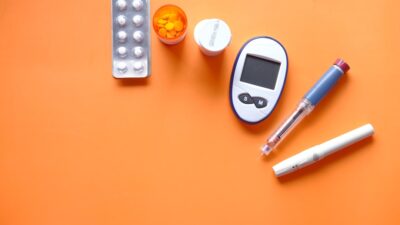
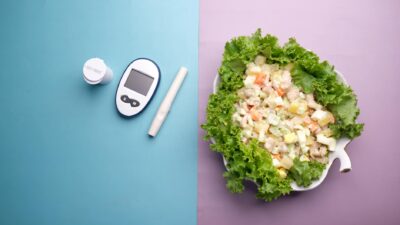
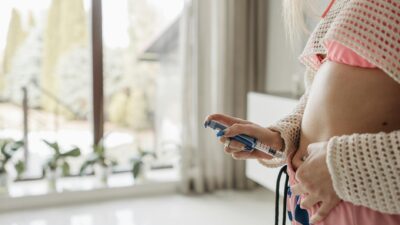
Prandial insulin is mealtime insulin — a rapid- or short-acting insulin injected before meals to cover the carbohydrate load. It works alongside basal (long-acting) insulin, which maintains fasting glucose. Common options are lispro (Humalog), aspart (NovoLog), glulisine (Apidra), ultra-rapid Fiasp and Lyumjev, and regular human insulin. Dosing uses an insulin-to-carb ratio plus a correction factor for glucose above target. Standard basal-bolus regimens involve 1 long-acting injection daily plus 3 mealtime injections.
What “Prandial” Means
- Prandial: relating to or during a meal
- Preprandial: before a meal (used for dosing timing)
- Postprandial: after a meal (used for glucose measurement timing)
- Interprandial: between meals
In diabetes care, “prandial insulin” and “mealtime insulin” are interchangeable.
The Main Prandial Insulin Options
| Insulin | Type | Onset | Peak | Duration | Inject Before Meal |
|---|---|---|---|---|---|
| Lispro (Humalog, Admelog) | Rapid analog | 10–20 min | 1–2 hr | 3–5 hr | 15 min |
| Aspart (NovoLog) | Rapid analog | 10–20 min | 1–2 hr | 3–5 hr | 15 min |
| Fiasp (faster aspart) | Ultra-rapid | 2–10 min | ~1 hr | 3–5 hr | At first bite or during meal |
| Lyumjev (faster lispro) | Ultra-rapid | 2–10 min | ~1 hr | 3–5 hr | At first bite or during meal |
| Glulisine (Apidra) | Rapid analog | 10–20 min | 1–2 hr | 3–5 hr | 15 min |
| Regular (Humulin R, Novolin R) | Short-acting human | 30–60 min | 2–4 hr | 5–8 hr | 30–45 min |
| Afrezza (inhaled) | Ultra-rapid | 12 min | ~30 min | ~3 hr | At first bite |
How Prandial Fits in a Full Insulin Regimen
Basal-Bolus (Standard Type 1 and Advanced Type 2)
- One long-acting insulin daily (glargine, detemir, degludec)
- One prandial injection before each meal (typically 3 per day)
- Total 4 injections per day
- Prandial dose calculated per meal from carb count and glucose level
Basal-Plus (Step-Up Type 2)
- One long-acting insulin daily
- One prandial injection before the largest meal of the day
- Often the next step after basal-only fails to reach A1C target
- Can intensify to full basal-bolus later
Pump Therapy (CSII)
- Continuous subcutaneous infusion from a reservoir
- Micro-basal delivered every few minutes
- Boluses command-initiated before meals
- Automated insulin delivery (AID) systems adjust basal automatically using CGM data; meal boluses still manual
Premixed Insulin
- Fixed-ratio mixtures of rapid/intermediate (e.g., 70/30, 75/25)
- Taken before breakfast and dinner
- Simpler but less flexible than basal-bolus
- Still used in some type 2 diabetes regimens where flexibility is less critical than compliance
How to Calculate a Prandial Dose
Step 1: Count the Carbs
- Read nutrition labels for packaged foods
- Use apps (MyFitnessPal, Carb Manager) for cooked meals
- Weigh or measure portions when possible
- Experience builds accuracy over months
Step 2: Divide by Your Insulin-to-Carb Ratio
- Typical adult ratio: 1 unit per 10 to 15 grams of carbs
- Teens often need 1:8 to 1:12 due to growth and insulin resistance
- Your clinician sets your initial ratio; refine from glucose data
- Example: 60 g of carbs with a 1:10 ratio = 6 units
Step 3: Add a Correction Dose
- Correction factor (insulin sensitivity factor) = how many mg/dL one unit of insulin drops your glucose
- Typical adult: 1 unit drops glucose 30 to 50 mg/dL
- Target glucose: typically 100 to 120 mg/dL for meals
- If current glucose is 200 and target is 120, the excess is 80 mg/dL; at 1:50 correction factor, that is 1.6 units of correction
- Correction dose added to meal dose — so 6 units for meal + 1.6 units correction = 7.6 units total
Step 4: Adjust for Activity and Special Cases
- Reduce dose by 20 to 50 percent if exercising within 2 hours
- Reduce for fatty or low-carb meals (less carb, slower absorption)
- Increase for high-fat meals (extended bolus on pumps) — fat delays absorption
- Pregnancy, illness, stress, and menstrual cycle all affect ratios
Timing: Why Pre-Meal Timing Matters
Injecting at the first bite typically causes post-meal highs because insulin lags food absorption. Optimal pre-meal timing:
- Lispro, aspart, glulisine: 15 minutes before eating
- Fiasp, Lyumjev: at first bite or up to 20 minutes after starting
- Regular: 30 to 45 minutes before eating
- Adjust later by 5 to 10 minutes in either direction based on your post-meal CGM or fingerstick data
Common Dose-Calculation Mistakes
- Counting net carbs only (subtract fiber) — for most people, use total carbs
- Forgetting a correction dose for pre-meal high glucose
- Not adjusting for exercise within 2 hours
- Guessing carb counts for restaurant meals (often 20 to 40 percent under)
- Injecting after eating instead of before
- Using the wrong pen/vial (mixing up basal with prandial)
- Skipping a dose because you are not hungry, leading to later highs
Side Effects and Monitoring
- Hypoglycemia — most common side effect; always carry 15 g of fast-acting carbs
- Weight gain — calories are retained that would otherwise spill in urine
- Injection site reactions, lipohypertrophy from under-rotation
- Monitor post-meal glucose at 1 and 2 hours after meals
- Review patterns weekly with your clinician; adjust ratios as needed
Storage and Handling
- Unopened: refrigerate (36–46°F), do not freeze
- In use: room temperature (under 86°F) for 28 days for most rapid analogs
- Fiasp and Lyumjev: check label for specific room-temp duration
- Travel: insulated case, cabin luggage only
- Discard frozen or heat-damaged insulin
Related Reading
See our companion guides on treatment and prediabetes 101.
The Bottom Line
Prandial insulin is mealtime insulin — rapid- or short-acting, taken before meals to cover carbohydrate intake. Common options are lispro, aspart, glulisine, Fiasp, Lyumjev, and regular human insulin. Dosing uses an insulin-to-carb ratio (typically 1 unit per 10 to 15 g) plus a correction factor for pre-meal highs. Timing matters — inject 15 minutes before eating for most rapid analogs. Prandial insulin combined with basal insulin mimics natural pancreatic release in basal-bolus therapy. Work with your endocrinologist to set your ratios, monitor post-meal glucose, and refine dosing over time.