Blood sugar is measured in two units depending on where you live: milligrams per deciliter (mg/dL) in the United States and millimoles per liter (mmol/L) in most other countries. Both describe the same concentration of glucose in your blood. To convert, divide mg/dL by 18 to get mmol/L, or multiply mmol/L by 18 to get mg/dL.
Why Two Units Exist
In the 1970s, the World Health Organization and the International Federation of Clinical Chemistry recommended that laboratories around the world switch to the International System of Units (SI), which expresses concentrations in moles per liter. Most of Europe, Canada, Australia, and much of Asia adopted mmol/L for glucose. The United States, along with a handful of other countries, kept the older mass-based unit, mg/dL. Both are equally accurate; the difference is historical and cultural rather than scientific.
The Conversion Formula
Glucose has a molecular weight of roughly 180 grams per mole. One deciliter is one-tenth of a liter. If you do the arithmetic, the conversion factor works out to 18:
- mg/dL to mmol/L: divide by 18
- mmol/L to mg/dL: multiply by 18
So a fasting glucose of 90 mg/dL equals 5.0 mmol/L. A post-meal reading of 140 mg/dL equals 7.8 mmol/L. The diabetes diagnostic threshold of 126 mg/dL fasting equals 7.0 mmol/L.
Conversion Reference Table
| mg/dL (US) | mmol/L (rest of world) | Category (fasting) |
|---|---|---|
| 70 | 3.9 | Low-normal |
| 90 | 5.0 | Normal |
| 100 | 5.6 | Upper normal / prediabetes threshold |
| 110 | 6.1 | Prediabetes (impaired fasting) |
| 125 | 6.9 | Prediabetes |
| 126 | 7.0 | Diabetes threshold |
| 140 | 7.8 | Normal 2-hr post-meal upper limit |
| 200 | 11.1 | Diabetes (2-hr OGTT) |
| 300 | 16.7 | Very high |
Which Units Does Your Meter Use?
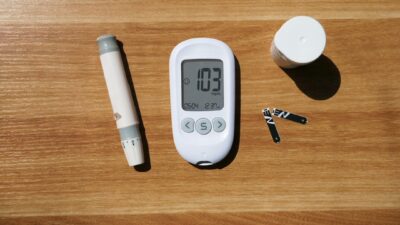
Glucose meters sold in the US default to mg/dL, and most US-issued continuous glucose monitors (CGMs) such as Dexcom and FreeStyle Libre do the same. Meters sold in the UK, EU, Australia, and Canada default to mmol/L. Many modern meters let you toggle the unit in settings. If your meter was bought abroad, or your travel clinician hands you a result in a different unit, do the division-by-18 in your head or on your phone to stay oriented.
Units for A1C
A1C is primarily reported as a percentage: 5.7% is the prediabetes threshold, 6.5% is the diabetes threshold. The SI version, adopted in Europe, expresses A1C in mmol/mol, which measures millimoles of glycated hemoglobin per mole of total hemoglobin. The two scales are interchangeable; an A1C of 5.7% equals 39 mmol/mol, and 6.5% equals 48 mmol/mol. The A1C levels guide uses the percentage scale throughout, which is what most US patients will see.
Common Mistakes in Unit Handling
The most frequent error is decimal confusion. A reading of 7.8 mmol/L is a normal post-meal upper limit, but a reading of 78 mg/dL is a low-normal fasting value, and 780 mg/dL is a medical emergency. Check which unit you are reading before you panic. Another error: mixing units within a conversation, for example, discussing a fasting target of 100 and a post-meal target of 7.8 without specifying which system you are in. Pick one and stick with it.
When Do Units Matter Clinically?
Units matter any time you compare numbers from different sources: a smart watch with a European default, a lab report, a friend’s meter, an international research paper. They matter especially for medication dosing in hospital settings, where confusing 180 mg/dL with 18 mmol/L could lead to serious errors. For everyday use, pick the unit your doctor uses and stay consistent. For a broader overview of testing and targets, see the prediabetes 101 hub.
The Bottom Line
Blood sugar is reported in mg/dL in the US and mmol/L in most other countries; divide mg/dL by 18 to convert to mmol/L, or multiply mmol/L by 18 to go the other way. Learn the few anchor points (100 mg/dL = 5.6 mmol/L, 126 mg/dL = 7.0 mmol/L, 200 mg/dL = 11.1 mmol/L) and you will be able to read any glucose number from anywhere in the world.