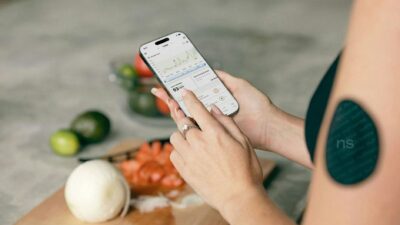
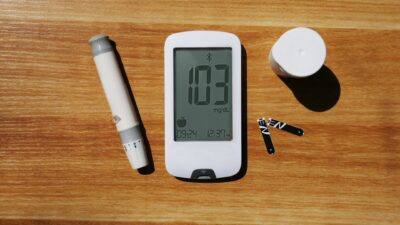
To check your blood sugar without needles in any meaningful sense, a continuous glucose monitor (CGM) is the closest legitimate option. CGMs replace most finger-sticks with a single small sensor insertion that lasts 10–15 days. As of 2024, no FDA-cleared consumer device measures blood glucose fully noninvasively — the FDA issued a safety communication warning against smartwatches and rings making that claim.
What “Without Needles” Actually Means
People searching for needle-free blood sugar checks usually mean one of three things:
- Fewer finger-sticks each day.
- A device worn on the body that measures glucose without breaking skin.
- A gadget (smartwatch, ring, smartphone camera) that reads glucose through the skin.
The first is achievable today with CGM. The second is partially true — CGMs reduce, but do not eliminate, skin penetration. The third is not yet possible with any FDA-cleared consumer device.
The 2024 FDA Safety Communication
In February 2024 the FDA warned consumers that it had not authorized, cleared, or approved any smartwatch or smart ring intended to measure or estimate blood glucose values without penetrating the skin. The agency cautioned that inaccurate measurements could lead to mistakes in diabetes management, including incorrect dosing of insulin, sulfonylureas, or other medications, which could result in dangerously low blood glucose within hours.
Smartwatches that pair with an FDA-cleared CGM are different. A Dexcom G7 or Libre 3 sensor can stream to an Apple Watch or Android Wear device — but the CGM sensor, not the watch, does the measuring.
How CGMs Reduce (But Do Not Eliminate) Needles
A CGM sensor is placed with a brief, retractable introducer needle. The needle enters and withdraws in a fraction of a second, leaving behind a thin flexible plastic filament. The filament reads glucose from interstitial fluid for 10 to 15 days depending on the model. That is one insertion per two weeks instead of three to ten finger-sticks per day.
Most users describe sensor insertion as a brief pinch; some feel nothing. For context on insertion mechanics see our piece on how CGMs fit into prediabetes monitoring.
Legitimate Options to Check Blood Sugar, Compared
| Method | Skin penetration? | Frequency of finger-sticks | FDA-cleared accuracy |
|---|---|---|---|
| Finger-stick meter | Yes — every test | 3–10 per day (typical) | Yes |
| Continuous glucose monitor (CGM) | Yes — once per sensor, every 10–15 days | 0–1 per day | Yes |
| Alternate-site meter (forearm, palm) | Yes — smaller lancet | Same as finger-stick | Yes, with caveats |
| Smartwatch “glucose” feature (standalone) | No | N/A — inaccurate | No — FDA warning issued |
| Over-the-counter ring or patch claiming noninvasive glucose | No | N/A — inaccurate | No — FDA warning issued |
Why Fully Noninvasive Glucose Is So Hard
Researchers have worked for decades on truly noninvasive glucose measurement using near-infrared spectroscopy, Raman spectroscopy, electromagnetic sensing, and tear or saliva glucose. Progress is real, but none has cleared the accuracy bar needed for clinical use. Skin varies by moisture, melanin, and temperature; glucose signals are small and easily drowned out by confounders; and clinical decisions require reliability across a wide glucose range.
Legitimate research is ongoing through companies like Apple (reportedly developing silicon photonics glucose sensing) and academic labs. None has produced a consumer product as of 2024.
What About Urine Test Strips?
Urine glucose strips detect glycosuria — glucose spilling into urine when blood levels exceed roughly 180 mg/dL. They are not a substitute for blood glucose testing. They miss normal and mildly elevated values, lag real-time blood glucose by hours, and are not part of current diabetes management standards. They retain a role only in limited scenarios with clinician guidance.
How to Talk to Your Clinician About CGM Access
If reducing finger-sticks is your main goal, ask your clinician about:
- Whether your diabetes type and treatment (insulin use, hypoglycemia risk, pregnancy) qualify for covered CGM.
- OTC options — FreeStyle Libre Rio and Dexcom Stelo are available without a prescription for adults not on insulin.
- Whether a two-week “professional CGM” trial — a clinic-owned sensor worn briefly for diagnostic insight — fits your care plan.
- How CGM data will inform your nutrition and treatment decisions.
What to Avoid
- Any ring, watch, or app that claims to measure blood glucose without a sensor inserted through the skin.
- Unregulated “biosensor” patches sold direct-to-consumer from overseas marketplaces.
- Adjusting insulin, sulfonylureas, or any diabetes medication based on readings from non-cleared devices.
- Assuming that a smartwatch displaying a glucose number is making the measurement — it is usually streaming from a CGM paired through an app.
When in doubt, cross-check with an FDA-cleared meter or sensor. According to the ADA Standards of Care, medication and lifestyle changes for diabetes should be guided by validated glucose data.
The Realistic Needle-Reduction Plan
If you have diabetes or elevated A1C and want fewer finger-sticks:
- Discuss CGM options with your clinician, including prescription and OTC.
- Plan sensor rotation across arms or abdomen to maintain skin health.
- Use finger-sticks only when sensor symptoms do not match, or when required by your clinician.
- Review downloaded CGM reports (AGP, time in range) with your clinician every few months.
The Bottom Line
There is no FDA-cleared consumer device that checks your blood sugar through the skin without any penetration, and the FDA has specifically warned against products marketed that way. CGMs are the realistic needle-minimizing option: one small insertion replaces hundreds of finger-sticks. Anything that promises more than that, today, is getting ahead of the evidence — and in diabetes care, that can be dangerous.
This article is for educational purposes only and is not medical advice. Always consult a licensed healthcare professional about any device, test, or health decision.