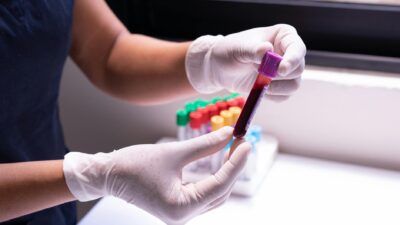
Hemoglobin A1C is a blood test that measures the percentage of your red blood cells coated with glucose, giving your doctor an average picture of your blood sugar over the past two to three months. It is the most widely used test to diagnose prediabetes and type 2 diabetes because it does not require fasting and reflects long-term control rather than a single moment.
What Hemoglobin A1C Actually Measures
Hemoglobin is the protein inside red blood cells that carries oxygen. When glucose circulates in your bloodstream, it attaches to hemoglobin in a process called glycation. Once sugar binds, it stays bound for the life of the red blood cell, which is about 90 to 120 days.
The A1C test counts the percentage of hemoglobin molecules that are glycated. If your blood sugar has been high, more hemoglobin is coated in glucose and your A1C percentage rises. If blood sugar has been well controlled, fewer molecules are glycated and A1C falls.
Because red blood cells are constantly being replaced, A1C reflects a rolling average. Roughly half of your A1C value comes from the last 30 days, about a quarter from the 30 to 60 day window, and the remaining quarter from days 60 to 120.
How the A1C Test Is Performed
The A1C test is a simple blood draw, usually from a vein in your arm, though point-of-care fingerstick devices are also available in many clinics. You do not need to fast and you can take it at any time of day.
The lab uses high-performance liquid chromatography, immunoassay, or enzymatic methods to separate glycated from non-glycated hemoglobin. Results are reported as a percentage and, increasingly, as an estimated average glucose (eAG) in mg/dL so that you can compare it directly to your home glucose readings.
The eAG Conversion
The formula the American Diabetes Association uses to convert A1C to eAG is:
eAG (mg/dL) = 28.7 × A1C − 46.7
So an A1C of 6.0% corresponds to an eAG of about 126 mg/dL, and an A1C of 7.0% corresponds to about 154 mg/dL.
What Your Hemoglobin A1C Number Means
The ADA Standards of Care classify A1C into three main bands for adults who are not pregnant:
| Hemoglobin A1C | Category | Estimated Average Glucose | What It Means |
|---|---|---|---|
| Below 5.7% | Normal | Under 117 mg/dL | Typical glucose control |
| 5.7% – 5.9% | Early prediabetes | 117 – 123 mg/dL | Elevated; often reversible with modest changes |
| 6.0% – 6.4% | Advanced prediabetes | 126 – 137 mg/dL | Near diabetes threshold; action recommended |
| 6.5% – 6.9% | Early type 2 diabetes | 140 – 154 mg/dL | Diagnosis after second confirmatory test |
| 7.0% or higher | Established diabetes | 154+ mg/dL | Elevated complication risk without treatment |
For an in-depth look at each band and what to do about it, see our A1C levels hub.
Why Hemoglobin A1C Is Better Than a Single Glucose Reading
Fingerstick glucose checks are useful for moment-to-moment decisions, especially if you take insulin. But they swing widely based on what you ate, how stressed you are, how well you slept, and even the time of day. A reading of 95 mg/dL before breakfast and 180 mg/dL after lunch are both common on the same day.
Hemoglobin A1C smooths out those swings. It is less sensitive to recent meals, recent exercise, or a bad night’s sleep. For long-term diagnosis and monitoring, it is the more reliable signal.
It also does not require fasting, which removes a common barrier to testing. The CDC estimates that 96 million US adults have prediabetes and the vast majority are unaware because they have never been tested.
Limitations and Conditions That Affect A1C Accuracy
A1C assumes a normal red blood cell lifespan. Conditions that shorten that lifespan reduce how long glucose has to bind to hemoglobin, which falsely lowers A1C. Conditions that lengthen the lifespan or affect the assay itself can falsely raise it.
| Condition | Effect on A1C |
|---|---|
| Iron-deficiency anemia | Falsely elevated |
| B12 or folate deficiency | Falsely elevated |
| Hemolytic anemia | Falsely lowered |
| Recent blood loss or transfusion | Falsely lowered |
| Second and third trimester pregnancy | Falsely lowered |
| Chronic kidney disease (advanced) | Variable |
| Hemoglobin variants (HbS, HbC, HbE) | Variable (assay dependent) |
If your clinical picture does not match your A1C, your doctor may order a fasting plasma glucose, an oral glucose tolerance test, or a fructosamine test. Fructosamine reflects a 2 to 3 week average and does not depend on hemoglobin.
How Often to Test Hemoglobin A1C
Testing frequency depends on your current status:
- Normal A1C with risk factors: Every 1 to 3 years.
- Prediabetes: At least annually, often every 3 to 6 months if you are actively lowering it.
- Stable diabetes on treatment: Every 6 months.
- Diabetes with recent medication changes or above target: Every 3 months.
The National Institute of Diabetes and Digestive and Kidney Diseases recommends starting screening at age 35 for all adults, and earlier for those with risk factors like family history, excess weight, polycystic ovary syndrome, or a history of gestational diabetes.
Setting Realistic A1C Targets
Most adults with diabetes aim for an A1C under 7%. Tighter targets (6.0% to 6.5%) may be appropriate for younger, healthier adults who can achieve them without significant hypoglycemia. Looser targets (7.5% to 8%) are often appropriate for older adults, those with limited life expectancy, or those with a history of severe low blood sugar.
For people with prediabetes, there is no formal “target” other than getting back under 5.7%. Even a drop from 6.3% to 5.9% is meaningful because it slows the glycation damage that drives long-term complications.
What Lowers Hemoglobin A1C
Four levers consistently move A1C down when applied over weeks and months:
1. Diet
Reducing refined carbohydrates, sugary drinks, and ultra-processed foods has the biggest per-calorie impact. Replacing them with non-starchy vegetables, lean protein, legumes, nuts, and whole grains stabilizes blood sugar across the day. Our diet and nutrition hub covers specific food swaps.
2. Physical Activity
150 minutes of moderate aerobic activity per week, plus two strength sessions, improves insulin sensitivity. Even a 10-minute walk after meals reduces post-meal glucose spikes and nudges A1C down over months.
3. Weight Management
If you carry excess weight, losing 5 to 7 percent of body weight reliably lowers A1C by 0.3 to 0.6 percentage points in people with prediabetes. More loss produces more benefit, up to a point.
4. Sleep and Stress
Short sleep (under 6 hours) and chronic stress both raise cortisol, which raises glucose. Seven to eight hours of sleep and basic stress management are often overlooked but meaningful.
Medications
When lifestyle changes alone are not enough, doctors commonly prescribe metformin for prediabetes or early diabetes. Newer classes including GLP-1 receptor agonists and SGLT2 inhibitors have strong glucose-lowering effects plus cardiovascular benefits in some populations. All medications should be discussed with your clinician.
Common Myths About Hemoglobin A1C
- “I can drop my A1C in a week by cutting carbs.” False. You can drop your fingerstick glucose quickly, but A1C reflects months of exposure. Plan on 3 months to see the first meaningful change.
- “A normal A1C means I am safe forever.” False. Risk drifts with age, weight, and inactivity. Recheck on a schedule, especially if you have a family history.
- “Fasting glucose is more accurate.” Neither test is objectively better; they measure different things. Fasting glucose shows one moment, A1C shows an average.
- “A low A1C is always good.” Not quite. Very low A1C in people on insulin or sulfonylureas can indicate frequent hypoglycemia, which is dangerous.
The Bottom Line
Hemoglobin A1C is the single most useful lab number for understanding your long-term blood sugar control. It integrates months of data into one percentage, doesn’t require fasting, and drives most diagnostic and treatment decisions in prediabetes and diabetes care. Know your number, know what affects its accuracy, and recheck it on a schedule that matches your risk. Small consistent changes in food, movement, and sleep show up in A1C over the course of a few months, which is usually enough time to make meaningful progress.