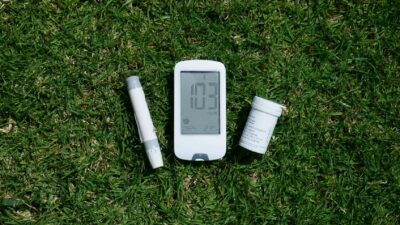
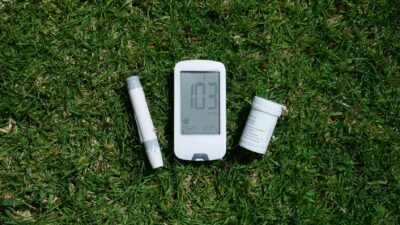
1,5-anhydroglucitol (1,5-AG) is a glucose-like sugar that circulates in blood and is normally reabsorbed by the kidneys. When blood glucose rises above the renal threshold (roughly 180 mg/dL) and spills into urine, glucose competes for the same renal transporter and 1,5-AG is excreted instead — so blood 1,5-AG drops. The result is a marker of glucose excursions over the past 1 to 2 weeks, complementary to A1C. Normal range is 10 to 25 mcg/mL; lower values indicate more recent postprandial hyperglycemia. The commercial assay (GlycoMark) is FDA-cleared for intermediate-term diabetes monitoring.
What 1,5-AG Is
1,5-anhydroglucitol is a naturally occurring polyol almost identical to glucose in shape — different by a single hydroxyl group. It is obtained mainly from food (especially soy, grains, dairy products) and circulates in blood at a relatively stable concentration. Healthy adults maintain serum 1,5-AG at 10 to 25 mcg/mL across days and weeks under normal conditions.
The kidney reabsorbs both glucose and 1,5-AG through the same proximal tubular transporters (SGLT1 and SGLT2). Normally, this system is efficient at low glucose loads — both glucose and 1,5-AG are largely reabsorbed. But when blood glucose rises above the renal threshold (about 180 mg/dL), glucose load overwhelms the transporter and out-competes 1,5-AG for reabsorption. Excess 1,5-AG spills into urine and serum levels fall.
Because the body’s 1,5-AG pool is large and only slowly replenished from diet, the serum level recovers gradually after a hyperglycemic episode — taking days to weeks depending on the magnitude and frequency of excursions. This kinetic profile makes serum 1,5-AG an integrated marker of recent above-threshold glucose excursions over 1 to 2 weeks.
How 1,5-AG Compares to Other Glycemic Markers
| Marker | Time window | What it reflects | Best use |
|---|---|---|---|
| Capillary glucose / CGM | Minutes | Real-time glucose | Acute decisions, patterns |
| 1,5-AG | 1 to 2 weeks | Glucose excursions above 180 mg/dL | Postprandial spike detection |
| Fructosamine | 2 to 3 weeks | Average glucose (weighted) | Short-term avg in pregnancy, hemoglobinopathies |
| Glycated albumin | 2 to 4 weeks | Average glucose | Same as fructosamine |
| HbA1c | 2 to 3 months | Long-term average glucose | Standard diabetes monitoring |
Reference Ranges and Interpretation
| 1,5-AG (mcg/mL) | Interpretation | Implication |
|---|---|---|
| 14 to 25 (men) / 10 to 25 (women) | Normal | No significant hyperglycemic excursions |
| 10 to 14 | Borderline low | Possible mild postprandial excursions |
| 6 to 10 | Low | Moderate postprandial hyperglycemia |
| 2 to 6 | Very low | Frequent or sustained hyperglycemia |
| Less than 2 | Severely low | Marked hyperglycemia or glucosuria |
Cutoffs vary slightly between men and women (men have slightly higher baseline 1,5-AG) and across populations. Asian and African populations may have different reference ranges. Always interpret with the lab’s own range.
When 1,5-AG Testing Is Useful
| Clinical situation | Why 1,5-AG helps |
|---|---|
| A1C at goal but suspected post-meal spikes | Detects excursions A1C misses |
| Tracking therapy changes (2 to 4 weeks) | Faster response than A1C |
| Distinguishing pre-meal vs post-meal hyperglycemia | Specifically reflects excursions over 180 mg/dL |
| Pregnancy (gestational diabetes follow-up) | Captures postprandial spikes; faster than A1C |
| Hemoglobinopathies that distort A1C | Alternative when A1C unreliable |
| Patients without easy CGM access | Integrated proxy for time above range |
| Cardiovascular risk stratification in diabetes | ARIC and other cohorts show association |
The GlycoMark Assay
The commercial 1,5-AG assay is sold under the GlycoMark brand and is FDA-cleared for monitoring intermediate-term glycemic control in patients with established diabetes. Practical details:
- Sample: serum or plasma from a routine blood draw — no fasting required
- Assay platform: enzymatic colorimetric or chemiluminescent immunoassay
- Turnaround: typically 2 to 5 days at commercial labs
- Cost: approximately 40 to 150 dollars self-pay; may or may not be covered by insurance — confirm with your plan
- Frequency: useful every 2 to 4 weeks for tracking; less often for monitoring stable patients
1,5-AG and Cardiovascular Outcomes
The Atherosclerosis Risk in Communities (ARIC) study and subsequent cohorts found that low 1,5-AG (reflecting postprandial hyperglycemia) is independently associated with:
- Higher risk of coronary heart disease
- Higher risk of stroke
- Higher all-cause mortality
- Higher risk of microvascular complications (retinopathy, nephropathy)
These associations persist even after adjustment for A1C — suggesting that postprandial glucose excursions captured by 1,5-AG add prognostic information beyond mean glycemia. The clinical implication is that controlling postprandial spikes (not just A1C) may matter for outcomes.
Limitations
- Insensitivity to mild hyperglycemia: if your glucose never exceeds 180 mg/dL, 1,5-AG remains in normal range. So 1,5-AG cannot detect prediabetes or mild type 2 diabetes — only excursions above the renal threshold.
- SGLT2 inhibitor confound: drugs like empagliflozin, dapagliflozin, canagliflozin deliberately lower the renal glucose threshold, causing glucosuria at normal glucose levels and making 1,5-AG uninterpretable.
- Renal disease: low GFR alters glucose reabsorption and 1,5-AG clearance — interpretation unreliable when eGFR less than 60.
- Loop diuretic interference: furosemide and similar drugs can lower 1,5-AG independently of glucose.
- Insulin therapy effects: with very tight glucose control on insulin, 1,5-AG may not add information beyond CGM or A1C.
- Dietary variability: dramatic changes in 1,5-AG dietary intake (rare in practice) could affect levels.
- Pregnancy: pregnancy lowers the renal glucose threshold, which can lower baseline 1,5-AG; interpret cautiously.
- Not for diabetes diagnosis: not used to diagnose diabetes or prediabetes per ADA criteria.
Pairing 1,5-AG with Other Tools
| Pairing | Insight provided |
|---|---|
| A1C + 1,5-AG | Average glycemia plus excursion frequency |
| A1C + CGM | Average plus full temporal pattern |
| 1,5-AG + fructosamine | Different short-term lenses on glycemia |
| 1,5-AG + postprandial glucose | Confirms specific post-meal pattern |
| 1,5-AG + GAD-65 | Postprandial pattern in suspected LADA |
Practical Patterns to Recognize
- A1C 6.8 percent, 1,5-AG 5 mcg/mL: patient looks “controlled” on A1C but has frequent severe postprandial spikes — therapy intensification or meal adjustment indicated.
- A1C 6.2 percent, 1,5-AG 18 mcg/mL: good control with minimal spikes — continue current management.
- A1C 8.0 percent, 1,5-AG 2 mcg/mL: consistent hyperglycemia — both marker patterns consistent with poor control.
- A1C 5.7 percent, 1,5-AG less than 5 mcg/mL on SGLT2 inhibitor: the SGLT2 invalidates 1,5-AG — use other markers.
Related Reading
See our broader guides on detection of prediabetes, A1C levels, postprandial glucose testing, C-peptide testing, and diabetes complications.
The Bottom Line
1,5-anhydroglucitol fills a specific niche in glycemic monitoring — it captures glucose excursions above the renal threshold (about 180 mg/dL) over the past 1 to 2 weeks, complementing A1C’s 2- to 3-month average. Normal range is 10 to 25 mcg/mL; lower values indicate more frequent or severe postprandial hyperglycemia. The commercial GlycoMark assay is FDA-cleared and easy to order. The most useful clinical pattern is detecting unrecognized postprandial spikes in patients whose A1C looks acceptable but whose post-meal glucose runs high. Major limitations include uselessness when glucose stays under 180 mg/dL, interference from SGLT2 inhibitors, and unreliability in kidney disease. The test is not used for diabetes diagnosis. Talk to your endocrinologist about whether 1,5-AG fits your specific monitoring needs.