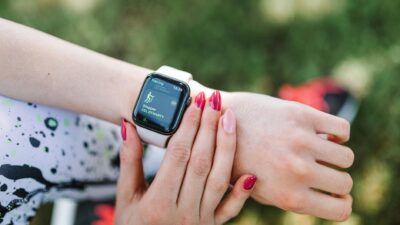
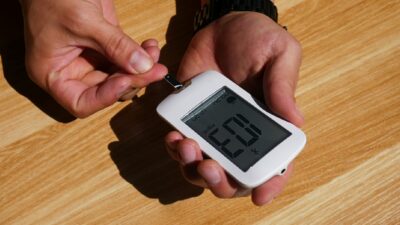
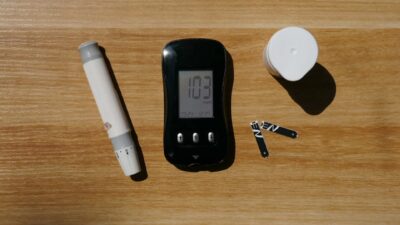
A bloodless glucose monitor in its legitimate, FDA-cleared form is a continuous glucose monitor (CGM) that reads glucose in interstitial fluid rather than blood. Once a thin sensor filament is inserted just under the skin, you do not need finger pricks for 10 to 15 days. Watches and rings that claim to measure glucose without any sensor are a separate category and are not validated; the FDA has warned consumers against them.
The Nuance: Bloodless Is Not the Same as Sensor-Less
The word “bloodless” in glucose monitoring has two very different meanings online, and mixing them up is the single biggest mistake shoppers make.
Legitimate bloodless: A CGM. You wear a small sensor on your upper arm or abdomen. A hair-thin filament sits under the skin in interstitial fluid. After the one-time painless insertion, no blood draws or fingersticks are needed to generate readings. This is real, FDA-cleared, and clinically validated.
Illegitimate “bloodless”: A smartwatch, smart ring, or clip-on gadget marketed as reading your glucose through skin alone, with no sensor insertion. Per the February 2024 FDA safety communication, no such device has been authorized. The technology does not reliably work yet.
Current FDA-Cleared Bloodless CGM Options
| Device | Wear Time | Prescription Needed? | Who It Is For |
|---|---|---|---|
| Dexcom G7 | 10 days + 12 hr grace | Yes | Type 1 and 2 diabetes, including insulin users |
| Dexcom Stelo | 15 days | No (OTC, 18+) | Type 2 not on insulin, prediabetes, wellness |
| Freestyle Libre 3 Plus | 15 days | Yes | Type 1 and 2 diabetes |
| Freestyle Libre Rio | 15 days | No (OTC, 18+) | Type 2 not on insulin, prediabetes, wellness |
All four sensors apply with a single-step applicator, warm up in 30 to 60 minutes, and connect via Bluetooth to a smartphone app. Mean absolute relative difference (MARD) values sit in the 8 to 10 percent range, making them accurate enough to inform treatment decisions without confirming every reading with a fingerstick.
How a Bloodless (CGM) Monitor Works
The sensor filament is coated with glucose oxidase. When glucose in interstitial fluid contacts the coating, a small electrochemical current is generated. Onboard electronics translate that current into a glucose value (in mg/dL or mmol/L), which is transmitted wirelessly. Readings refresh every 1 to 5 minutes, giving you hundreds of data points per day, compared with 1 to 4 from typical fingerstick routines.
Applying a Bloodless CGM Sensor
- Choose the back of your upper arm (Libre) or upper arm and abdomen (Dexcom). Skin must be clean, dry, and free of lotion, sunscreen, scars, and tattoos.
- Open the applicator and place it firmly against the skin.
- Press the button or push down to insert. Most users describe the sensation as a tap, not a pinch.
- Activate the sensor in the app. Warm-up takes 30 to 60 minutes.
- Wear up to 10 to 15 days, showering and swimming as normal (sensors are IP28 water-rated).
Why Watches and Rings Are Not Ready
Non-invasive glucose sensing is a hard engineering problem. Light-based sensors struggle with skin pigmentation and motion. Radio-frequency methods are disrupted by hydration and temperature. Sweat sensors capture glucose at concentrations 10 to 100 times lower than blood, with inconsistent correlation. Researchers continue to work on these approaches, but as of 2025, no standalone watch or ring has cleared the FDA for glucose measurement. The agency’s warning applies to any product making such claims outside of research settings.
Red Flags on Fake “Bloodless” Devices
- Marketing phrases like “no sensor needed” or “measures through skin”
- Prices under $200 with claims of medical-grade accuracy
- Sold primarily on social media, TikTok Shop, or third-party marketplaces
- No FDA 510(k) clearance number in the product documentation
- Branding that imitates Apple, Samsung, or Fitbit
Who Benefits From a Bloodless CGM
According to the American Diabetes Association, CGM is recommended for all adults using insulin and is increasingly considered for non-insulin type 2 diabetes and prediabetes when data-driven behavior change would help. Prediabetes users often benefit from a one-time two-week wear to see how their own body responds to specific foods, stress, sleep, and exercise. To place this in your larger plan, read our Prediabetes 101 hub, A1C Levels guide, and Diet and Nutrition hub.
What You Still Need a Fingerstick For
Even with a legitimate bloodless CGM, a quick fingerstick remains useful in specific moments:
- Symptoms of a low that do not match the sensor reading
- Very rapid glucose changes (above 2 mg/dL per minute)
- The first 24 hours of a new sensor (readings may be noisier)
- Higher-dose vitamin C or biotin supplementation, which can interfere
- Before treatment decisions if your clinician requests confirmation
The Bottom Line
A bloodless glucose monitor is a real, useful category, but only when the term refers to a continuous glucose monitor. CGMs eliminate fingersticks during wear by sampling interstitial fluid through a tiny under-skin filament. Any watch, ring, or clip-on gadget that promises glucose readings with no sensor at all is, as of 2025, not FDA-cleared and not safe to base medical decisions on.
This article is for informational purposes only and is not a substitute for professional medical advice. Talk to your clinician before using any glucose monitoring device to manage a medical condition.