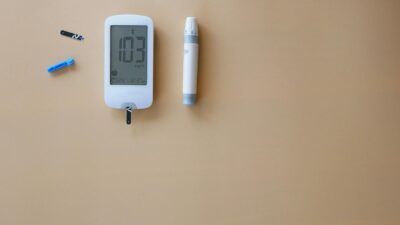
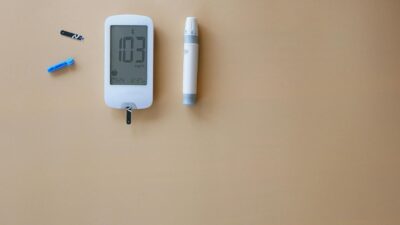
The Dexcom G7 is a small, all-in-one continuous glucose monitor (CGM) worn on the back of the upper arm. The sensor and transmitter are combined in a single disposable unit, the warmup is 30 minutes, and the newer 15-day version FDA-cleared in 2024 doubles wear time over the original G6. Pivotal-trial accuracy is roughly 8.2 percent mean absolute relative difference (MARD), among the best published figures for any consumer CGM.
What the Dexcom G7 Is
The Dexcom G7 is the seventh-generation continuous glucose monitor from Dexcom, Inc. It received FDA clearance in December 2022 (510(k) K223410) and launched in the US in February 2023. A 15-day version received clearance in 2024 (K243213) and began rolling out to US patients in early 2025. The G7 replaces the older G6 transmitter-plus-sensor design with a single integrated wearable: there is nothing to snap on and nothing to charge.
The device measures interstitial glucose, not blood glucose. Interstitial fluid lags arterial blood by roughly 5 to 10 minutes, which matters most during rapid changes such as the post-meal rise or hypoglycemia recovery.
How the Sensor Works
Inside the G7 is a thin filament about the diameter of a human hair, inserted just under the skin during application. The filament is coated with the enzyme glucose oxidase. When glucose in interstitial fluid contacts the enzyme, an electrochemical reaction generates a small current proportional to glucose concentration. The transmitter electronics convert that current to a glucose value, apply a factory-calibration algorithm, and broadcast the reading every five minutes via Bluetooth Low Energy.
The G7 is factory-calibrated. No fingerstick blood glucose values are required during routine wear. Optional fingerstick calibration can be entered if a user feels readings are drifting.
Wearing the G7
The G7 applicator is a single-button device. The user twists off the cap, presses the applicator firmly against the back of the upper arm, and pushes the button. The needle that introduces the filament retracts immediately, leaving only the wearable on the skin. A built-in adhesive holds the sensor for the wear period. Most users report no more than a brief pinch at insertion; some report no sensation at all.
The wearable itself is roughly the size of three stacked nickels. It is FDA cleared for use on the back of the upper arm in adults and children aged 2 and older, and additionally on the upper buttocks for pediatric patients aged 2 to 6. Dexcom does not officially clear other sites such as the abdomen, thigh, or chest, although some users self-experiment. Sticking to the cleared site preserves the accuracy figures the device was validated against.
Each sensor ships with a small overpatch tape included in the box. The overpatch is optional but extends adhesion in heat, with heavy sweating, or in active users. Third-party overpatches are also widely available in colors and patterns.
| Specification | Dexcom G7 |
|---|---|
| Wear sites (FDA cleared, US) | Back of upper arm (ages 2+); upper buttocks (ages 2-6) |
| Sensor life | 10 days (original) or 15 days (newer version) plus 12-hour grace period |
| Warmup time | 30 minutes |
| Reading interval | Every 5 minutes |
| Calibration | Factory; no fingersticks required |
| Water resistance | IP28 (8 feet for 24 hours) |
| Acetaminophen interference | None at standard doses |
Accuracy Data
The pivotal trial reported by Garg and colleagues in 2022 enrolled 308 adults and 36 youth with type 1 or type 2 diabetes wearing G7 sensors at the upper arm. Accuracy was assessed against YSI venous reference at multiple in-clinic sessions across the wear period.
| Metric | Adults | Pediatric (ages 2-17) |
|---|---|---|
| Overall MARD | 8.2 percent | 8.1 percent |
| Percentage within 20/20 percent | ~91 percent | ~89 percent |
| MARD on day 1 | ~9 percent | ~9 percent |
| MARD on final day | ~8 percent | ~8 percent |
An MARD under 10 percent is considered clinically acceptable for use in dosing decisions. The G7 figures are competitive with FreeStyle Libre 3 (8.2 percent adult MARD) and Abbott’s newer sensor generations. Accuracy on the 15-day version is reported by Dexcom as comparable to the 10-day, with no degradation in the extended-wear days.
What’s New in the 15-Day Sensor
The 15-day G7 hardware is essentially identical to the 10-day. The wear time extension came from algorithm refinements, improved enzyme stability, and validation studies showing accuracy held through day 15. Sensor cost per box did not increase, which means cost per day of wear drops by roughly one-third for users who switch over. Dexcom announced shipments of 15-day stock to US distributors beginning Q1 2025, with full inventory turnover expected by mid-to-late 2025.
The 12-hour grace period after expiration carries over from the 10-day version, giving total maximum wear of 15.5 days. The G7 app handles the transition automatically; users simply scan the new sensor and the countdown reads 15 days instead of 10. No new prescription is required.
For a deeper look at how the upgrade rolled out and what changed under the hood, see our companion piece on the Dexcom G7 15-day sensor upgrade path.
The G7 App and Display
- Dedicated G7 app for iOS (iPhone) and Android — replaces the older G6 app.
- Direct-to-Apple-Watch streaming so the watch displays glucose without the iPhone within range.
- Customizable high and low alerts with adjustable thresholds and snooze settings.
- Urgent Low Soon alert predicts hypoglycemia within 20 minutes.
- Dexcom Share lets up to 10 followers see live readings and trend arrows from another phone.
- Clarity report integration for clinician review and time-in-range reporting.
- Optional standalone touchscreen receiver for users who prefer not to use a smartphone.
The Dexcom Clarity reports translate raw glucose data into the metrics most clinicians want to see at a follow-up visit: time in range (typically 70 to 180 mg/dL), time below range, time above range, glucose management indicator (an A1C estimate from CGM data), and coefficient of variation as a measure of glycemic stability. Reports can be shared with the care team automatically or printed for an in-person visit.
The G7 mobile app supports trend arrows (steady, gradually rising or falling, or sharply changing) and predictive alerts. The Urgent Low Soon alert is particularly useful for people with hypoglycemia unawareness, since it predicts a low at least 20 minutes before the threshold is crossed. For nighttime safety, alerts can be customized by time of day.
Trend Arrows and Reading Patterns
Each glucose reading on G7 is paired with a trend arrow indicating direction and rate of change. Understanding the arrows is essential for safe insulin dosing:
| Arrow | Direction | Rate of Change |
|---|---|---|
| Double up | Rising rapidly | More than 3 mg/dL per minute |
| Single up | Rising | 2 to 3 mg/dL per minute |
| Up-angled | Rising slowly | 1 to 2 mg/dL per minute |
| Steady | Stable | Less than 1 mg/dL per minute |
| Down-angled | Falling slowly | 1 to 2 mg/dL per minute |
| Single down | Falling | 2 to 3 mg/dL per minute |
| Double down | Falling rapidly | More than 3 mg/dL per minute |
Pump and AID Integrations
The G7 is compatible with the major automated insulin delivery (AID) systems on the US market:
| System | G7 Compatible | Notes |
|---|---|---|
| Tandem t:slim X2 (Control-IQ) | Yes | Cleared 2024 |
| Insulet Omnipod 5 | Yes | Cleared 2024 |
| Beta Bionics iLet | Yes | Cleared 2024 |
| Tandem Mobi | Yes | Cleared 2024 |
| Twiist (Sequel Med Tech) | In development | Pending |
G7 vs G6: What Changed
- Size: G7 is roughly 60 percent smaller than G6.
- All-in-one: G7 sensor and transmitter are integrated; no transmitter to swap every 90 days.
- Warmup: 30 minutes for G7 versus 2 hours for G6.
- Wear site: G7 is back of upper arm; G6 was abdomen primarily.
- Wear time: G7 10 days (or 15 days on the newer version); G6 10 days.
- App: G7 uses a new dedicated app; G6 uses the older Dexcom G6 app.
- Cost per day: roughly comparable to G6 on the 10-day, lower on the 15-day.
Insurance Coverage and Cost
Medicare Part B covers G7 for beneficiaries who use insulin (any frequency, expanded in 2023) or who have a history of problematic hypoglycemia. The patient pays 20 percent coinsurance after the deductible. Most commercial insurers cover G7 under durable medical equipment or pharmacy benefit; specifics vary by plan, with copays typically between 30 and 80 dollars per month. Out-of-pocket cash price is roughly 350 to 450 dollars for a one-month supply.
Coverage criteria typically require either a diagnosis of type 1 diabetes, or insulin use (any frequency) for type 2 diabetes, or documented hypoglycemic events for non-insulin-treated diabetes. Some Medicare Advantage and commercial plans have expanded criteria. The Dexcom website includes a benefit-checker tool that confirms coverage in roughly 24 to 48 hours given a patient’s insurance details.
For non-diabetic users curious about CGMs, Dexcom now offers Stelo, an over-the-counter CGM built on the G7 platform but with a separate app and 15-day wear, available without a prescription. Stelo costs roughly 99 dollars for a two-pack (covering 30 days) and is sold direct-to-consumer through Dexcom’s website.
How G7 Has Changed Routine Care
Continuous glucose monitoring is now considered standard of care for type 1 diabetes and is increasingly recommended for type 2 diabetes on multiple daily insulin injections. The American Diabetes Association’s 2024 Standards of Care endorsed CGM use as soon as possible after diagnosis of type 1 diabetes and recommended it for any patient on insulin therapy who is willing to use it.
The G7’s smaller size, faster warmup, and improved accuracy reduce the friction that historically kept patients from adopting CGM. The 15-day extension further reduces the cadence of sensor changes, removing one of the most common patient complaints.
Who the G7 Is and Is Not For
The G7 is FDA cleared for people aged 2 and older with diabetes, including type 1, type 2 on insulin, gestational diabetes, and (by clinician judgment) some non-insulin-treated type 2. It is not cleared as a screening device for prediabetes. People interested in glucose tracking outside diabetes can consider Stelo or Abbott’s Lingo, both of which sit in the wellness category.
For background on how clinicians distinguish prediabetes from diabetes, see the overview of A1C levels.
Common Issues
- Compression lows: Sleeping on the sensor arm can falsely depress readings; a quick position change usually resolves them.
- Adhesive lift: Overpatch tape from Dexcom or third parties extends adhesion in heat or with heavy sweating.
- Signal loss: Bluetooth range is roughly 20 feet line-of-sight. Walls and bodies attenuate the signal.
- Sensor failure: Replacement sensors are available through Dexcom customer support, typically with one-business-day shipping.
- Skin reactions: A small minority of users develop adhesive-related dermatitis. Barrier wipes (Skin Tac, Cavilon) applied before sensor placement can reduce irritation.
- First-day variability: Some users notice slightly more variability in the first 12 hours of a new sensor as the local tissue equilibrates around the filament.
What to Discuss With Your Clinician
If you are considering G7 for the first time, useful talking points for your visit include:
- What problem you want CGM to solve — frequent lows, post-meal patterns, A1C improvement, or general awareness.
- Which app and integrations you would actually use (smartphone, watch, pump).
- How your insurance covers CGM and what the prior-authorization process looks like.
- Whether your clinician’s office uses Dexcom Clarity or another data-sharing platform.
- What targets to set — most people aim for at least 70 percent time in range (70 to 180 mg/dL) and less than 4 percent time below 70 mg/dL.
The Bottom Line
The Dexcom G7 is a mature, well-validated continuous glucose monitor with the smallest form factor and one of the best accuracy profiles on the US market. The new 15-day sensor extends wear time without raising sensor cost. For people on insulin, it integrates with every major US automated insulin delivery system. For people without diabetes, the same hardware platform is available over the counter as Stelo. Talk with your clinician about which option fits your treatment plan and insurance coverage.