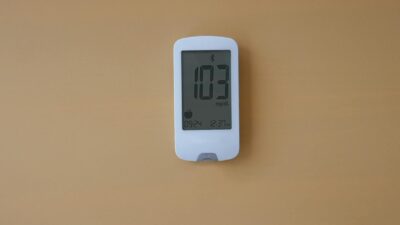
A continuous glucose monitor works by placing a tiny enzyme-coated electrode into interstitial fluid just under the skin. Glucose diffusing from nearby capillaries reacts with the enzyme to produce a small electrical current proportional to glucose concentration, which a wearable transmitter converts into a reading displayed on your phone every 1-5 minutes.
The Three Parts of a CGM
Every modern CGM has three functional components, though some are packaged together:
- Sensor: A flexible filament roughly the thickness of a human hair, inserted 4-5 mm beneath the skin. It contains immobilized glucose oxidase (or occasionally glucose dehydrogenase) on an electrode surface.
- Transmitter: A small electronic unit that reads the sensor signal, applies a calibration algorithm, and sends values over Bluetooth Low Energy.
- Display: Typically a smartphone app or dedicated reader that renders current glucose, trend arrow, historical graph, and alerts.
The Chemistry: Glucose Oxidase
The enzyme glucose oxidase catalyzes the oxidation of glucose to gluconic acid, producing hydrogen peroxide in the process:
Glucose + O2 -> Gluconic acid + H2O2
The hydrogen peroxide is then oxidized at a platinum or similar electrode, releasing electrons. The current generated is directly proportional to the glucose concentration in the surrounding fluid. A digital converter inside the transmitter samples this current at a high frequency, applies temperature compensation, and averages readings into a 1- or 5-minute value.
Why Interstitial Fluid, Not Blood
Interstitial fluid is the thin layer of fluid surrounding cells between capillaries. Glucose diffuses from blood into this fluid rapidly. Sampling it requires only a tiny subcutaneous sensor rather than repeated venous or capillary blood access.
The trade-off is a time lag of 5-15 minutes between blood and interstitial glucose during rapid changes. When glucose is falling fast – for example, after an insulin dose or hard exercise – the CGM value may read higher than a simultaneous fingerstick. When glucose is rising fast, the CGM may read lower. At steady state, the two correspond closely.
Signal Processing and Calibration
Raw electrode current is noisy. Manufacturers apply proprietary algorithms that smooth the signal, correct for temperature and sensor drift, and compensate for known interferences (such as acetaminophen for some devices). Modern CGMs arrive factory calibrated, meaning each sensor lot is tested and algorithmic parameters are baked in, eliminating the need for user fingerstick calibration.
How Accurate Is It?
| Device | Approx. MARD | Wear time | Calibration |
|---|---|---|---|
| Dexcom G7 | ~8.2% | 10 days | Factory |
| FreeStyle Libre 3 | ~7.9% | 14 days | Factory |
| Dexcom Stelo (OTC) | ~10% | 15 days | Factory |
| Medtronic Guardian 4 | ~10-11% | 7 days | Optional fingerstick |
Mean absolute relative difference (MARD) is the average percentage difference between the CGM value and a simultaneous laboratory reference. Values under 10% are considered clinically acceptable for non-adjunctive use, meaning patients can make treatment decisions directly from CGM data.
What the Trend Arrows Mean
Because a CGM reads every few minutes, it can calculate rate of change. Display arrows typically indicate:
- Flat: Changing less than 1 mg/dL per minute.
- Slowly rising or falling: 1-2 mg/dL per minute.
- Rising or falling: 2-3 mg/dL per minute.
- Rapidly rising or falling: Greater than 3 mg/dL per minute.
Trend arrows are often more clinically useful than the single number, especially for people using insulin or watching for post-meal response.
Who CGMs Help
CGMs are standard of care for people using insulin and are increasingly recommended for type 2 diabetes on non-insulin therapies. Research in prediabetes is growing. The American Diabetes Association supports CGM use in type 2 diabetes to improve time-in-range and reduce A1C.
People using them alongside a structured prediabetes treatment plan can identify meal and activity patterns that affect glucose and adjust accordingly.
Limitations Worth Knowing
- Accuracy decreases on day 1 (warm-up) and day 10+ (sensor drift).
- Dehydration and compression (lying on the sensor) can produce falsely low readings.
- Very low glucose values below 40 mg/dL are less accurate across most devices.
- Interstitial lag means confirm with a fingerstick before treating suspected severe hypoglycemia if readings disagree.
The Bottom Line
A CGM works through a tiny enzyme-electrode sensor that measures glucose in interstitial fluid and transmits readings wirelessly every few minutes. Modern devices are accurate enough for most treatment decisions, require no calibration, and last up to two weeks per sensor. Understanding the chemistry and the interstitial fluid lag helps you interpret the data thoughtfully and avoid overreacting to short-term swings. Work with a clinician to translate CGM patterns into actionable lifestyle or medication changes.