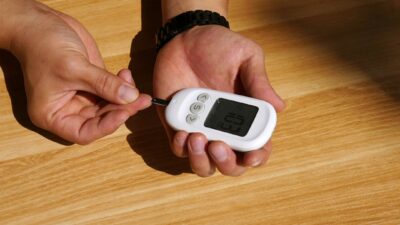
Libre CGM is the Abbott family of continuous glucose monitors, including the FreeStyle Libre 14-day, Libre 2, Libre 3, and the over-the-counter Libre Rio. Each uses a small upper-arm sensor to track interstitial glucose every minute for up to 14 days, giving people with diabetes — and, through Rio, adults without diabetes — a continuous view of how food, activity, and medication affect glucose.
How Every Libre Sensor Works
All Libre sensors share the same basic design. A flexible filament under the skin sits in the interstitial fluid and reacts with glucose through an enzyme coating. The electrochemical signal is converted to a glucose estimate and transmitted — either on scan (original Libre 14-day) or continuously via Bluetooth (Libre 2 and 3).
Because interstitial glucose lags plasma glucose by five to ten minutes, values trail a finger-stick briefly during rapid change and align closely when glucose is stable.
The Libre Lineup Compared
| Model | Wear time | Alarms | Bluetooth streaming | Reported adult MARD |
|---|---|---|---|---|
| FreeStyle Libre 14-day | 14 days | No | No (scan only) | ~9.4% |
| FreeStyle Libre 2 | 14 days | Yes | Yes | ~9.3% |
| FreeStyle Libre 3 | 14 days | Yes | Yes (every minute) | ~7.9% |
| FreeStyle Libre Rio (OTC) | 15 days | Optional | Yes | ~9% |
Who Libre CGM Is Designed For
Indications vary by model and country. In the US, prescription Libre sensors are cleared for people two years and older with diabetes. Typical clinical scenarios include:
- Type 1 diabetes at any age.
- Type 2 diabetes on basal or prandial insulin.
- Gestational diabetes, under obstetric supervision.
- Non-insulin type 2 diabetes when the clinician judges CGM will improve self-management.
- Adults without diabetes seeking metabolic feedback — through Libre Rio, purchased OTC.
For people exploring CGM in the context of prediabetes, the value lies in seeing personal responses to meals and activity that group averages do not predict.
Setting Up a Sensor
Clean the back of the upper arm, let it dry, and apply the sensor with the included applicator. A one-hour warm-up follows. Pair the sensor with the Libre reader or the compatible app, and configure alarms (if supported). Rotate arms with each new sensor to reduce skin irritation.
Sensors are water-resistant to 1 meter for 30 minutes. Avoid hot tubs, extended submersion, and MRI, CT, or diathermy exposure.
What the Data Looks Like
Libre apps show real-time glucose, a trend arrow, and 24-hour history. Downloaded clinic reports include:
- Time in range (TIR) — percentage of time glucose is between 70 and 180 mg/dL.
- Glucose management indicator (GMI) — an estimated A1C derived from 14 days of CGM data.
- Ambulatory glucose profile (AGP) — an at-a-glance 24-hour curve your clinician reviews.
GMI and lab A1C can differ, especially with anemia, hemoglobinopathies, or short CGM windows. Use them together, not interchangeably. See our A1C levels guide for lab context.
Accuracy and Its Limits
MARD below 10 percent is the FDA’s general benchmark for non-adjunctive CGMs. Libre sensors meet that threshold in adults. Accuracy is typically best in the mid-range and can drift at hypoglycemic extremes. If symptoms do not match a reading, a finger-stick remains a sensible check.
Acetaminophen does not materially interfere with Libre sensors. Vitamin C at very high supplemental doses can cause falsely elevated readings in some CGM systems; check the user guide before high-dose supplementation.
Cost, Coverage, and OTC Options
US cash pricing for prescription Libre sensors runs approximately $75–$90 per 14-day sensor at major pharmacies. Insurance coverage is typically strong for insulin-treated diabetes, mixed for non-insulin type 2, and limited for prediabetes.
Abbott’s OTC FreeStyle Libre Rio launched for adults not on insulin and changes the access equation — anyone can buy it without a prescription. OTC status does not mean it is clinically appropriate for every user, and it is not intended for people with type 1 diabetes or severe hypoglycemia risk.
Common Troubleshooting
- Early sensor failure: Contact Abbott customer service; replacement sensors are typically provided on request.
- Skin irritation: Use a barrier film or hypoallergenic tape ring around the adhesive edge; consult a dermatologist if severe.
- Signal loss: Keep the phone within 33 feet for Bluetooth models; ensure background app refresh is enabled.
- Unexpected readings: Compare with a finger-stick and note any recent meals, exercise, or medication changes before acting.
Libre CGM in a Broader Care Plan
CGM is a data source, not a treatment. It works best when paired with nutritional planning, activity goals, and — when appropriate — medication supervised by a clinician. For foundational context, see prediabetes nutrition and treatment options. The ADA Standards of Care describe how to interpret CGM data in clinical decision-making.
The Bottom Line
The Libre CGM family covers the spectrum from factory-calibrated, scan-based monitoring to minute-by-minute Bluetooth streaming with alarms, plus an OTC option for non-insulin adults. Choosing a model depends on your diabetes status, insurance, and how you plan to use the data — a decision best made with your clinician.
This article is for educational purposes only and is not medical advice. Always consult a licensed healthcare professional about any device, test, or health decision.