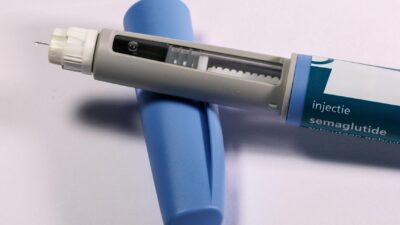
Hers tirzepatide is the compounded telehealth form of tirzepatide offered through the Hims & Hers platform to women exploring medical weight management. The service connects you with a licensed clinician who can prescribe a compounded version of the same molecule found in Mounjaro and Zepbound, typically at a lower monthly price. The finished product is not FDA-approved, which is an important distinction. This article is informational, not an endorsement.
What Hers Tirzepatide Actually Is
Tirzepatide is a once-weekly GLP-1 and GIP receptor agonist. The FDA-approved brand-name versions are Mounjaro (for type 2 diabetes) and Zepbound (for obesity and weight management), both made by Eli Lilly. Hers, the women-focused division of Hims & Hers Health, lists tirzepatide among its weight-loss options. The product dispensed is a compounded preparation made by a licensed compounding pharmacy, not a Lilly-manufactured pen.
Compounded medications are legal under specific sections of federal law, usually when a drug is listed on the FDA’s official shortage list or when a patient has a documented clinical need for a customized formulation. Tirzepatide moved on and off the FDA shortage list in 2024 and 2025, and Hims & Hers has adjusted its offerings accordingly. Check the current FDA status before assuming the product is available.
How the Hers Tirzepatide Telehealth Model Works
The process is similar to other telehealth weight-management services. You complete an online intake form covering medical history, current medications, weight, and goals. A licensed clinician reviews the information and, if tirzepatide is appropriate, writes a prescription. The compounding pharmacy ships the medication to your home, usually as vials and syringes rather than single-dose pens.
Pricing Tiers
Public pricing has shifted several times, but the typical range is:
- Starter month: often around 200 dollars for a lower compounded dose.
- Ongoing monthly subscription: roughly 250 to 400 dollars depending on dose.
- Multi-month bundles: discounted further, often prepaid.
Compare that to cash prices of roughly 1,000 to 1,300 dollars a month for brand-name Mounjaro or Zepbound without insurance or Lilly’s savings programs. Insurance almost never covers compounded versions.
Compounded vs Brand-Name: Key Differences
| Feature | Hers Compounded Tirzepatide | Mounjaro / Zepbound (Lilly) |
|---|---|---|
| FDA-approved finished product | No | Yes |
| Typical format | Vial and syringe | Single-dose pen |
| Typical monthly cost | 200 to 400 dollars | 550 to 1,300 dollars |
| Insurance coverage | Rare | Possible for type 2 diabetes; limited for weight loss |
| Manufacturing oversight | State pharmacy boards; FDA for 503B facilities | Full FDA drug approval and inspection |
FDA Stance on Compounded Tirzepatide
The FDA has repeatedly warned consumers that compounded GLP-1 and GIP drugs have not been reviewed for safety, efficacy, or quality in the way approved products have. The agency has documented adverse-event reports tied to dosing errors, including people drawing up tenfold overdoses from multi-dose vials. When tirzepatide came off the official shortage list, the FDA set deadlines for compounding pharmacies to stop producing essentially identical copies, which is why some telehealth products changed formulation or paused.
This is not a blanket condemnation of compounding. Legitimate compounding, including 503A and 503B facilities, plays an important role in medicine. But patients should know they are taking a product with less regulatory oversight than a brand-name pen.
Who Might Consider Hers Tirzepatide
People who sometimes look at telehealth tirzepatide include those who:
- Are not eligible for Lilly’s patient assistance or insurance coverage.
- Want a lower monthly cost than brand-name pens.
- Prefer the privacy of online care.
- Have a documented clinical need that the clinician agrees fits compounding rules.
It is less appropriate for people with complex comorbidities, those requiring close in-person monitoring, or anyone already well-managed on a brand-name pen with good coverage. If you are navigating prediabetes or newly diagnosed type 2 diabetes, a primary care clinician or endocrinologist who knows your full history is usually a better starting point than a direct-to-consumer service.
Side Effects and Safety Considerations
Common tirzepatide side effects include nausea, vomiting, diarrhea, constipation, reduced appetite, and injection-site reactions. Boxed warnings in the FDA label address thyroid C-cell tumors in rodents and potential risk of medullary thyroid carcinoma. Serious but rare adverse events include pancreatitis, gallbladder disease, and severe hypoglycemia, especially when combined with insulin or sulfonylureas. Compounded versions carry all of these risks plus the added uncertainty about purity, concentration, and sterility.
Dosing errors are a real concern. Brand-name pens are pre-set to a single dose, while compounded vials require you to draw a specific volume into a syringe. A decimal-point mistake can mean a 10x overdose. Always confirm the concentration, the prescribed dose in milligrams, and the corresponding volume in units with the prescribing clinician and the pharmacy.
Questions to Ask Before Starting
- What pharmacy compounds the tirzepatide, and is it a 503A or 503B facility?
- What is the concentration, and how many units equal my prescribed dose?
- Who do I call if I have side effects at 2 a.m.?
- What happens if the FDA restricts compounding again?
- How will my A1C, weight, and kidney function be monitored?
The Bottom Line
Hers tirzepatide is a compounded, telehealth pathway to tirzepatide with clinician oversight and lower upfront cost than brand-name Mounjaro or Zepbound. It is not FDA-approved, the product format is usually a vial with a syringe, and dosing requires extra care. If the price and privacy advantages fit your situation, talk with your own primary care clinician or endocrinologist, not only the telehealth prescriber, so you get a second perspective before starting weekly injections.
Medical disclaimer: This article is informational and is not medical advice or an endorsement of any specific product or pharmacy. Discuss weight-management medications with a licensed healthcare provider who knows your complete medical history.