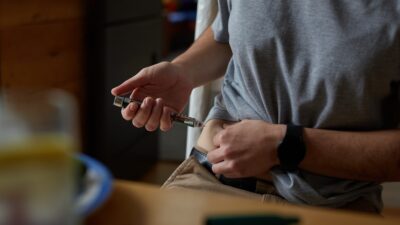
Yes, insulin glargine is a long-acting basal insulin. Sold under brand names Lantus, Basaglar, Semglee, and Toujeo, glargine provides a steady, peakless release of insulin over approximately 24 hours, making it a once-daily option for background glucose control in type 1 and type 2 diabetes.
What Makes Glargine “Long Acting”
Insulin glargine is a recombinant human insulin analog modified at three amino acid positions. These changes make it soluble at the acidic pH of the injection solution (pH 4) but less soluble at the neutral pH of body tissue. After injection, glargine forms microprecipitates under the skin, which slowly dissolve over 24 hours and release insulin gradually.
The result is a relatively flat pharmacokinetic profile – no sharp peak, no deep trough – that mimics the body’s natural background insulin secretion. This is different from rapid-acting insulins like lispro or aspart, which spike within minutes and last 3-5 hours.
Insulin Glargine at a Glance
| Property | Detail |
|---|---|
| Class | Long-acting basal insulin analog |
| Onset | 1-2 hours |
| Peak | None (flat profile) |
| Duration | ~24 hours (U-100); up to 36 hours (U-300) |
| Dosing frequency | Once daily (some split into twice daily) |
| Route | Subcutaneous injection only |
| Storage (unopened) | Refrigerated, 2-8 degrees C |
| Storage (in use) | Room temperature up to 28 days |
Who Uses Insulin Glargine
- Type 1 diabetes – paired with rapid-acting meal insulin as part of a basal-bolus regimen.
- Type 2 diabetes – when oral medications and GLP-1 agonists no longer control glucose adequately. Glargine is typically the first injectable insulin added.
- Gestational diabetes – sometimes used when diet and metformin aren’t sufficient, under specialist supervision.
For the broader landscape of diabetes medications, see our treatment hub.
Starting Dose and Titration
The American Diabetes Association recommends starting glargine in type 2 diabetes at 10 units daily, or 0.1-0.2 units/kg per day. The dose is titrated every 3-7 days based on fasting glucose:
- Fasting glucose consistently above 130 mg/dL: increase by 2 units.
- Fasting glucose 80-130 mg/dL: maintain dose.
- Fasting glucose below 80 mg/dL or hypoglycemia: decrease by 2-4 units.
Typical maintenance doses range from 0.3-1.0 units/kg per day, though insulin-resistant patients may need more. Titration should be guided by your healthcare team – do not adjust insulin on your own.
Lantus vs. Toujeo vs. Biosimilars
Lantus (U-100) was the first glargine approved in 2000. It delivers 100 units per milliliter and lasts about 24 hours.
Toujeo (U-300) is three times more concentrated. The smaller injection volume forms a more compact subcutaneous depot, extending duration to 30-36 hours with an even flatter profile. Trials show 15-20% less nocturnal hypoglycemia than Lantus, but Toujeo usually requires a slightly higher total dose (about 10-15%) for equivalent A1C reduction.
Basaglar and Semglee are FDA-approved biosimilars – essentially identical to Lantus at lower cost. They use the same 100 unit/mL concentration and dose 1:1 with Lantus.
Side Effects and Risks
- Hypoglycemia – the most common adverse effect. Symptoms include shakiness, sweating, confusion, and rapid heartbeat. Severe hypoglycemia can cause seizures or loss of consciousness.
- Injection site reactions – redness, itching, or lipodystrophy (fat changes) with repeated injection at the same site. Rotate sites to prevent.
- Weight gain – typically 1-4 kg in the first year.
- Edema – mild fluid retention, especially at initiation.
- Allergic reactions – rare but possible; seek care for hives, facial swelling, or breathing difficulty.
Do not mix glargine with other insulins in the same syringe – this disrupts the delayed-release profile.
Comparing Basal Insulins
| Insulin | Duration | Brand Examples |
|---|---|---|
| NPH | 10-16 hours | Humulin N, Novolin N |
| Glargine U-100 | ~24 hours | Lantus, Basaglar, Semglee |
| Detemir | 12-24 hours | Levemir |
| Glargine U-300 | 30-36 hours | Toujeo |
| Degludec | >42 hours | Tresiba |
Lifestyle Considerations
Insulin therapy is most effective alongside lifestyle strategies. Carb counting, regular exercise, and consistent meal timing all reduce glucose variability and improve dosing predictability. For patients with type 2 diabetes, the goal is often to minimize insulin needs through weight loss and sensitizing medications. Learn about supporting strategies in our diet and nutrition guide.
The Bottom Line
Insulin glargine is a long-acting basal insulin that delivers steady, roughly 24-hour glucose control with once-daily injection. Available as Lantus, Basaglar, Semglee, and the longer Toujeo, it is a cornerstone of both type 1 and type 2 diabetes treatment. Talk with your doctor about whether glargine fits your needs, and never adjust your dose without medical guidance.