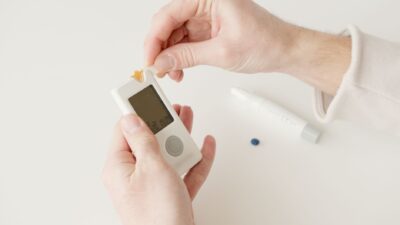
No, you should not use expired diabetic test strips. Each strip contains enzymes and chemicals that react with the glucose in your blood, and these break down over time. An expired strip can give a reading that is too high or too low, with nothing on the meter screen to warn you that the number is wrong.
That matters most when you use readings to make decisions, such as treating a low or adjusting insulin. This guide explains why strips expire, how opened-vial dates work, how storage affects accuracy, and what to do if you find old strips in your supplies.
Why Diabetic Test Strips Expire
A glucose test strip is a small chemical sensor. When blood touches the strip, an enzyme (usually glucose oxidase or glucose dehydrogenase) reacts with the glucose and creates a tiny electrical signal. Your meter turns that signal into a number in mg/dL or mmol/L.
The enzyme and other reagents are sensitive. Over time, and faster with exposure to air, heat and moisture, they lose activity. Manufacturers test how long their strips stay accurate under the storage conditions printed on the label, and the expiration date reflects that testing. After the date, the maker no longer guarantees that the strip will read within its accuracy range.
The problem is that a degraded strip does not usually fail loudly. You may still get a number, and it may look believable. That is why the printed date is a safety limit, not a suggestion.
Printed Expiration Date vs Opened-Vial Date
Many people only check one date, but there are often two rules to follow.
| Date | Where to find it | What it means |
|---|---|---|
| Printed expiration date | Strip vial, foil packet or outer box | The last date the maker guarantees accuracy for unopened, properly stored strips |
| Opened-vial discard date | Package insert or vial label (varies by brand) | Some brands set a shorter window that starts when you first open the vial |
| Individually foil-wrapped strips | Each foil packet | Each strip is protected until its own packet is opened |
Opened-vial rules differ from brand to brand, so there is no single number that applies to everyone. Read the insert that came with your strips. If there is an opened-vial limit, write the date you opened the vial on the label with a marker so you know when to discard it, whichever date comes first.
What Can Happen If You Use Expired Strips
An inaccurate result is not just an annoyance. It can lead to the wrong decision at the wrong time:
- A falsely high reading could lead someone who uses insulin to take a correction dose they do not need, which can cause low blood sugar.
- A falsely low reading could lead you to eat extra carbohydrate when your glucose is already high, or to miss a real high that needs attention.
- A falsely normal reading could hide a true low. For most people with diabetes, a low is below 70 mg/dL (3.9 mmol/L), according to the National Institute of Diabetes and Digestive and Kidney Diseases (NIDDK).
- Misleading logs can affect the treatment changes your care team makes based on your records.
If you have prediabetes and check your glucose only now and then, the stakes are lower, but an inaccurate reading can still give you false reassurance or needless worry. Either way, the number is only useful if you can trust it.
Storage Problems Can Ruin Strips Before They Expire
Strips can go bad well before their printed date if they are stored poorly. According to the U.S. Food and Drug Administration (FDA), improperly stored meters and test strips may cause less accurate results, and the agency advises keeping strip vials tightly closed when not in use. The FDA also notes that high altitude, extreme temperatures and extreme humidity can have unpredictable effects on glucose results.
Practical storage habits that protect your strips:
- Keep strips in their original vial. Do not move them into a pill box or a plastic bag.
- Close the cap right after you remove a strip.
- Store the vial within the temperature range on the label, away from direct sunlight.
- Do not leave strips in a hot car, a steamy bathroom or a freezer.
- Handle strips with clean, dry hands, and use each strip only once.
How to Check That Your Strips Are Reading Accurately
Control solution is a liquid with a known amount of glucose. The FDA recommends checking your meter with control solution every time you open a new container of test strips and whenever your results seem unusual. The result should fall within the range printed on the strip vial label.
A control check is a good habit, but it does not make expired strips safe. A strip past its date may pass one test and still read poorly later. If your strips are expired, replace them instead of testing them.
You should also recheck with a fresh strip, after washing and drying your hands, if a reading does not match how you feel. Food or sugar on your fingers can falsely raise a result. If you have symptoms of a low, such as shakiness, sweating or confusion, treat the low and follow your care plan rather than waiting for a perfect reading. Our guide to blood glucose meter accuracy explains why meters vary even with good strips.
What to Do With Old or Expired Strips
- Separate them. Remove expired vials from your testing kit so they are not used by mistake.
- Dispose of them. Strips can usually go in household trash. Used lancets go in a sharps container.
- Do not resell or donate expired strips. Another person would face the same accuracy problem.
- Plan ahead. If strips keep expiring before you use them, ask your prescriber whether your testing schedule is right, or buy smaller packs.
Saving Money on Test Strips Without Using Expired Ones
Cost is a common reason people hold on to old strips. Safer options include:
- Asking your pharmacist about store-brand meter systems, which often have lower-priced strips.
- Checking which meter and strip brand your insurance plan prefers, since non-preferred strips may cost more.
- Asking your meter maker about savings or assistance programs.
- Reviewing how often you actually need to test with your care team.
The FDA advises using only new test strips authorized for sale in the United States and warns against previously owned strips. Secondhand strips may have been stored badly or may be close to or past their date. For a comparison of strip costs, see our guide to the best glucose meter with cheap strips, and our overview of how glucose test strips work.
When Accurate Readings Matter Most
Fresh, properly stored strips are especially important if you:
- Use insulin or a sulfonylurea, which can cause lows
- Are pregnant or have gestational diabetes and are tracking targets
- Are sick, which can push glucose up quickly
- Drive or operate machinery and check before you go
- Are making changes to diet, activity or medication and want reliable trends
If you are tracking glucose because of prediabetes, remember that home meters are for monitoring, not diagnosis. Diagnosis relies on lab tests such as fasting plasma glucose and the A1C test. Learn more about what your numbers mean in our prediabetes overview.
The Bottom Line
Expired diabetic test strips should go in the trash, not in your meter. The chemicals inside break down and can give readings that look normal but are wrong, which can lead to a missed low or a wrong treatment decision. Check both the printed expiration date and any opened-vial limit on your strip insert, store vials closed and away from heat and humidity, and run a control solution test with each new vial. If cost is the reason you are holding on to old strips, talk with your pharmacist or care team about lower-cost options.