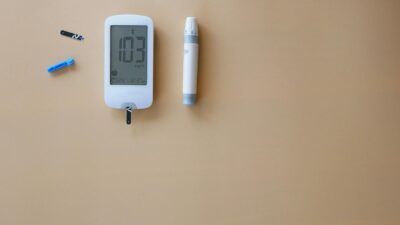
The Stelo glucose sensor is the first over-the-counter continuous glucose monitor sold in the United States, manufactured by Dexcom and FDA cleared in March 2024. It is designed for adults age 18 and older who do not use insulin, including people with prediabetes, type 2 diabetes managed without insulin, and anyone interested in metabolic health. Each sensor lasts 15 days, requires no prescription, and streams readings to the Stelo smartphone app every 15 minutes.
What Makes Stelo Different
Until 2024 every CGM in the US required a prescription. Stelo broke that pattern as the first FDA-cleared OTC glucose biosensor. Abbott followed with Lingo and Libre Rio, but Stelo was first to market and remains the most widely available OTC option. According to the FDA’s March 2024 clearance announcement, Stelo is intended for adults who are not at risk for severe hypoglycemia and who want to learn how lifestyle factors affect blood glucose.
How Stelo Works
The Stelo sensor is a single-piece disc, similar in size to a US quarter, that you apply to the back of your upper arm with a one-handed applicator. A thin filament about 4 mm long inserts under the skin and sits in the interstitial fluid between cells. The filament is coated with the enzyme glucose oxidase, which reacts with glucose to produce a small electrical current. The current is converted to a glucose value and sent over Bluetooth Low Energy to the Stelo app on your phone every 15 minutes.
Stelo Specifications
| Spec | Stelo |
|---|---|
| Wear time | 15 days |
| Warm-up period | 30 minutes |
| Reading frequency | Every 15 minutes (app) |
| Calibration | Factory calibrated; no fingersticks |
| Water resistance | 8 feet for 24 hours |
| Reported MARD | ~10 percent |
| App platforms | iOS and Android |
| Approved age | 18 and older, non-insulin users |
Stelo vs Dexcom G7 vs FreeStyle Libre 3
| Feature | Stelo (OTC) | Dexcom G7 (Rx) | FreeStyle Libre 3 (Rx) |
|---|---|---|---|
| Prescription needed | No | Yes | Yes |
| Wear time | 15 days | 10 days + 12 hr grace | 14 days |
| Reading frequency | 15 min | 5 min | 1 min |
| Insulin dosing approved | No | Yes | Yes |
| Urgent low alarm | No | Yes | Yes |
| Typical cost (cash) | $89-$99/sensor | $89-$120/sensor | $75-$140/sensor |
Who Should Use Stelo
- People with prediabetes who want to see how meals affect post-meal glucose and trend toward a healthier baseline
- Type 2 diabetes patients on metformin or diet alone who do not need urgent-low alerts
- People in weight-loss programs, particularly those on GLP-1 agonists like semaglutide or tirzepatide, who want to see metabolic changes
- Athletes and biohackers exploring meal timing, fasting, and exercise
- Caregivers of family members with prediabetes who want a low-cost way to track patterns
Who Should Not Use Stelo
- Anyone using insulin (basal or bolus) – Stelo is not approved for insulin dosing
- People with a history of severe hypoglycemia or hypoglycemia unawareness
- Children under 18
- Pregnant patients – use a prescription CGM that has been studied in pregnancy
- People with diabetes managed with sulfonylureas, glinides, or other insulin secretagogues at risk of lows
Stelo App Features
The Stelo app shows your current glucose, a 24-hour graph, time in range, and a “Spike” log that highlights post-meal peaks. Unlike Dexcom G7’s Clarity app, Stelo does not have urgent-low alarms but does send a high-glucose notification if values exceed a user-set threshold (default 250 mg/dL). The app integrates with Apple Health and Google Fit, and many users pair it with food and activity logs in apps like MyFitnessPal or Fitbit.
Cost and How to Buy
Stelo is sold direct from Dexcom at stelo.com and through select retail partners. Pricing as of 2025:
- Single sensor (15 days): about $89
- 2-pack (30 days): about $159
- Subscription (delivered every 30 days): about $89 per month
Stelo is not currently covered by Medicare or most commercial insurance plans because it is an OTC consumer product. HSA and FSA funds can typically be used for purchases.
How to Apply a Stelo Sensor
- Choose a clean spot on the back of either upper arm.
- Wash with soap, dry, then wipe with an alcohol pad and let fully air dry.
- Twist off the cap on the applicator and align the white circle on your skin.
- Press firmly until you hear or feel the click; the sensor is now applied.
- Open the Stelo app, scan the sensor with your phone, and wait 30 minutes for warm-up.
Where Stelo Fits in Prediabetes Care
For people in the prediabetes range, Stelo provides immediate visibility into how oatmeal vs eggs, a 20-minute walk after dinner, or a poor night of sleep affects glucose. That feedback can accelerate behavior change. According to the American Diabetes Association, CGM use in prediabetes is an emerging area of research, with early studies showing improved time in range when paired with coaching. For more on detection and treatment, see the detection of prediabetes guide and the A1C levels hub.
The Bottom Line
The Stelo glucose sensor is the first OTC CGM in the US, designed for non-insulin adults who want continuous glucose insights without a prescription. It uses Dexcom G7 hardware tuned for non-insulin users, lasts 15 days per sensor, costs about $89-$99, and pairs with the Stelo app for trend tracking. It is a strong option for prediabetes, type 2 diabetes managed without insulin, and metabolic-health curiosity, but not appropriate for insulin users.
Medical disclaimer: This article is for educational purposes only and is not a substitute for professional medical advice, diagnosis, or treatment. Always consult your physician or qualified healthcare provider with any questions about a medical condition or medication.