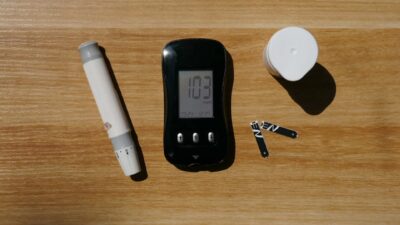
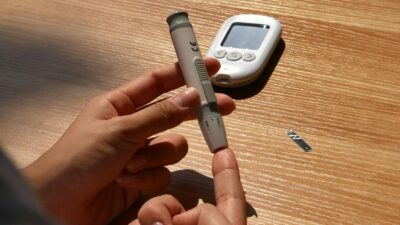
Whats a CGM? CGM stands for continuous glucose monitor. It is a small wearable sensor that measures your glucose level every 1 to 5 minutes, 24 hours a day, and sends the data to a phone, smartwatch, or dedicated receiver. Unlike a fingerstick meter that gives a single number, a CGM shows you an entire day of glucose trends.
Whats a CGM Made Of?
A CGM has two visible parts and one hidden piece:
- A sensor wire thinner than a human hair, placed just under the skin.
- A small plastic patch (the transmitter) that sticks to your skin and contains the electronics and Bluetooth radio.
- An app on your phone or smartwatch that receives and displays the readings.
Modern CGMs like Dexcom G7, Dexcom Stelo, and FreeStyle Libre 3 combine the sensor and transmitter into a single disposable patch the size of a small coin. You snap the applicator on your arm or abdomen, press a button, and a tiny spring-loaded needle inserts the sensor wire. The needle retracts immediately; only the soft filament stays in place.
What Does a CGM Actually Measure?
A CGM does not measure blood directly. It measures glucose in the interstitial fluid, the thin layer of liquid between skin cells. Interstitial glucose tracks very closely with blood glucose but lags by about 5 to 15 minutes during rapid changes. For steady glucose, the two values are nearly identical.
The reading you see on your app is already corrected for that lag using the manufacturer algorithm. If your glucose is changing fast, a fingerstick may still differ slightly.
How Is a CGM Different from a Fingerstick Meter?
| Feature | Fingerstick Meter | CGM |
|---|---|---|
| Frequency | One reading per prick | Reading every 1-5 minutes |
| Finger pricks | Every test | Only for occasional confirmation |
| Trend arrows | No | Yes, shows direction and rate |
| Alerts for highs and lows | No | Yes, customizable |
| Overnight data | Only if you wake up and test | Continuous while you sleep |
| Cost per day (no insurance) | ~$1-2 for strips | ~$5-15 depending on brand |
Fingerstick meters remain accurate, inexpensive, and reliable. CGMs add pattern recognition. Many people use both: a CGM for day-to-day trends and a fingerstick for confirmation when something looks off.
Who Uses a CGM?
CGMs started out as tools for type 1 diabetes. Today they are used by:
- Anyone on insulin who needs to see glucose in real time.
- People with type 2 diabetes managed with non-insulin medication.
- Adults with prediabetes who want to understand which foods spike their glucose.
- Pregnant people with gestational diabetes.
- Athletes and biohackers tracking how workouts and meals affect metabolism.
To understand the baseline A1C categories your CGM data will compare against, see the A1C levels hub.
What You See on a CGM App
Open the app and you will typically see:
- A large current reading in mg/dL (or mmol/L outside the US).
- A trend arrow pointing up, down, or sideways.
- A 24-hour graph with your glucose curve.
- Time in range, the percentage of hours you spent between 70 and 180 mg/dL.
- Average glucose and an estimated A1C-equivalent.
You can also log meals, workouts, and insulin doses to see how each event shifts the curve.
Prescription vs Over-the-Counter CGMs
As of 2024, the FDA has cleared two over-the-counter CGMs for adults in the United States: Dexcom Stelo and Abbott Lingo. Both are aimed at people who are not on insulin and who want to track glucose patterns for lifestyle reasons or prediabetes awareness. Prescription CGMs, which tend to have more features and tighter accuracy, include Dexcom G7, FreeStyle Libre 2 and 3, and Medtronic Guardian 4.
According to the FDA press release on the first OTC CGM, the agency expects wider adoption will help more adults notice patterns they would have missed with fingersticks alone.
Simple Ways People Use CGM Data
You do not need a medical background to use a CGM. Common starter experiments:
- Eat the same meal two different ways (white rice alone vs white rice with chicken and vegetables) and compare post-meal spikes.
- Take a 10-minute walk after dinner and watch the descending curve.
- See how a poor night of sleep affects fasting glucose the next morning.
- Track the glucose response to stress or a workout.
Over time, these small experiments build an individualized map of what your body responds to. For broader lifestyle strategies, see the diet and nutrition hub.
Are CGMs Accurate?
Yes. Modern CGMs deliver accuracy within 8 to 10 percent of a lab blood draw, which the FDA considers excellent. Accuracy can dip during the first 24 hours of wear, during very rapid glucose changes, or if the sensor is dehydrated or compressed against a hard surface while sleeping.
What Does a CGM Cost?
Without insurance, expect roughly $75 to $250 per month. With insurance, out-of-pocket costs vary widely. Medicare covers CGMs for people with diabetes who use insulin and for certain non-insulin users with hypoglycemia. Pharmacy discount programs and manufacturer coupons often cut cash prices significantly.
The Bottom Line
Whats a CGM, plainly stated? It is a small, stick-on sensor that replaces finger pricks with continuous glucose data delivered to your phone. If you have diabetes, prediabetes, or just want to understand how food and movement affect your metabolism, a CGM can turn abstract numbers into a visible pattern. Talk with your clinician about whether a prescription or over-the-counter option fits your goals best.
Medical disclaimer: This article is for educational purposes only and is not a substitute for professional medical advice, diagnosis, or treatment. Always consult your physician or qualified healthcare provider with any questions about a medical condition or medication.