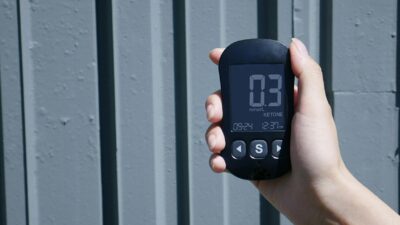
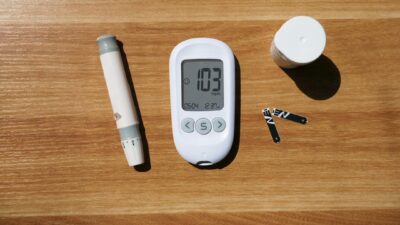
Glucose meters are pocket-sized electrochemical devices that measure blood sugar from a tiny finger-stick blood drop in 4 to 6 seconds. They work by reacting blood glucose with an enzyme on a disposable test strip, generating an electrical current proportional to the glucose concentration. The FDA requires 95 percent of readings to fall within plus or minus 15 percent of a lab reference value. Below is how they work, the top models for 2024-2025, and how to choose one.
How a Glucose Meter Works
Insert a test strip. The strip has a small reaction zone coated with an enzyme — most commonly glucose oxidase (GOx) or glucose dehydrogenase (GDH). Touch a drop of blood to the strip’s intake. Capillary action wicks the blood into the reaction zone.
The enzyme reacts with glucose in the blood and transfers electrons to a mediator molecule. The mediator delivers those electrons to a small electrode in the strip. The meter applies a tiny voltage and measures the resulting current in microamperes. The meter’s microprocessor converts that current into a glucose reading in mg/dL (United States) or mmol/L (most of the rest of the world) and displays it on the screen.
The whole process takes 4 to 6 seconds with modern meters, requires 0.3 to 1.0 microliters of blood (much less than the days of full drops), and uses one disposable strip per test.
FDA Accuracy Standards
| Glucose Level | Accuracy Requirement |
|---|---|
| 75 mg/dL or higher | 95% of readings within plus or minus 15% of lab reference |
| Below 75 mg/dL | 95% of readings within plus or minus 15 mg/dL of lab reference |
| Hospital/professional use | Stricter ISO 15197:2013 standard — 99% within plus or minus 15% |
A 2018 Diabetes Care study tested 18 marketed meters against the standard and found wide variation — some passed easily, others failed. The FDA’s official guidance details the criteria. Top-performing brands like Contour Next, Accu-Chek, and OneTouch consistently meet or beat the standard.
Top Glucose Meters for 2024-2025
| Meter | Strip Cost (per 100) | Strengths | Best For |
|---|---|---|---|
| Contour Next One | $50 to $80 | Excellent accuracy, Bluetooth, second-chance sampling, smartLIGHT range indicator | Insulin users who want top accuracy |
| Accu-Chek Guide Me | $50 to $90 | Spill-resistant strip vial, large display, simple interface | Older adults, simplicity-first users |
| OneTouch Verio Reflect | $60 to $90 | Color range indicator, blood sugar mentor, app sync | Newly diagnosed wanting feedback |
| FreeStyle Lite | $40 to $70 | No coding required, tiny 0.3 mcL sample, backlit display | Frequent testers, smaller blood sample needed |
| ReliOn Premier (Walmart) | $9 to $18 | Cheapest mainstream strips, decent accuracy | Budget-conscious, T2D not on insulin |
| Care Touch | $20 to $30 (Amazon) | Inexpensive starter kit, basic functionality | Occasional checks, prediabetes monitoring |
What Drives Ongoing Cost
The meter itself is often free or under $30 — manufacturers price strips to recoup their margin. Strip cost ranges from about 9 cents (ReliOn) to over $1 (some name-brand strips at retail). For someone testing 4 times daily, that is the difference between $130 and $1,500 per year just for strips.
Insurance changes the math. Most US plans cover specific meter and strip combinations through preferred durable medical equipment (DME) suppliers. Switching to a covered meter can reduce out-of-pocket strip cost to a small copay. Always call your plan before buying.
Features Worth Paying For
- Bluetooth sync to phone app: Auto-logs readings, generates trends and reports. Useful for sharing data with your doctor.
- Second-chance sampling: If your blood drop was too small, you can add more without wasting a strip (Contour Next).
- Color or arrow range indicators: Tells you at a glance whether you are in target range.
- Backlit display and audible cues: Helpful for nighttime checks or visual impairment.
- Pre/post-meal tagging: Helps your data make sense in retrospect.
- No-coding strips: Newer meters set the strip code automatically.
Sources of Reading Error
- Insufficient blood drop — wait for a full drop, do not “milk” the finger excessively.
- Wet, dirty, or alcohol-residue fingers — wash with soap and warm water, dry fully.
- Expired or improperly stored strips — heat and humidity degrade enzymes.
- Hematocrit extremes — anemia or polycythemia can skew some meters.
- High altitude (above 10,000 feet) — affects some meters.
- Certain medications (acetaminophen at high doses, some antibiotics) — interfere with specific strip chemistries.
Meters vs CGMs
Continuous glucose monitors (CGM) like Dexcom G7 and FreeStyle Libre 3 measure interstitial glucose every 1 to 5 minutes and stream data to a phone. CGMs do not replace meters entirely — backup checks are still useful when CGM accuracy is in doubt, when sensors fail, or when starting a new sensor — but they shift the burden away from fingersticks for most insulin users. The 2024 ADA Standards of Care recommend CGM for all adults with type 1 diabetes (T1D) and most adults with insulin-treated T2D.
For people not yet on insulin — those with prediabetes, T2D managed by lifestyle and metformin, or anyone monitoring meal responses — a meter is still the standard tool. Periodic structured checks paired with a balanced eating plan can show how specific foods affect your blood sugar without the cost of a CGM.
How to Get Started
If you are newly diagnosed with prediabetes or T2D, ask your doctor or pharmacist for a meter recommendation that fits your insurance. Most major chains and DME suppliers offer free starter kits. Practice the technique a few times before relying on the readings — wash, dry, lance, drop, read. To know what your numbers should look like, see our A1C levels guide, and read our prediabetes overview for context.
The Bottom Line
Glucose meters use enzyme-coated strips and electrochemistry to give you a reliable blood sugar reading in seconds. Top models for 2024-2025 include Contour Next One, Accu-Chek Guide Me, OneTouch Verio Reflect, FreeStyle Lite, ReliOn Premier, and Care Touch. The biggest ongoing cost is strips, so choose a meter your insurance covers. Pair the readings with food, medication, and activity logging to make the data useful.