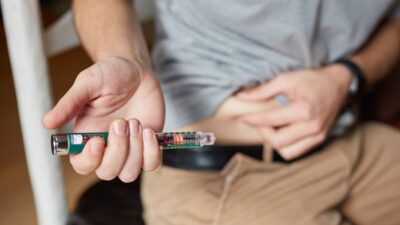
Dementia and diabetes care is the intersection of two slow-moving conditions that complicate each other. Diabetes roughly doubles the long-term risk of dementia. Dementia, once established, makes every aspect of diabetes self-management harder — meals get forgotten, doses get missed or doubled, hypoglycemia warning signs disappear, equipment gets lost, and complex regimens that worked at 65 stop working at 80. The clinical task is to adapt care to the cognitive trajectory: simplify regimens, involve caregivers earlier, relax targets, lean on technology, and review medications at every cognitive change. Both the American Diabetes Association and the American Geriatrics Society have published frameworks that align on this approach.
The Diabetes-Dementia Link
- Diabetes is associated with roughly 1.5 to 2 times higher dementia risk.
- Mechanisms include cerebrovascular disease, repeated severe hypoglycemia, brain insulin resistance, and chronic hyperglycemia.
- Severe hypoglycemic events are independently associated with accelerated cognitive decline.
- Good long-term glycemic control reduces — but does not eliminate — dementia risk.
- Mild cognitive impairment (MCI) often precedes dementia by years and is a window for intervention.
- See our broader guide on cognitive decline and diabetes for mechanisms in detail.
Stages of Cognitive Decline and Diabetes Care
| Stage | Functional Picture | Diabetes Adaptations |
|---|---|---|
| Normal cognition | Independent self-management | Standard care; baseline screening |
| Mild cognitive impairment | Occasional missed doses; appointment reminders helpful | Simplify regimen; caregiver oversight; CGM |
| Mild dementia | Needs reminders; meal planning support | Reduce daily decisions; automated pill dispensers |
| Moderate dementia | Cannot self-administer reliably | Caregiver-administered; fixed dose basal; once-weekly GLP-1 |
| Severe dementia | Bedbound; minimal communication | Minimum effective regimen; hospice consideration |
Targets by Cognitive Stage
- Mild cognitive impairment: A1C 7.0–7.5% reasonable in otherwise healthy older adults.
- Mild dementia: A1C 7.5–8.0% prioritizing hypoglycemia avoidance.
- Moderate dementia: A1C 8.0–8.5% acceptable; avoid values below 7.0%.
- Severe dementia: avoid symptomatic hyperglycemia; comfort glucose 100–300 mg/dL.
- Hospice transition: see our end-of-life glycemic targets guide.
Medications to Avoid in Cognitive Impairment
- Long-acting sulfonylureas (glyburide, chlorpropamide): Beers Criteria caution — hypoglycemia risk.
- Sliding-scale insulin alone: Beers Criteria caution — wide glucose swings; no preventive coverage.
- Complex multi-injection regimens: high error risk in cognitively impaired patients.
- SGLT2 inhibitors: caution — volume depletion, UTIs, DKA risk especially with reduced oral intake.
- Pioglitazone: edema, fracture risk, heart failure caution.
- Metformin with eGFR <30: contraindicated.
- Mealtime insulin requiring carb counting: difficult in moderate to advanced dementia.
Preferred Regimens at Each Stage
| Stage | Preferred Oral | Preferred Injectable | Insulin Approach |
|---|---|---|---|
| MCI / mild dementia | Metformin (if eGFR ok); DPP-4 | Once-weekly GLP-1 RA | Basal once daily; consider AID |
| Moderate dementia | Once-daily metformin or stop | Caregiver-administered weekly GLP-1 | Fixed-dose basal; smart pen logging |
| Severe dementia | Often stop all oral agents | Often discontinue | Minimum basal; symptom-based |
| Hospice | Stop | Stop | T1D: minimum basal; T2D: often stop |
Practical Adaptations
- Automated pill dispensers with timed alarms — reduce missed and double doses for oral agents.
- Smart pens (InPen, Tempo Smart Button) — log doses automatically; alert caregivers to missed doses.
- CGM with caregiver share — Dexcom Follow, Libre LinkUp — remote monitoring for hypoglycemia.
- Pre-filled pen devices instead of vial-and-syringe — easier for arthritic hands and caregivers.
- Once-weekly GLP-1 receptor agonists — caregiver-administered injection one day per week.
- Fixed-dose basal insulin — same dose every night rather than sliding-scale or correction.
- Meal-time post-dosing — administer mealtime insulin after eating in patients with variable intake.
- Hypoglycemia kit — nasal glucagon (Baqsimi) accessible to all caregivers, with training.
- Medical alert jewelry — for when the patient is found confused away from home.
- Power of attorney for healthcare and finances — established early, while capacity allows.
The Hypoglycemia Problem
- Hypoglycemia unawareness rises with both age and dementia severity.
- The first symptom may be confusion or aggression rather than sweating or shakiness.
- Confusion overlaps with the dementia baseline, making hypoglycemia harder to recognize.
- Severe hypoglycemia accelerates cognitive decline, creating a feedback loop.
- CGM with high alarms (set at 90 mg/dL or above) catches lows before symptoms.
- Caregiver training on glucagon is essential — Baqsimi nasal is easiest.
- Every hypoglycemic event warrants regimen review within 48 hours.
Caregiver Involvement
- Spousal and adult-child caregivers carry most of the management load.
- Diabetes education for caregivers is often inadequate — most learn ad hoc.
- Caregiver burden in this group is well documented — see our caregiver burden in diabetes guide.
- Respite care, paid in-home help, and adult day programs all reduce caregiver strain.
- Family meetings to coordinate care across siblings or extended family.
- Documented care plans in writing reduce confusion and disputes.
Long-Term Care Settings
As dementia progresses, many patients move from home to assisted living or nursing home care. Diabetes management in long-term care has its own framework — see our nursing home diabetes care guide. Key principles overlap: simpler regimens, relaxed targets, Beers Criteria adherence, family advocacy.
Driving and Other Safety Questions
- Driving with dementia is a complex assessment beyond diabetes.
- Diabetes adds hypoglycemia-at-the-wheel risk — particularly dangerous when warning signs are blunted.
- Formal driving evaluation through an occupational therapy program is the safest path.
- Several states require physician reporting of conditions affecting driving safety.
- Cooking safety — gas stoves, leaving food unattended — separate from but interacting with diabetes diet management.
- Medication storage and access — locked storage as dementia advances.
Hospice Transition
Hospice eligibility in dementia typically follows functional decline criteria — bedbound status, dependence in all activities of daily living, severely limited verbal communication, and recurrent infections or significant weight loss. Diabetes is rarely the qualifying diagnosis but commonly accompanies advanced dementia. The transition involves further regimen simplification and broader comfort glucose ranges. See our companion guide on hospice and diabetes.
The Bottom Line
Dementia and diabetes care requires deliberate adaptation as cognition declines. Diabetes roughly doubles dementia risk, and dementia complicates every aspect of diabetes self-management. Targets relax — A1C goals of 8.0 to 8.5 percent or higher in advanced dementia, with hypoglycemia avoidance prioritized over tight control. Beers Criteria flag complex insulin regimens, sliding-scale insulin alone, and long-acting sulfonylureas as medications to avoid. Preferred regimens favor simplicity: once-daily metformin where kidney function allows, once-weekly GLP-1 receptor agonists that caregivers can administer, once-daily basal insulin in fixed doses, and CGM with caregiver alarm sharing. Smart pens, automated pill dispensers, and CGM remote monitoring all reduce medication errors and caregiver burden. Each cognitive change should trigger a medication review. Family caregivers carry most of the load and benefit from explicit education, respite, and structured communication with the clinical team. As dementia advances toward end of life, the transition to hospice diabetes care continues the same simplification trajectory. Done well, dementia-adapted diabetes care preserves comfort, reduces preventable harm, and supports the families who provide most of the day-to-day care.