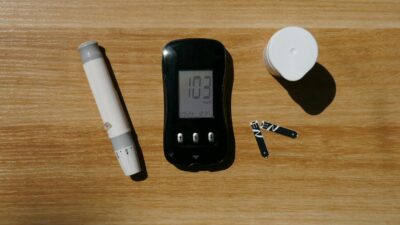
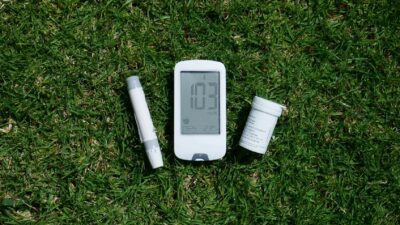
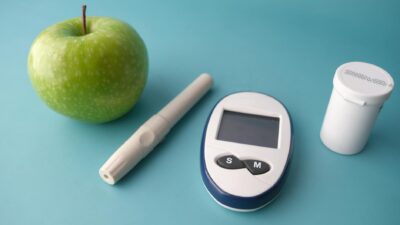
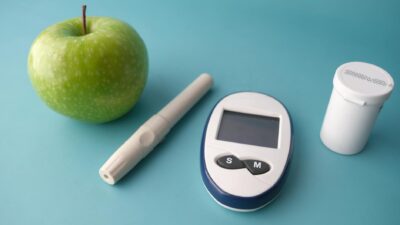
A blood glucose monitoring device is any tool that measures glucose from a small blood sample or from a sensor inserted under the skin. The two main categories are fingerstick glucometers, which give a single-moment reading, and continuous glucose monitors (CGMs), which record values every 1 to 5 minutes for up to 14 days. Choosing well depends on how you treat your diabetes and how much data you want.
How Blood Glucose Monitoring Works
Fingerstick meters pull capillary blood through a reagent test strip. An enzyme on the strip — usually glucose oxidase or glucose dehydrogenase — reacts with glucose and generates an electrical current proportional to its concentration. The meter converts that current into a reading in milligrams per deciliter (mg/dL) or millimoles per liter (mmol/L).
Continuous glucose monitors use a hair-thin filament inserted in the interstitial fluid just under the skin. That filament hosts the same enzymatic reaction but in a tiny, ongoing form. A transmitter sends readings wirelessly to a smartphone or receiver. Interstitial glucose lags blood glucose by 5 to 15 minutes, which matters most during rapid changes.
Types of Devices Available Today
| Category | Examples | Wear Time | Best For |
|---|---|---|---|
| Standard fingerstick meter | Contour Next, Accu-Chek Guide, OneTouch Verio | Per test | Low-cost daily checks |
| Real-time CGM | Dexcom G7, Medtronic Guardian 4 | 10 to 14 days | Insulin users, tight control |
| Flash CGM | FreeStyle Libre 3, Libre 2 Plus | 14 to 15 days | Type 2 diabetes, trend awareness |
| OTC biosensors | Stelo, Lingo | 15 days | Prediabetes, wellness, non-insulin users |
| Continuous implanted CGM | Eversense 365 | 365 days | Long-term, clinic-inserted sensors |
Accuracy Standards and What They Mean
In the United States, blood glucose monitoring devices sold for personal use must be FDA-cleared. Clearance requires meeting ISO 15197:2013 performance criteria, which specify that 95 percent of results fall within plus or minus 15 mg/dL of a lab reference (for glucose below 100 mg/dL) or within plus or minus 15 percent (at or above 100 mg/dL). CGMs are evaluated with a Mean Absolute Relative Difference (MARD); current market leaders run 8 to 10 percent.
Accuracy is not just a function of the device. Cold hands, dehydration, hematocrit variations, and expired strips all shift readings. For context on how these numbers feed into diagnosis, see the A1C levels guide.
Choosing a Device That Fits Your Life
The right monitor depends on a short set of questions:
- Do you take insulin? Real-time CGM is the clinical standard of care for anyone on multiple daily insulin injections.
- Do you have prediabetes or type 2 without insulin? A flash CGM or OTC sensor for a month can teach you more than a year of random fingersticks.
- Is cost a constraint? Meters remain cheap; strip prices have dropped sharply, and store-brand options are often as accurate as name brands.
- Do you want smartphone integration? All modern CGMs and most new meters sync to iOS and Android apps with shareable reports.
- Do you dislike adhesives? A meter avoids sensors entirely but sacrifices trend data.
How Each Device Type Fits Into Care
Monitoring data only matter if they change behavior or medication. A real-time CGM flags overnight highs, lets a clinician fine-tune basal insulin, and alerts insulin users before a dangerous low. A flash CGM shows meal-by-meal impacts and the cumulative effect of walking, sleep, and stress. A fingerstick meter, used strategically at paired times (before and two hours after a meal), still provides enough data for most non-insulin users to drive better prediabetes diet and prediabetes treatment decisions.
According to the NIDDK continuous glucose monitoring overview, CGM use has repeatedly improved A1C, reduced hypoglycemia, and improved patient satisfaction across large trials.
Setup, Calibration, and Common Pitfalls
Modern devices require less manual work than they did a decade ago. Most CGMs are factory-calibrated — no fingersticks required for calibration, though a fingerstick is still recommended whenever the sensor reading does not match how you feel. Key habits that keep readings trustworthy:
- Wash and dry hands before fingerstick testing; alcohol residue and sugary hands cause false highs.
- Apply CGM sensors to clean, dry skin; shower an hour before and skip lotions near the site.
- Replace test strips by their expiration date and store them closed in a cool, dry place.
- Rotate fingerstick sites; the sides of the fingertips are less painful than the pad.
- If readings feel off, lab-verify with an HbA1c or venous glucose, rather than switching devices repeatedly.
Insurance, Cost, and Access
Commercial insurance plans now cover CGM for anyone using insulin; Medicare extended coverage to people with type 2 diabetes on non-insulin therapies in 2023. Out of pocket, a monthly CGM supply runs roughly 75 to 150 dollars without insurance. Fingerstick supplies run 10 to 40 dollars monthly. OTC sensors like Stelo are priced between 89 and 99 dollars per monthly pair. Ask your provider to submit medical necessity documentation if you are declined, and check pharmacy-based CGM programs, which sometimes beat durable medical equipment prices.
The Bottom Line
A blood glucose monitoring device is only as useful as the decisions it drives. Fingerstick meters remain a low-cost, highly accurate backbone of care. CGMs produce the richest data and have become the standard for insulin users and anyone who wants to see how food, sleep, and movement actually affect their numbers. Choose based on your treatment, budget, and tolerance for wearables, then use the data in partnership with your clinician — not as a replacement for clinical judgment.