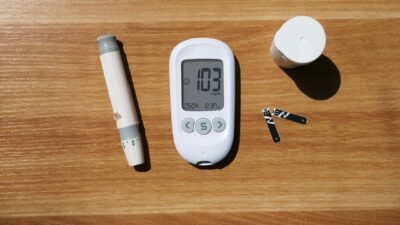
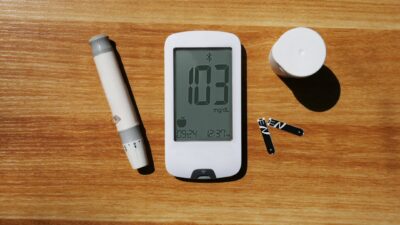
A blood sugar meter, also called a glucometer, is a handheld device that measures blood glucose from a single drop of capillary blood. It remains the most widely used tool for home glucose monitoring worldwide and complements — or, for many people, still replaces — continuous glucose monitors.
How a Blood Sugar Meter Works
You prick the side of a fingertip with a spring-loaded lancet, touch the drop of blood to a test strip, and the strip’s electrochemical or photochemical reaction produces a signal proportional to the glucose concentration. The meter converts that signal into a mg/dL value and displays the result in 4-7 seconds.
According to the FDA, all US-marketed meters must be cleared under 510(k) regulations and meet ISO 15197 accuracy standards.
What a Meter Costs
Meters themselves are inexpensive — many brands give them away — because ongoing revenue comes from test strips. Strip prices range from 15 cents to over a dollar each depending on brand and whether you buy through insurance. Lancets, a lancing device, alcohol swabs, and a sharps container are also needed.
Features to Compare
- Strip cost per test — often the biggest long-term expense
- Sample size — modern meters need only 0.3-0.5 microliters
- Memory and averaging — most store hundreds of readings
- App connectivity — Bluetooth sync to iOS or Android
- Backlight and audio — important for vision-impaired users
- Alternate site testing — palm or forearm options
Meter vs. CGM Comparison
| Feature | Blood Sugar Meter | Continuous Glucose Monitor |
|---|---|---|
| Sample type | Capillary blood | Interstitial fluid |
| Readings per day | 2-10 typically | 288 (every 5 min) |
| Requires fingerstick | Yes | Usually no |
| Accuracy standard | ISO 15197: 15% | MARD 8-10% |
| Cost per day (US) | $0.50-$3 | $3-$6 |
| Best for | Confirmation, spot checks | Trend awareness, alerts |
Proper Testing Technique
Small technique errors can shift readings by 10-20%. Follow these steps for reliable results:
- Wash and dry your hands. Food residue (especially fruit) can falsely raise values.
- Insert a fresh strip and let the meter read its code if needed.
- Prick the side of a fingertip, not the pad, to minimize pain.
- Let a hanging drop form. Squeezing the finger thins the sample.
- Touch the strip edge to the drop — do not smear blood on top.
- Wait for the reading. Log it to your app or written record.
Understanding the Numbers
The American Diabetes Association defines these reference ranges for home measurements:
- Fasting glucose: normal under 100, prediabetes 100-125, diabetes 126+
- 2-hour post-meal: normal under 140, prediabetes 140-199, diabetes 200+
- Bedtime: typically target 100-140 for people with diabetes
Our A1C levels hub explains how daily readings relate to your quarterly A1C. For symptom-level guidance see our prediabetes symptoms page.
When to Distrust a Reading
Repeat the test or use a different meter if:
- The result conflicts with how you feel
- Strips were exposed to heat, cold, or humidity
- The strip code does not match the meter
- Your hands were not clean and dry
- Battery power is low or the display flickers
Who Still Benefits from a Meter
Even in the age of CGMs, a blood sugar meter is useful for:
- Confirming CGM readings that do not match symptoms
- Covering gaps when a sensor fails or is being replaced
- People who cannot afford a CGM or whose insurance does not cover one
- Occasional testing for prediabetes lifestyle check-ins
Storing and Caring for Your Meter
Glucometers are sensitive to temperature and humidity. Keep the meter and strips between 50 and 86 degrees Fahrenheit (10-30 C) and avoid leaving them in a hot car, a refrigerator, or a humid bathroom. Sealed strip vials should be closed immediately after removing a strip and discarded after the expiration date printed on the label. Meters running on button batteries typically need replacement every 6-12 months — the meter will flash a low-battery icon when it is time.
Traveling with a Meter
Pack your meter, lancets, and strips in your carry-on luggage rather than checked bags, where cargo-hold temperatures can damage supplies. Bring extra strips in case of travel delays, and carry a prescription or pharmacy label if you are crossing borders. Meters and lancets pass through airport security without difficulty; TSA guidelines allow diabetes supplies even beyond standard liquid restrictions.
The Bottom Line
A blood sugar meter is an affordable, accurate, and widely available way to check glucose whenever you need a number. Choose a model based on strip cost, app integration, and ease of use, and follow good technique to get reliable results. Even if you wear a CGM, keeping a meter and fresh strips in your bag is smart backup.
Medical disclaimer: This article is for educational purposes and is not medical advice. Consult your healthcare provider for a personalized glucose-monitoring plan.