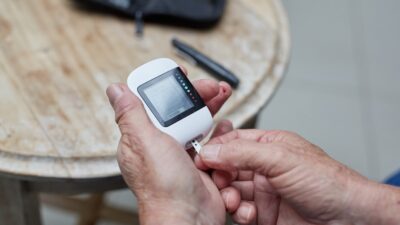
A Dexcom CGM is a wearable continuous glucose monitor that measures glucose in the interstitial fluid every few minutes and streams the readings wirelessly to your phone, smartwatch, or insulin pump. The current Dexcom G7 model is the most widely used CGM in the United States for people with type 1 or insulin-treated type 2 diabetes.
The Dexcom Product Family
| Model | For Whom | Wear Time | Prescription? |
|---|---|---|---|
| Dexcom G7 | Type 1, type 2 on insulin, age 2+ | 10 days | Yes |
| Dexcom G6 | Same as G7 (older model) | 10 days | Yes |
| Stelo by Dexcom | Prediabetes, type 2 not on insulin, adults | 15 days | No (OTC) |
The G7 replaced the G6 starting in 2023. It is 60 percent smaller, warms up in 30 minutes instead of two hours, and transmits to more devices including direct-to-watch with Apple Watch.
How a Dexcom CGM Works
The sensor contains a tiny flexible filament coated with glucose oxidase, an enzyme that reacts with glucose in your interstitial fluid. This reaction produces an electrical signal proportional to your glucose level, which the transmitter converts to a numeric reading and sends every five minutes via Bluetooth.
You apply the sensor to the back of your upper arm (or abdomen for G6) using a single-use applicator. After a 30-minute warm-up, the G7 begins sending readings to the Dexcom G7 app or a dedicated receiver. It also syncs to the Clarity app for long-term reporting.
Accuracy: What the Studies Show
The pivotal trial supporting Dexcom G7 clearance by the FDA demonstrated a mean absolute relative difference (MARD) of 8.2 percent in adults and 8.1 percent in children. Lower MARD means higher accuracy. For comparison, a home finger-stick meter has a MARD of roughly 5 to 10 percent, so the G7 is nearly as accurate as a lab-grade fingerprick test.
Accuracy is highest when glucose is stable. During rapid changes (after a high-carb meal or a hypoglycemic event), interstitial glucose can lag blood glucose by 5 to 15 minutes. If the CGM and your symptoms do not match, confirm with a finger stick.
What the Data Can Tell You
Beyond individual glucose values, a Dexcom CGM reports:
- Time in range (percentage of readings between 70 and 180 mg/dL, target above 70 percent)
- Glucose management indicator (GMI), an estimate of your 3-month A1C
- Variability (standard deviation and coefficient of variation)
- Post-meal spikes and overnight patterns
Tracking your A1C levels alongside GMI gives a clearer picture of long-term control.
Who Should Use Dexcom G7?
The G7 is ideal for anyone on insulin, especially those on multiple daily injections or an insulin pump. The American Diabetes Association recommends CGM for all people with type 1 diabetes and for type 2 diabetes patients on intensive insulin therapy. It is also helpful for people with frequent hypoglycemia, hypoglycemia unawareness, or pregnancy complicated by diabetes.
If you have prediabetes or type 2 diabetes not treated with insulin, Stelo by Dexcom is the OTC alternative. See our Stelo review for details on how the two products differ.
Cost and Insurance Coverage
Without insurance, Dexcom G7 runs about $300 to $400 per month for three sensors and the transmitter component. With commercial insurance or Medicare Part B (for insulin users), out-of-pocket costs typically drop to $0 to $100 per month. Pharmacy benefit coverage varies, so check both medical and pharmacy paths.
Integrations and App Features
Dexcom G7 integrates with the Tandem t:slim X2 and Omnipod 5 insulin pumps for automated insulin delivery. It connects directly to Apple Watch, shares readings with up to 10 followers, and feeds data to Apple Health, Google Fit, and many third-party diabetes apps. These integrations are why Dexcom holds the largest CGM market share in the United States.
Common User Issues
Sensor errors and signal loss are the most common complaints, usually solved by keeping your phone within 20 feet. Adhesive issues can be managed with skin prep wipes and overpatches. Compression lows (false low readings when sleeping on the sensor) resolve when you shift position.
The Bottom Line
The Dexcom CGM, especially the G7, is the benchmark continuous glucose monitor in the United States. It delivers lab-grade accuracy, integrates with the widest range of pumps and devices, and is covered by most insurance plans for people on insulin. For prediabetes or non-insulin users, Stelo by Dexcom offers the same sensor technology over the counter. Ask your clinician or visit our treatment hub to learn which option fits your care plan.
Medical disclaimer: This article is for educational purposes only. Discuss CGM options and treatment decisions with your healthcare provider.