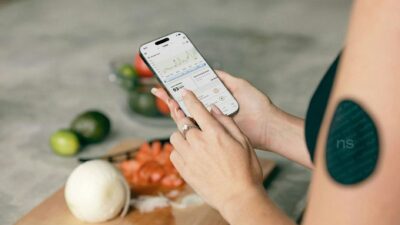
A Dexcom glucose monitor is a continuous glucose monitor (CGM) that uses a small sensor under the skin to measure interstitial glucose every five minutes. Readings stream to a smartphone or receiver, giving you real-time values, trend arrows, and customizable alerts for highs and lows.
How the Dexcom Sensor Works
Each Dexcom sensor contains a flexible filament about the width of a human hair that sits just below the skin. The filament is coated with glucose oxidase, an enzyme that reacts with glucose in interstitial fluid to generate a small electrical current. The transmitter translates the current into a glucose value and sends it via Bluetooth to your paired phone or receiver.
The G7, Dexcom’s current flagship, combines the sensor and transmitter into a single disposable unit. It warms up in 30 minutes, about half the time of previous generations, and is waterproof to eight feet for 24 hours.
Accuracy and What MARD Means
CGM accuracy is reported as Mean Absolute Relative Difference (MARD). A lower MARD means more accurate readings. The FDA classifies integrated CGMs with a MARD under 10% as suitable for non-adjunctive insulin dosing. The G7 reports 8.2% MARD in adults and 8.1% in pediatrics.
Dexcom Model Comparison
| Model | Sensor Life | MARD | Prescription | Warm-up |
|---|---|---|---|---|
| Dexcom G6 | 10 days | 9.0% | Required | 2 hours |
| Dexcom G7 | 10.5 days | 8.2% | Required | 30 min |
| Dexcom Stelo | 15 days | Similar to G7 | Not required | 30 min |
| Dexcom ONE+ | 10 days | 8.8% | Required (outside US) | 30 min |
Setting Up a Dexcom Glucose Monitor
- Prescription and shipment. Your provider sends the prescription to Dexcom or a pharmacy. Sensors arrive in boxes of three.
- App installation. Download the Dexcom G7 app. Create an account and enter the sensor code printed on the applicator.
- Application site. Clean the back of an upper arm with alcohol. For children, the upper buttock is also approved.
- Deployment. Press the applicator firmly; the sensor inserts in under a second with minimal sensation.
- Warm-up. Wait 30 minutes for the first reading.
If you are new to glucose monitoring entirely, our guide on A1C levels explains how average glucose relates to long-term diabetes risk, which complements the real-time picture a Dexcom provides.
Reading Your Data
The Dexcom app displays a current glucose value, a trend arrow showing the direction of change, and a 24-hour graph. Trend arrows are often more useful than the number itself: a sensor value of 110 with a double-down arrow means you are dropping fast and may be low soon.
Customize high and low alerts in the app settings. Typical starting thresholds are 70 mg/dL for lows and 180 mg/dL for highs, but these should be personalized. The urgent-low alarm fires at 55 mg/dL and cannot be silenced without explicit action.
Sharing Data with Clinicians and Family
Dexcom Clarity is the companion web app for healthcare providers. Patients can share data automatically so that at each appointment the endocrinologist sees 14-day reports including Time in Range, average glucose, and hypo/hyperglycemia events. The Follow app lets family or caregivers receive the same alerts you do.
Insurance and Cost
Medicare Part B covers Dexcom for people on insulin or with a history of problematic hypoglycemia. Most commercial plans follow similar criteria. Without insurance, a one-month supply (three sensors) retails around $375. For out-of-pocket users with prediabetes, the OTC Dexcom Stelo at roughly $49 per 15-day sensor is often more affordable. For broader context, see our prediabetes treatment overview.
Common Problems and Fixes
- Sensor error. Restart the Dexcom app and keep your phone within 20 feet. If it persists for more than three hours, contact Dexcom support for a free replacement.
- Adhesion issues. Use an overpatch or skin-prep wipe on day five or six.
- Readings off on day one. Sensors can drift in the first 24 hours; confirm with a fingerstick if symptoms disagree.
The Bottom Line
A Dexcom glucose monitor provides hospital-grade glucose data from a wearable the size of a quarter. With 8.2% MARD, 10-day sensor life, and no calibration required, it is one of the most reliable CGM options available. Discuss with your doctor whether a Dexcom is clinically indicated for your situation and explore both prescription and OTC paths before buying.
This article is educational and not medical advice. Consult your healthcare provider before starting or changing any glucose monitoring plan.