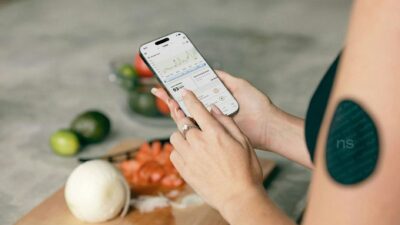
A Libre sensor is a wearable continuous glucose biosensor made by Abbott that measures glucose in the interstitial fluid just under your skin. Worn on the back of the upper arm for 14 or 15 days depending on the model, the Libre sensor streams or scans glucose readings to a phone app or reader without any finger-stick calibration.
The FreeStyle Libre Family
| Model | Wear Time | Reading Interval | Prescription? |
|---|---|---|---|
| FreeStyle Libre 14 Day | 14 days | On scan | Yes |
| FreeStyle Libre 2 | 14 days | On scan + optional real-time | Yes |
| FreeStyle Libre 3 | 14 days | Every minute (real-time) | Yes |
| FreeStyle Libre 3 Plus | 15 days | Every minute | Yes |
| Lingo (OTC) | 14 days | Every minute | No |
Libre 3 and 3 Plus are the current flagship products in the United States. Older Libre 14 Day and Libre 2 remain in use for patients on established insurance plans or who prefer a separate reader device.
How the Libre Sensor Works
Each Libre sensor contains a thin, flexible filament coated with the enzyme glucose oxidase. The filament sits about 5 millimeters beneath the skin’s surface. As glucose from the surrounding interstitial fluid contacts the enzyme, an electrochemical reaction produces a tiny current. The sensor measures that current and converts it to a glucose value.
On the Libre 3 and 3 Plus, the reading is transmitted automatically to the FreeStyle Libre 3 app every minute via Bluetooth. On the older 14 Day model, you must scan the sensor with a reader or phone held within 1.5 inches to pull the latest reading.
Applying a Libre Sensor
- Clean the back of your upper arm with an alcohol wipe and let it dry
- Open the single-use applicator and twist off the cap
- Press the applicator firmly against your arm and release
- Pair the sensor with the FreeStyle Libre app
- Wait 60 minutes for warm-up (Libre 3) or 1 hour (Libre 14 Day)
- Receive readings for the programmed wear time
Accuracy Across Models
Accuracy is measured by MARD (mean absolute relative difference) against reference blood glucose. According to published FDA submission data and clinical studies:
- FreeStyle Libre 3: MARD 7.9 percent (among the best of any CGM)
- FreeStyle Libre 2: MARD 9.2 percent
- FreeStyle Libre 14 Day: MARD 9.7 percent
All are sufficient for routine glucose management and treatment decisions. During rapid glucose changes, interstitial fluid lags blood by 5 to 15 minutes, so finger-stick confirmation is recommended if symptoms do not match the reading.
Who Should Use a Libre Sensor?
Libre sensors are cleared for anyone age 4 and older with diabetes. The American Diabetes Association recommends CGM use for all people with type 1 diabetes, type 2 diabetes on multiple daily injections, and increasingly for anyone on basal insulin or struggling to meet A1C goals. If you have prediabetes or type 2 diabetes not on insulin, Abbott’s Lingo or Dexcom’s Stelo are OTC alternatives using the same sensor platforms.
What You Can Learn From a Libre Sensor
Two weeks of data almost always reveals patterns that lab A1C cannot capture:
- Time in range (percentage of readings between 70 and 180 mg/dL)
- Glucose management indicator, a real-time A1C estimate
- Dawn phenomenon (early-morning glucose rise)
- Post-meal spikes tied to specific foods
- Effect of walking, strength training, and sleep on your numbers
Comparing these patterns against your A1C levels gives both a macro and micro view of control.
Cost and Insurance
Without insurance, two Libre 3 sensors (one month) cost about $150 to $200 at US pharmacies. With commercial insurance, out-of-pocket cost often drops to $30 to $75 per month. Medicare Part B covers Libre for insulin users. Pharmacy versus durable medical equipment coverage differs by plan, so ask your pharmacy to check both paths.
Common Issues and Tips
The most frequent complaint is early sensor failure due to knocks against doorways or bumping the sensor during exercise. Overpatches help. Compression lows (false low readings while sleeping on the sensor) resolve with a position change. Keep your phone within 33 feet for uninterrupted readings.
The Bottom Line
The Libre sensor is the most widely used CGM sensor worldwide, and the Libre 3 Plus delivers lab-grade accuracy in a near-invisible wearable. For people with diabetes, it is a mainstream tool for daily management; for those with prediabetes, the OTC Lingo version brings the same technology to wellness users. Talk to your clinician or review our treatment resources to decide which model fits your plan.
Medical disclaimer: This article is educational and not a substitute for medical advice. Consult your healthcare provider about CGM use and treatment decisions.