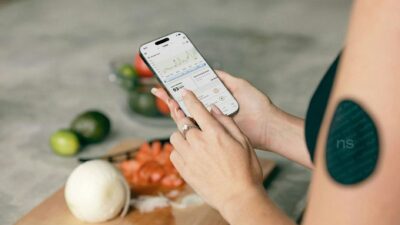
A continuous glucose monitor (CGM) is a small wearable sensor that measures glucose in the interstitial fluid under your skin every few minutes and sends those readings to a reader or smartphone. For type 2 diabetes, a CGM can turn isolated fingerstick numbers into a trend line, making it easier to see what food, activity, stress, and medication actually do to your blood sugar across the day.
How a CGM Actually Works
Current consumer CGMs consist of a tiny filament inserted just under the skin, a transmitter on the surface, and software that displays readings. The filament uses an enzyme (usually glucose oxidase) that generates an electrical signal proportional to glucose concentration. Algorithms translate that signal into an estimated glucose value and update it every 1 to 5 minutes.
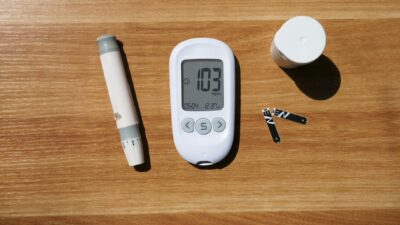
Because the sensor reads interstitial fluid rather than whole blood, there is a small physiologic lag — typically a few minutes — between CGM and fingerstick values, most noticeable when glucose is changing quickly. Your CGM number is not “wrong” during a spike; it is simply catching up.
Why a CGM Matters in Type 2 Diabetes
Type 2 diabetes is a condition of glucose variability as much as average glucose. Two people can share an A1C value while having very different day-to-day experiences: one bouncing between highs and lows, the other relatively flat. A CGM exposes this pattern.
Randomized trials and real-world studies in type 2 diabetes have linked CGM use with lower A1C, more time in the target glucose range, and fewer severe hypoglycemia events — particularly in people using insulin. The American Diabetes Association’s Standards of Care recommend CGM for most adults with diabetes on intensive insulin therapy, and endorse it as an option for those on basal insulin or other therapies when clinically appropriate.
Who Is a Good Candidate?
Clinicians typically consider CGM for people with type 2 diabetes who fit one or more of the following profiles:
- On insulin (multiple daily injections or basal-only) and needing tighter titration.
- Experiencing frequent or unrecognized hypoglycemia.
- Working actively to lower A1C and struggling to identify the highest-impact changes.
- Newly diagnosed and motivated to learn how lifestyle factors drive their glucose.
- Pregnant or planning pregnancy with diabetes.
CGM Accuracy: What the Numbers Mean
CGM accuracy is often expressed as mean absolute relative difference, or MARD — essentially, the average percentage difference between the sensor and a reference blood glucose measurement. Lower is better. Modern FDA-cleared CGMs generally report MARDs in the single digits in controlled studies, but real-world accuracy varies.
| Factor | Effect on CGM Accuracy |
|---|---|
| Rapid glucose change | Physiologic lag can widen sensor-vs-fingerstick gap temporarily. |
| Day 1 after insertion | Many sensors are slightly less accurate on the first day. |
| Insertion site | Arm vs abdomen vs back of upper arm can differ by sensor brand. |
| Dehydration | Can reduce interstitial fluid flow and affect readings. |
| Pressure on sensor | Sleeping on the sensor can cause transient false lows. |
| Certain medications | High-dose vitamin C and some others can interfere on select devices — check labeling. |
How CGM Data Shapes Treatment
The real power of CGM in type 2 diabetes is not any single number but the ambulatory glucose profile (AGP) report your clinician can review. Three core metrics come from that report:
- Time in range (TIR): percentage of time glucose is between 70 and 180 mg/dL.
- Time below range (TBR): percentage of time below 70 mg/dL, a hypoglycemia marker.
- Glucose variability: how much glucose swings over the day, often expressed as coefficient of variation.
Your clinician can pair these numbers with your current diabetes treatment plan and dietary patterns to fine-tune medication timing, meal composition, and activity.
When a CGM May Not Help
A CGM is not automatically better for everyone. Some people with well-controlled type 2 diabetes managed on a single oral agent may gain little over periodic fingersticks. Others find the constant stream of numbers anxiety-provoking rather than informative. Cost, insurance coverage, and comfort with wearable tech also factor in. A short trial or a professional (clinician-worn) CGM can help answer the question before a long-term commitment.
Medical Disclaimer
This article is informational and does not replace advice from a licensed healthcare provider. Do not start, stop, or change any diabetes therapy based on a CGM reading alone. Discuss CGM selection, interpretation, and treatment decisions with your clinician.
The Bottom Line
A CGM for type 2 diabetes can turn scattered fingerstick data into a trend-rich picture that drives better decisions — especially for people on insulin, those experiencing hypoglycemia, or anyone actively working to improve time in range. Accuracy of FDA-cleared sensors is strong but not perfect, and the right device depends on your regimen, budget, and clinician’s guidance. Ask about a short trial if you are unsure whether CGM fits your care plan.