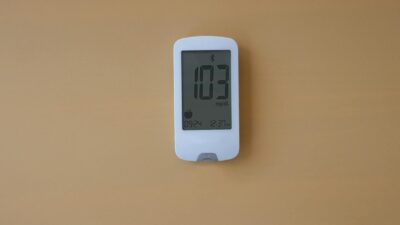
Truly needleless glucose monitors do not yet exist as FDA-approved consumer products. Every available continuous glucose monitor (CGM), including the FreeStyle Libre 3, Dexcom G7, Stelo, Lingo, and Eversense implant, uses a thin filament under the skin that is inserted with a single applicator needle. The FDA issued a February 2024 warning that smartwatches and apps claiming to measure blood glucose without piercing the skin are unsafe and have not been authorized.
What “Needleless” Usually Means
The term gets thrown around loosely. In practice, marketing for “needleless” glucose monitors usually means one of three things:
- No fingerstick required for routine readings: this is true of every modern CGM. Once the sensor is in place, you do not need a fingerstick to get a glucose value.
- A flexible filament rather than a rigid needle during wear: CGM sensors leave a tiny soft filament under the skin, not a needle. The needle is part of the applicator, not the sensor itself.
- Truly non-invasive (nothing pierces the skin): this category exists only in research and in unapproved scam products. No FDA-cleared device meets this definition.
How Real CGMs Work
Continuous glucose monitors measure glucose in interstitial fluid (the fluid between cells just under the skin) rather than directly in blood. A small enzyme-coated filament about 5 mm long sits beneath the skin. Glucose oxidase reacts with glucose to generate a tiny electrical signal proportional to glucose concentration. The sensor electronics translate that signal into a glucose value and transmit it to your phone or a dedicated reader. Insertion uses a single-piece applicator with a needle that places the filament in one motion and then retracts. Most users describe the sting as brief and dramatically less painful than repeated fingersticks.
| Device | Wear Time | Insertion | Calibration | OTC? |
|---|---|---|---|---|
| FreeStyle Libre 3 | 14 days | Single applicator needle (retracts) | Factory-calibrated | No (Rx) |
| Dexcom G7 | 10 days | Single applicator needle (retracts) | Factory-calibrated | No (Rx) |
| Stelo (Dexcom) | 15 days | Single applicator needle (retracts) | Factory-calibrated | Yes |
| Lingo (Abbott) | 14 days | Single applicator needle (retracts) | Factory-calibrated | Yes |
| Eversense 365 | 365 days (implant) | In-office procedure | Periodic fingerstick | No (Rx) |
The FDA Warning on Smartwatch Glucose Scams
In February 2024, the FDA issued a safety communication telling consumers and providers not to use smartwatches or smart rings that claim to measure blood glucose without piercing the skin. The agency noted that no such device has been authorized, cleared, or approved by the FDA. Inaccurate readings from these devices can lead to dangerous decisions about insulin dosing, food intake, or whether to seek emergency care for hypoglycemia or hyperglycemia. Common scam categories include:
- Smartwatches and rings claiming optical glucose measurement through the skin.
- Fingertip-photo apps that claim to estimate glucose from a phone camera image.
- Bioimpedance bracelets sold under various brand names through online ads.
- “AI glucose monitors” with vague descriptions of how they work.
If a glucose monitor is real and FDA-cleared, it will say so explicitly and the manufacturer will reference a 510(k) or PMA number. Verify on the FDA’s device database before buying.
Real Options Available Today
FreeStyle Libre 3
Abbott’s smallest CGM, about the size of two stacked pennies. Streams readings every 1 minute via Bluetooth. 14-day wear, factory-calibrated, FDA-cleared for ages 4 and older. Reported MARD around 7.9 percent.
Dexcom G7
10-day wear, 5-minute readings, fast 30-minute warm-up. Tight integration with Apple Watch, iPhone, and several insulin pumps. Reported MARD around 8.2 percent.
Stelo (Dexcom)
The first FDA-cleared over-the-counter CGM, launched in 2024 for adults not on insulin. 15-day wear, 15-minute readings. Marketed for general health and prediabetes awareness rather than treatment decisions.
Lingo (Abbott)
Abbott’s OTC consumer CGM aimed at metabolic wellness. 14-day wear with 1-minute readings. Sold without prescription for adults not on insulin.
Eversense 365
An implantable sensor placed under the skin of the upper arm in a brief in-office procedure. Lasts up to 12 months per insertion. Requires a removable transmitter worn over the site and periodic calibration fingersticks.
Why CGMs Hurt Less Than Fingersticks
For people who have used fingersticks several times a day, the most striking thing about a CGM is how much less it hurts overall. Sensor insertion involves one brief sting per 10 to 14 days, compared with 4 to 8 fingerstick lances per day on an intensive monitoring schedule. Many users report not feeling the insertion at all, particularly with the Libre 3’s smaller applicator. The sensor itself, once in place, is generally not felt during normal activity. For broader context on glucose testing, see our detection of prediabetes guide.
What Truly Non-Invasive Glucose Monitoring Would Look Like
Researchers have studied several non-invasive technologies for decades. Approaches include near-infrared spectroscopy, Raman spectroscopy, microwave-based dielectric sensing, photoacoustic measurement, and analysis of sweat or tears. Each faces challenges with accuracy, calibration drift, and interference from skin pigmentation, hydration, temperature, and other variables. The Apple Watch glucose project is the highest-profile effort, but Apple has not announced any timeline. As of 2026, no truly non-invasive consumer device is on the market. If and when one is approved, the FDA clearance and peer-reviewed accuracy data will be widely publicized.
How to Choose a Real CGM
For most people with diabetes, the choice comes down to FreeStyle Libre 3 or Dexcom G7, depending on insurance coverage, smartphone compatibility, and integration with any insulin pump. For people without diabetes who want metabolic insight, the OTC Stelo or Lingo are reasonable options without a prescription. For people who hate sensor changes, the Eversense 365 implant is worth a conversation with an endocrinologist. Talk with your prescriber about which option fits your treatment goals and budget. For more on overall management, see our treatment hub.
The Bottom Line
“Needleless glucose monitor” usually means a CGM with a flexible filament inserted via a brief, retracting needle — not a device with no skin penetration at all. Real options include the FreeStyle Libre 3, Dexcom G7, Stelo, Lingo, and the Eversense implant. The FDA has explicitly warned against smartwatches and apps that claim to measure blood glucose without piercing the skin. If a product sounds too good to be true, check the FDA database before trusting it with diabetes management.
Medical disclaimer: This article is for informational purposes only and does not constitute medical advice. Always consult a qualified healthcare professional before starting, stopping, or changing any medication or treatment plan.