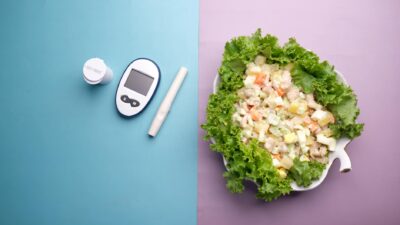
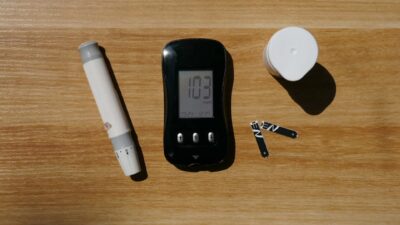
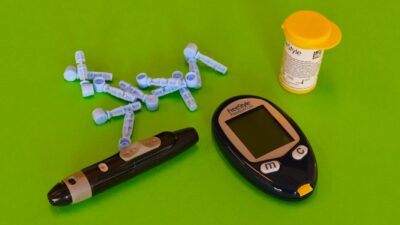
A true no-stick glucose meter — one that reads glucose through the skin with no insertion at all — does not exist at medical grade in 2026. What people mean by no-stick is typically a continuous glucose monitor (CGM): Dexcom G7, FreeStyle Libre 3, Abbott Lingo, or Dexcom Stelo. These use a small filament inserted under the skin once every 10 to 15 days and measure glucose every 1 to 5 minutes without additional finger pricks. Smart rings and watches advertising glucose monitoring are still in development and should not be used for medical decisions.
Three Very Different Things Marketed As “No-Stick”
| Type | How It Works | FDA Status | Accuracy |
|---|---|---|---|
| CGM with filament | Thin sensor inserted under skin; wireless reader | Cleared | 7–9% MARD |
| OTC CGM (Stelo, Lingo) | Same as above; sold without prescription | Cleared 2024 | 8–10% MARD |
| Infrared or optical sensors in watches/rings | Tries to read glucose through skin optically | Not cleared | Not validated |
| Saliva or tear glucose sensors | Samples non-blood fluid | Research only | Not validated |
| Breath analyzers | Detects acetone/VOCs correlated with ketones | Research / wellness claims | Not glucose specifically |
What CGMs Actually Feel Like
- Insertion is a brief, spring-loaded push — most users report “I barely felt it”
- Sensor filament is about the diameter of a human hair; it sits in the subcutaneous tissue, not muscle
- Once inserted, the sensor stays in place with adhesive for 10 to 15 days
- No daily finger pricks needed for most insulin-dosing decisions (some systems still require calibration for some models; Dexcom G7 and Libre 3 do not)
- Data transmits to a phone or reader every 1 to 5 minutes
The Main Options in the US Today
| Device | Maker | Wear Time | Access | Monthly Cost With Insurance |
|---|---|---|---|---|
| Dexcom G7 | Dexcom | 10 days + 12-hr grace | Prescription | $0–$100 |
| FreeStyle Libre 3 / Libre 3 Plus | Abbott | 14–15 days | Prescription | $0–$100 |
| Medtronic Guardian 4 / Simplera | Medtronic | 7 days | Prescription | $0–$150 |
| Dexcom Stelo | Dexcom | 15 days | OTC | $89 self-pay |
| Abbott Lingo | Abbott | 14 days | OTC | $89 self-pay |
| Eversense E3 | Senseonics | 6 months (implanted) | Prescription, in-office insertion | Variable |
Why True Non-Invasive Is So Hard
Blood glucose is typically 70 to 180 mg/dL, which is about 0.007 to 0.018 percent of body mass. Measuring something that dilute through skin without penetrating it requires distinguishing glucose from water, proteins, lipids, and many other compounds that absorb light at similar wavelengths. Optical approaches also have to contend with skin pigmentation, hydration state, temperature, and body-position-dependent blood flow. Decades of attempts — Pendra, GlucoWatch, Cygnus — have either failed to meet accuracy bars, caused skin reactions, or been withdrawn. Active development continues, but no device has cleared FDA as a non-invasive glucose meter.
CGM Accuracy vs Finger Stick
| Device | Published MARD | Notes |
|---|---|---|
| Dexcom G7 | 8.2% | No calibration needed |
| FreeStyle Libre 3 Plus | 7.9% | No calibration; 14-day wear |
| Medtronic Guardian 4 | 9.1–9.6% | Used with MiniMed 780G pump |
| Most OTC home meters | 10–15% | ISO 15197 standard |
| Lab plasma glucose | Reference (0%) | Gold standard |
CGMs meet or beat the accuracy of home finger-stick meters. The small lag between interstitial and plasma glucose is the main limitation — during rapid changes (meals, insulin injections, exercise), the CGM reading trails by 5 to 10 minutes. A finger stick is still a good confirmatory check when a reading does not match how you feel.
What to Consider Before Buying
- Do you have insurance coverage? Prescription CGMs are typically cheaper with insurance than OTC CGMs out of pocket.
- Wear-time preference: Libre 3 Plus at 15 days has a slight edge over G7 at 10 days
- Phone compatibility: check the manufacturer’s supported-phone list
- Pump integration: Omnipod 5 pairs with Dexcom G6 and G7; Tandem t:slim X2 pairs with Dexcom G7 and Libre 2 Plus; Medtronic 780G pairs with Guardian 4 and Simplera
- Alerts: most systems alert for low and high glucose — useful for hypoglycemia unawareness
- Data sharing: Dexcom Share, LibreView, etc., let family or clinicians see readings remotely
- Calibration: G7, Libre 3, Stelo, Lingo are factory-calibrated (no finger sticks needed)
Red Flags on “Non-Invasive” Products
- Sold only on Amazon, Alibaba, or Temu with no FDA clearance number
- Claims accuracy without citing clinical trial data
- Smart ring or smartwatch that displays a glucose number
- Price under $50 for a supposedly clinical-grade device
- No company address or clinical partner disclosed
- Uses unclear terms like “glucose wellness score” instead of a measured mg/dL value
Related Reading
See our guides on detection of prediabetes and our broader prediabetes 101 overview.
The Bottom Line
No-stick glucose monitoring means a continuous glucose monitor — Dexcom G7, FreeStyle Libre 3, Abbott Lingo, or Dexcom Stelo — which eliminates daily finger pricks once a small filament sensor is inserted every 10 to 15 days. Accuracy is comparable to or better than home meters. True non-invasive glucose measurement through the skin is still not FDA-cleared; smart rings and watches claiming glucose readings are not validated and should not replace a real meter or CGM. If you are newly considering CGM, start with a prescription device through your clinician to maximize insurance coverage; if you just want 2 weeks of readings to understand your glucose patterns, OTC Stelo or Lingo fill that niche well.