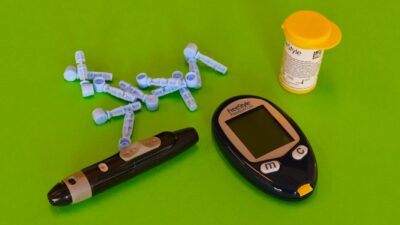
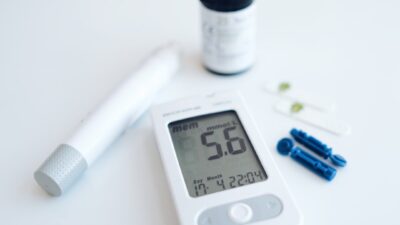
The Dexcom GMI (Glucose Management Indicator) is an estimated A1C calculated from CGM data using the formula GMI = 3.31 + 0.02392 × mean glucose in mg/dL over a minimum 14-day window. It is not a direct A1C measurement, but it closely tracks lab A1C (usually within 0.3 percentage points) and updates far faster — in 2 to 4 weeks vs 2 to 3 months for a laboratory A1C. GMI combined with time-in-range and glucose variability gives a complete glycemic picture that A1C alone cannot provide.
The Formula
GMI = 3.31 + 0.02392 × (mean CGM glucose in mg/dL)
Each 10 mg/dL change in mean glucose changes GMI by about 0.24 percentage points.
| Mean CGM Glucose (mg/dL) | GMI (Estimated A1C %) |
|---|---|
| 100 | 5.7% |
| 120 | 6.2% |
| 140 | 6.6% |
| 160 | 7.1% |
| 180 | 7.6% |
| 200 | 8.1% |
| 220 | 8.6% |
| 240 | 9.0% |
GMI vs A1C — How They Differ
| Feature | GMI | A1C |
|---|---|---|
| What is measured | CGM mean glucose | Glycated hemoglobin in blood |
| Time window | 14+ days (user-selectable) | ~90 days (red cell lifespan) |
| Source | Continuous glucose monitor | Venous blood draw, lab |
| Speed of response | 2–4 weeks | 8–12 weeks |
| Affected by anemia or hemoglobinopathy | No | Yes |
| Diagnostic use | Not diagnostic | Diagnostic if ≥ 6.5% |
| Gold-standard reference | No | Yes (with caveats) |
When GMI Is More Useful Than A1C
- Recent medication change: GMI responds in 2 to 4 weeks; A1C takes 3 months
- Anemia: iron-deficiency anemia can falsely elevate A1C; GMI is unaffected
- Hemoglobinopathies: sickle cell trait, thalassemia can distort A1C; GMI is reliable
- Kidney disease advanced: shortened red-cell survival can lower A1C; GMI is not affected
- Pregnancy: red cell turnover increases, A1C may underestimate glycemia; GMI and time-in-range are more useful
- Recent blood transfusion or significant blood loss: A1C is unreliable for 2 to 3 months; GMI is not affected
When A1C Is More Useful Than GMI
- Diagnosis: A1C is a diagnostic test; GMI is not
- Insurance and guideline tracking: most care guidelines and quality metrics rely on A1C
- Long-term average: 90 days is a more stable picture than 14 days
- Intermittent CGM wearers: if you only wear a CGM 14 days every 3 months, the GMI reflects only those 14 days, not the full quarter
Time-in-Range and GMI Together
GMI tells you the average; time-in-range (TIR) tells you how the average is distributed. Two patients with GMI 7.0 percent can have very different time-in-range:
- Patient A: consistently 140 mg/dL all day, TIR 90 percent — stable control
- Patient B: swings 50 to 250 mg/dL, TIR 45 percent — unstable, high hypo risk, high complication risk despite the same “average”
ADA targets: TIR in 70–180 mg/dL > 70 percent for most adults; > 80 percent for pregnancy. Time-below-range (under 70 mg/dL) should be under 4 percent. Coefficient of variation (CV) under 36 percent indicates stable glycemia.
How to Lower Your GMI
- Identify your high-glucose windows from the CGM graph — after specific meals, overnight, post-exercise lows followed by rebound
- Address the biggest contributor first — usually post-meal spikes
- Pre-meal insulin timing: inject 15 minutes before eating instead of at first bite
- Lower refined-carb content at meals; add protein and fiber
- If on insulin, review insulin-to-carb ratios and correction factors with your clinician
- If on GLP-1, confirm you are at therapeutic dose
- Regular activity — 10- to 20-minute walk after each meal dramatically reduces post-meal peak
- Adequate sleep — 7 hours minimum; poor sleep raises cortisol and morning glucose
- Treat underlying conditions — untreated sleep apnea, hypothyroidism, elevated cortisol, or depression all blunt glycemic efforts
Common Reasons GMI and A1C Do Not Match
- GMI higher than A1C: often reflects recent increase in glucose that has not yet shown in A1C; or anemia / hemoglobinopathy lowering A1C independent of glucose
- GMI lower than A1C: often reflects recent improvement not yet in A1C; or conditions that raise A1C independent of glucose (high cell lifespan, splenectomy)
- Very short CGM data: GMI computed over less than 14 days is less reliable; use at least 14 days, preferably 30
- Sensor compression lows (nighttime): artificially low overnight readings lower mean glucose and GMI without matching A1C
Related Reading
See our guides on A1C levels, detection of prediabetes, and prediabetes 101.
The Bottom Line
Dexcom GMI is an estimated A1C derived from CGM data — useful, fast-responding, and accurate within 0.3 percentage points of a lab A1C for most patients. It is not a replacement for A1C (A1C remains the diagnostic standard and what insurance and guidelines track), but GMI plus time-in-range and variability gives a much more actionable picture of glycemic control. Use GMI to see the effect of changes in 2 to 4 weeks, rather than waiting 3 months for an A1C; confirm periodically with a lab A1C to catch conditions that cause the two to diverge.