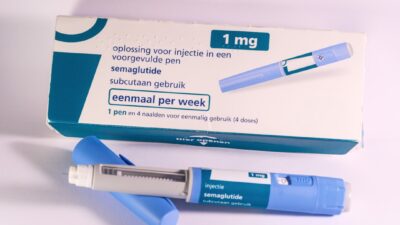
20 units of semaglutide on a U-100 insulin syringe equals 0.20 mL of volume — always. Units on an insulin syringe measure volume, not mass. The mg dose at 20 units depends entirely on your vial concentration: 0.5 mg at 2.5 mg/mL, 1.0 mg at 5 mg/mL, or 2.0 mg at 10 mg/mL. This unit-to-volume-to-mg relationship is the source of most compounded semaglutide dosing errors per FDA safety reports.
Understanding U-100 Insulin Syringes
“U-100” refers to a specific type of insulin syringe designed for U-100 insulin (insulin formulated at 100 units per mL). The marking system on these syringes is:
- 1 mL syringe = 100 units total capacity
- 0.5 mL syringe = 50 units total capacity
- 0.3 mL syringe = 30 units total capacity (often with half-unit markings)
Each tick mark on the syringe represents 1 unit of volume, which equals 0.01 mL. So:
- 20 units = 0.20 mL
- 40 units = 0.40 mL
- 50 units = 0.50 mL
- 100 units = 1.00 mL
These volume relationships are fixed by the syringe markings, independent of what liquid you are measuring.
The MG Conversion Depends on Concentration
To find the mg of semaglutide in 20 units, multiply concentration by volume:
| Vial Concentration | 20 units = mL | 20 units = MG | Typical Wegovy step |
|---|---|---|---|
| 1 mg/mL | 0.20 mL | 0.20 mg | Below starting dose |
| 2.5 mg/mL | 0.20 mL | 0.50 mg | Weeks 5-8 dose |
| 5 mg/mL | 0.20 mL | 1.0 mg | Weeks 9-12 dose |
| 10 mg/mL | 0.20 mL | 2.0 mg | Ozempic max dose |
Same syringe markings — vastly different mg doses. This is why concentration verification is so critical.
The Dangerous Misconception
The most dangerous misunderstanding is interpreting “20 units” as 20 mg directly. This would be:
- ~8 times the maximum Wegovy weight-loss dose (2.4 mg)
- ~10 times the maximum Ozempic diabetes dose (2.0 mg)
If you drew up 20 mL of semaglutide solution (the volume that would actually hold 20 mg at standard concentrations), it would be more volume than most insulin syringes can hold. The conceptual error usually presents in someone seeing “20” on a label and assuming it’s mg without checking the syringe markings.
Practical Implications for Your Dose
If your prescriber tells you “take 20 units” you need to know what concentration your vial is at to interpret this correctly. A safer instruction includes both: “take 20 units (0.5 mg) at 2.5 mg/mL concentration.”
If your prescriber tells you “take 0.5 mg” and your vial is at 2.5 mg/mL, you draw 20 units. If your vial is at 5 mg/mL, you draw 10 units. Always do the math fresh for each refill.
How to Verify Your Concentration
Read your vial label carefully. The concentration is typically printed clearly, often near the drug name:
- “Semaglutide 2.5 mg/mL”
- “Semaglutide 5 mg/mL”
- “Semaglutide 10 mg/mL with cyanocobalamin”
Some compounded products list total mg per vial AND volume (e.g., “5 mg / 2 mL”). To calculate concentration, divide: 5 mg ÷ 2 mL = 2.5 mg/mL.
If the label is unclear, contact your pharmacy before injecting. Don’t guess.
What If You Need 20 MG, Not 20 Units?
The maximum approved semaglutide dose is 2.4 mg (Wegovy maintenance). A 20 mg dose would be far above any approved or safe dose and should never be injected. If a prescription or instruction says “20 mg semaglutide,” verify with the prescriber before doing anything — this is almost certainly a typo or transcription error.
Common 20-Unit Scenarios
| Scenario | Concentration | MG dose |
|---|---|---|
| Starting Wegovy titration (compounded) | 2.5 mg/mL | 0.5 mg (week 5-8) |
| Mid Wegovy titration (compounded) | 5 mg/mL | 1.0 mg (week 9-12) |
| Compounded semaglutide for diabetes | 2.5 mg/mL | 0.5 mg (Ozempic week 5-8 equivalent) |
The Bottom Line
20 units of semaglutide on a U-100 insulin syringe is always 0.20 mL — units measure volume, not mass. The mg dose at 20 units depends on the vial concentration: 0.5 mg at 2.5 mg/mL, 1.0 mg at 5 mg/mL, or 2.0 mg at 10 mg/mL. Always verify concentration before calculating mg from units. Never interpret “20 units” as “20 mg” — that would be a massive overdose. Brand-name pens eliminate this math by delivering pre-measured doses. Consult your prescriber and pharmacist for any dose questions. For more on GLP-1 treatment options, see our hub.