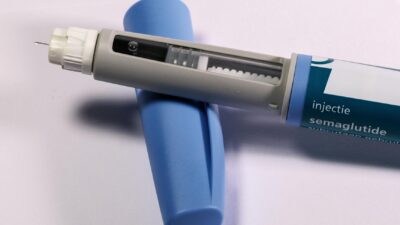
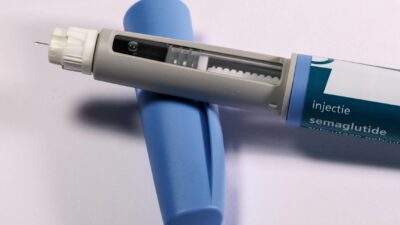
Semaglutide at the 5 mg per milliliter concentration is a high-strength compounded formulation. Each unit on a standard U-100 insulin syringe delivers 0.05 mg of semaglutide, so the standard weight-loss titration doses translate to small unit counts: 5 units for the 0.25 mg starting dose, up to 48 units for the 2.4 mg maintenance dose. The chart below covers every dose in the standard weight-loss and diabetes titration schedules.
Quick Reference: Standard Doses at 5 mg/mL
| Dose (mg) | Volume (mL) | Units on U-100 syringe | Typical week / phase |
|---|---|---|---|
| 0.25 mg | 0.05 mL | 5 units | Weeks 1-4 (start) |
| 0.50 mg | 0.10 mL | 10 units | Weeks 5-8 |
| 1.0 mg | 0.20 mL | 20 units | Weeks 9-12 |
| 1.7 mg | 0.34 mL | 34 units | Weeks 13-16 (Wegovy) |
| 2.0 mg | 0.40 mL | 40 units | Ozempic max |
| 2.4 mg | 0.48 mL | 48 units | Wegovy maintenance |
Intermediate Doses (Sub-Standard Titration)
Some prescribers use finer titration steps to minimize side effects. Here are common intermediate doses:
| Dose (mg) | Volume (mL) | Units |
|---|---|---|
| 0.125 mg | 0.025 mL | 2.5 units |
| 0.375 mg | 0.075 mL | 7.5 units |
| 0.625 mg | 0.125 mL | 12.5 units |
| 0.75 mg | 0.15 mL | 15 units |
| 1.5 mg | 0.30 mL | 30 units |
| 2.25 mg | 0.45 mL | 45 units |
Half-unit measurements (2.5, 7.5, 12.5) require a 0.3 mL low-dose insulin syringe with half-unit markings. Standard 1 mL U-100 syringes typically have only whole-unit markings.
How to Read a U-100 Insulin Syringe
A U-100 insulin syringe has tick marks at every 2 units (sometimes every 1 unit on 0.3 mL pediatric syringes). To draw up 5 units of 5 mg/mL semaglutide:
- Pull the plunger to the 5-unit mark while the needle is in air
- Insert needle into the rubber stopper of the vial
- Push the plunger down to inject air into the vial
- Invert the vial and slowly pull the plunger back to the 5-unit mark while keeping the needle below the liquid surface
- Tap to remove any air bubbles, then adjust to exactly 5 units
- Withdraw needle, prepare injection site, inject subcutaneously
Why 5 mg/mL Requires Extra Care
The higher concentration amplifies the consequences of any measurement error:
- 1-unit measurement error at 5 mg/mL = 0.05 mg dose difference (versus 0.025 mg at 2.5 mg/mL)
- 5-unit error at 5 mg/mL = 0.25 mg = a full titration step
- Pulling 10 units instead of 5 = doubling your starting dose
This is why FDA safety reports about compounded semaglutide overdoses often involve higher-concentration vials. Beginners or anyone uncertain about measurement may prefer the lower 2.5 mg/mL concentration, where small errors have smaller consequences.
Vial Stability and Storage
Compounded semaglutide at 5 mg/mL typically:
- Requires refrigeration (36-46°F / 2-8°C)
- Has 4-6 weeks stability after reconstitution at refrigerator temperature
- Can sit at room temperature for short periods (typically up to a few hours) during injection prep
- Should not be frozen — freezing damages the peptide
- Should be discarded if cloudy, discolored, or past the expiration date your pharmacy provides
Storage requirements vary by formulation; always follow the instructions provided by your compounding pharmacy.
Switching From 2.5 mg/mL to 5 mg/mL
If your pharmacy changes your vial concentration, recalculate your dose. The number of units to inject changes:
- If you were taking 40 units at 2.5 mg/mL (= 1.0 mg), you now take 20 units at 5 mg/mL (= 1.0 mg)
- If you were taking 96 units at 2.5 mg/mL (= 2.4 mg), you now take 48 units at 5 mg/mL (= 2.4 mg)
The mg dose stays the same; the unit count is halved when concentration doubles.
FDA Safety Reminders
Compounded semaglutide is not FDA-reviewed for safety or efficacy. The FDA has documented dosing errors, contamination issues, and unsafe additives in some compounded products. If you use compounded semaglutide:
- Verify the compounding pharmacy is licensed in your state
- Always check the concentration printed on the label
- Use the syringe type your pharmacy specifies
- Report adverse events to FDA MedWatch
- Consult your prescriber before any dose changes
The Bottom Line
At 5 mg/mL concentration, the standard weight-loss titration runs from 5 units (0.25 mg) to 48 units (2.4 mg). Each unit delivers 0.05 mg, so dosing errors have larger consequences than at lower concentrations. Always verify the concentration on your specific vial, use the appropriate U-100 insulin syringe, and double-check the math before each injection. Consult your prescriber for any dose changes and your pharmacist for vial-specific guidance. For more on GLP-1 treatment options, see our hub.