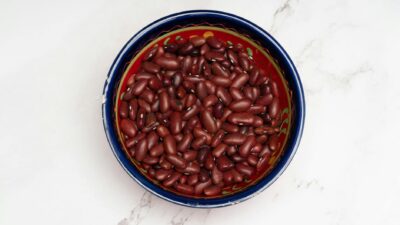
Why do beans spike my blood sugar when everyone says they have a low glycemic index? The answer comes down to four factors most people overlook: portion size (1 cup of beans has 20 to 30 grams of carbs), canned vs home-cooked (canned beans are softer and digest faster), pairing (beans with rice or bread doubles the carb load), and personal physiology (glucose response to identical foods varies dramatically between individuals). Beans really do have a low GI — most fall between 25 and 40 — but a low GI does not mean zero glucose impact, and the way you prepare and eat them matters as much as the type.
The Numbers: GI, GL, and Carb Load
| Bean | GI | Carbs per 1 cup cooked (g) | Fiber (g) | Net Carbs (g) | GL | Protein (g) |
|---|---|---|---|---|---|---|
| Black beans | 30 | 40 | 15 | 25 | 7-8 | 15 |
| Kidney beans | 24 | 40 | 13 | 27 | 6-7 | 15 |
| Pinto beans | 33 | 45 | 15 | 30 | 10 | 15 |
| Chickpeas (garbanzo) | 28 | 45 | 13 | 32 | 9 | 15 |
| Lentils (brown/green) | 29 | 40 | 16 | 24 | 7 | 18 |
| Lentils (red) | 26 | 38 | 16 | 22 | 5-6 | 17 |
| Navy beans | 31 | 47 | 19 | 28 | 9 | 15 |
| Baked beans (canned, sweetened) | 40-48 | 54 | 10 | 44 | 17-21 | 13 |
| Refried beans (canned) | 38-44 | 45 | 14 | 31 | 12-14 | 14 |
Reason 1: Portion Size
Glycemic index is a relative measure normalized to 50 grams of available carbs. It does not account for how much you actually eat. A 1 cup serving of cooked black beans has 25 to 27 grams of net carbs — about the same as a slice of bread plus a small apple. People often serve themselves 1.5 to 2 cups of beans (especially in chili, burrito bowls, or bean salads), which pushes total carbs to 40 to 60 grams.
- 1/2 cup cooked beans: 12 to 15 g net carbs — minimal spike for most
- 1 cup cooked beans: 25 to 30 g net carbs — meaningful glucose rise
- 1.5 cups cooked beans: 38 to 45 g net carbs — significant rise in many people
- 2 cups cooked beans: 50 to 60 g net carbs — often a 60 to 100 mg/dL spike
Reason 2: Canned vs Dried, Soft vs Al Dente
Canned beans are cooked at high temperatures (240 to 250 degrees F) under pressure for 60 to 90 minutes during canning. The result is much softer beans with more thoroughly gelatinized starch. Home-cooked dried beans simmered until tender but still holding their shape have a tighter cell structure and slower digestion.
- Canned beans (drained and rinsed): moderate GI, faster glucose response
- Canned in sauce (baked beans, chili beans): often has added sugar; highest glucose response
- Home-cooked dried beans (firm to al dente): lowest GI, slowest glucose response
- Home-cooked dried beans (soft): moderate response
- Refried beans: mashed and often cooked with lard or oil; faster glucose absorption
Reason 3: What You Pair Them With
The classic “beans and rice” combination doubles the carb load of either food alone. Other common high-carb pairings include:
| Meal | Total Net Carbs | Typical Spike |
|---|---|---|
| 1 cup black beans alone | 25 g | 20 to 40 mg/dL |
| 1 cup black beans + 1 cup white rice | 70 g | 50 to 90 mg/dL |
| 1 cup chili + cornbread | 55 g | 50 to 80 mg/dL |
| Burrito bowl (beans + rice + corn + tortilla) | 90+ g | 80 to 120 mg/dL |
| 1/2 cup beans + leafy salad + olive oil | 15 g | 10 to 25 mg/dL |
| 3/4 cup beans + grilled chicken + non-starchy veg | 18 g | 15 to 30 mg/dL |
Reason 4: The Delayed Curve from Resistant Starch
Beans contain a high proportion of resistant starch and slowly digestible carbs. Roughly 30 to 40 percent of bean carbs are not absorbed in the small intestine — they ferment in the colon. The starch that is absorbed digests slowly. This produces a glucose curve that often peaks at 90 to 180 minutes rather than the typical 45 to 60 minutes after a refined carb meal. If you only test at 1 hour, you may miss the peak; if you only test at 2 hours, you may catch it on the way down. A continuous glucose monitor reveals the full pattern.
Reason 5: Personal Variability
A landmark 2015 study published in Cell tracked glucose responses to identical foods in 800 people. Glucose response to the same food varied dramatically — one person might spike 70 mg/dL from beans while another spikes only 15 mg/dL. The drivers include:
- Gut microbiome composition (especially bacteria that ferment resistant starch)
- Time of day (insulin sensitivity is higher in the morning for most)
- Sleep quality the previous night
- Stress and cortisol levels
- Recent exercise
- Genetic factors
Your friend may eat 1.5 cups of black beans with rice and stay flat; you may spike 70 mg/dL from the same meal. This is not unusual.
Practical Strategies to Eat Beans Without Spikes
- Keep portion to 1/2 to 3/4 cup cooked: the sweet spot for most people.
- Cook your own dried beans al dente: firmer texture, slower digestion.
- Drain and rinse canned beans: removes some soluble starch and sodium; lowers the glycemic response.
- Avoid bean + rice + bread combos: pick one starch, not three.
- Pair with olive oil, avocado, or nuts: fat slows digestion.
- Add vinegar or lemon juice: a tablespoon in dressing or salsa lowers the glucose response 15 to 25 percent.
- Add non-starchy vegetables: bell peppers, onions, leafy greens — volume without carbs.
- Walk after the meal: 10 to 20 minutes of walking lowers the peak by 20 to 30 percent.
- Skip the bean-based desserts: bean-flour brownies and sweetened baked beans can spike like cake.
When Beans Are Genuinely a Good Choice
Despite the spike potential, beans remain one of the most evidence-supported foods for long-term metabolic health:
- High fiber improves insulin sensitivity over weeks to months.
- Plant protein supports lean mass without saturated fat.
- Magnesium, folate, and potassium content are excellent.
- Resistant starch feeds beneficial gut bacteria.
- Large prospective studies link 3 to 4 servings per week of legumes to lower A1c and lower diabetes incidence.
Personal Response Testing
- Test 1 cup of black beans alone at 30, 60, 90, 120, and 180 minutes — the peak is often later than you expect.
- Compare canned (drained and rinsed) vs home-cooked dried at the same portion.
- Compare beans alone vs beans + rice — the difference can be 30 to 50 mg/dL.
- Try the same beans with added olive oil and vinegar — typically 20 to 30 percent lower peak.
Related Reading
See our broader guides on diet-and-nutrition, do beans raise blood sugar, and beans glycemic index.
For additional reading, the American Diabetes Association recommends legumes as a cornerstone of healthy carbohydrate intake, and the CDC diabetes resources describe beans as a high-fiber, blood-sugar-friendly carbohydrate when portioned appropriately.
The Bottom Line
Beans have a genuinely low glycemic index, but a low GI does not mean zero glucose impact. The most common reasons beans spike blood sugar are oversized portions, canned vs home-cooked preparation, pairing with rice or bread, and individual variability. Keep portions to 1/2 to 3/4 cup cooked, cook dried beans al dente when possible, pair with vegetables and a fat source rather than another starch, and use a CGM or finger stick to learn your personal pattern. Beans remain one of the most metabolically beneficial foods you can eat — just not in unlimited quantity.