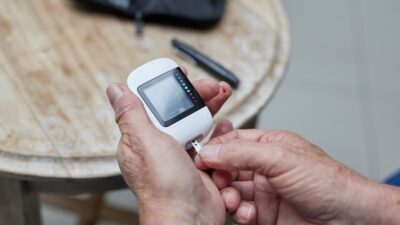
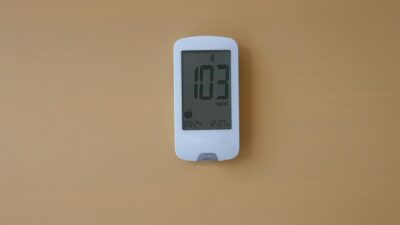
CGM is the medical abbreviation for continuous glucose monitor. A CGM is a wearable sensor that measures glucose in the interstitial fluid under the skin and sends a new reading every one to five minutes to a smartphone or receiver, giving you a near-continuous picture of your blood sugar.
What CGM Stands For in Clinical Settings
In clinical notes, device labeling, and peer-reviewed journals, “CGM” refers to a continuous glucose monitoring system. Some clinicians also write “rtCGM” for real-time CGM and “isCGM” for intermittently scanned CGM (also called flash glucose monitoring). All three share the same core abbreviation root and the same basic purpose: track glucose across hours, days, and weeks rather than at a single moment.
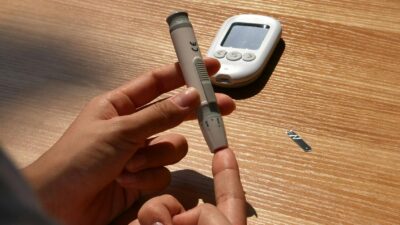
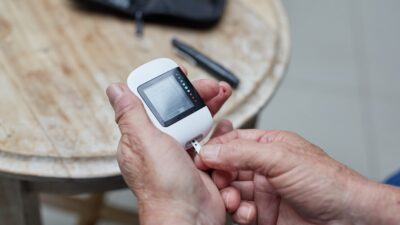
The abbreviation shows up on referrals, pharmacy orders, diabetes education materials, and in the electronic medical record. When a provider writes “start CGM” or “review CGM data,” they mean a wearable continuous glucose monitoring device. It is distinct from “SMBG” (self-monitored blood glucose) on a finger-stick meter and from “HbA1c,” which estimates average glucose over about three months.
How a Continuous Glucose Monitor Works
A CGM has three parts: a small sensor with a hair-thin filament inserted just under the skin, a transmitter that sits on top of the sensor, and a display on a phone app or dedicated receiver. The filament sits in the interstitial fluid, where it measures glucose using a glucose-oxidase or similar enzymatic reaction. That signal is converted into a glucose value and transmitted to the display.
Sensors are typically worn on the back of the upper arm or abdomen and last 7 to 15 days depending on the brand. Most modern systems are “factory calibrated,” meaning you no longer need daily finger sticks to calibrate the device. Alerts notify you when glucose is rising or falling fast or when values drift outside a target range you set with your clinician.
Common CGM Devices You May See Referenced
| Device | Manufacturer | Wear Time | Reading Interval |
|---|---|---|---|
| Dexcom G7 | Dexcom | Up to 10 days | Every 5 minutes |
| FreeStyle Libre 3 | Abbott | Up to 14 days | Every 1 minute |
| Stelo (OTC) | Dexcom | Up to 15 days | Every 15 minutes (display) |
| Eversense E3 | Senseonics | Up to 180 days (implanted) | Every 5 minutes |
Each system has its own app, alert options, and data-sharing features. Your clinician or a certified diabetes care and education specialist (CDCES) can help match a device to your needs.
How Accurate Are CGM Readings?
Accuracy is usually described using mean absolute relative difference (MARD). Current FDA-cleared CGMs report a MARD of roughly 8 to 10 percent against a lab reference, meaning most readings are within about 10 percent of a lab glucose value. That is generally accurate enough for treatment decisions in non-critical settings, and the most recent A1C guidelines and ADA Standards of Care recognize CGM data as valid for diabetes management.
There is a normal 5 to 15 minute lag between interstitial glucose and blood glucose, so CGM values can trail a rapidly rising or falling blood sugar. If a reading does not match how you feel, confirm with a finger-stick meter and contact your care team if symptoms persist.
When Clinicians Recommend a CGM
The American Diabetes Association recommends CGM for all adults with type 1 diabetes and for adults with type 2 diabetes on intensive insulin therapy. CGMs are also often suggested for people on basal insulin, pregnant people with diabetes, and those with frequent hypoglycemia or hypoglycemia unawareness. Some clinicians prescribe short-term “professional” CGM wear for people with prediabetes who want to see how specific foods and activity affect their glucose.
Since the FDA cleared the first over-the-counter CGM in 2024, people without diabetes have also started wearing them for lifestyle insights. The current ADA Standards of Care do not yet endorse routine CGM use in people without any form of dysglycemia. A conversation with your clinician is the right starting point.
How to Use CGM Data Alongside Diet and Activity
CGM data is most useful when you can connect patterns to behavior. Many people combine their CGM with attention to diet and physical activity, looking at how specific meals, sleep, stress, and exercise affect glucose curves. Standard CGM metrics include time in range (TIR), time above range (TAR), time below range (TBR), and the glucose management indicator (GMI), which approximates A1C from CGM data.
Work with your clinician on what TIR target is realistic for you. Do not adjust insulin doses based on CGM alone without guidance; rapid changes in interstitial glucose and occasional sensor errors can mislead you. Treat the device as a pattern-spotting tool that complements, not replaces, clinical judgment.
The Bottom Line
CGM is the medical abbreviation for continuous glucose monitor. It describes a wearable sensor that tracks interstitial glucose every few minutes and streams readings to a phone or receiver. Modern devices are accurate enough to guide diabetes management, are increasingly available over the counter, and are endorsed by the ADA for people using insulin. Ask your clinician whether a CGM is right for your situation before buying one.
Medical disclaimer: This article is for educational purposes only and does not replace medical advice. Always consult a qualified healthcare provider before starting, stopping, or changing any medical device or therapy.