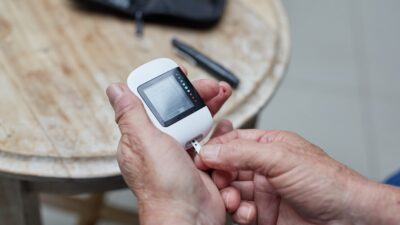
There is no FDA-approved non invasive glucose monitor as of 2024. Every continuous glucose monitor cleared for use in the United States still requires a small sensor under the skin. If you see a smartwatch, ring, or patch advertised as “non-invasive blood glucose monitoring,” the FDA has issued public warnings against relying on those devices.
What “Non-Invasive” Actually Means for Glucose Monitors
In medical device language, a truly non-invasive monitor reads a measurement through intact skin without needles, filaments, or blood samples. Pulse oximeters that measure oxygen saturation by shining light through a fingertip are a common example. A non-invasive glucose monitor would work similarly, reporting blood sugar without piercing the skin or drawing blood at any step.
The FDA’s 2024 safety communication states clearly that the agency has not authorized any smartwatch or smart ring to measure blood glucose directly. Devices that pair with a CGM and display its data are different; they are receivers, not standalone monitors.
How Current FDA-Cleared Monitors Work
The devices most often called “non-invasive” in consumer advertising are actually minimally invasive continuous glucose monitors. A CGM has a flexible filament the width of a hair that sits in the interstitial fluid just below the skin. The filament measures glucose using an enzymatic reaction and sends data to a transmitter, which relays it to a phone or receiver every one to five minutes.
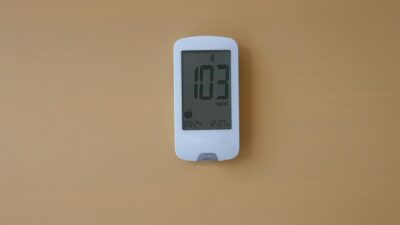
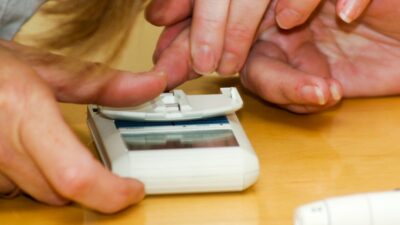
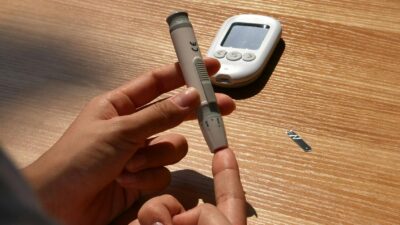
Finger-stick glucometers remain the other widely used technology. They require a lancet to draw a small drop of capillary blood. Both CGMs and finger-stick meters break the skin briefly, but neither requires a venous blood draw for routine use.
Devices Marketed as Non-Invasive vs. Reality
| Product Claim | FDA Status | What It Actually Does |
|---|---|---|
| Smartwatch measuring glucose | Not authorized | No validated glucose sensor; FDA warns against use |
| Smart ring tracking blood sugar | Not authorized | Same limitation; no cleared optical glucose sensor |
| FreeStyle Libre 3 / Dexcom G7 | FDA cleared | Minimally invasive sensor under the skin |
| Eversense E3 implant | FDA cleared | Implanted sensor, professionally inserted |
The table illustrates why language matters. “Continuous” and “wearable” are real, but “non-invasive” is not yet achievable with an approved consumer device.
What Is in Research and Development
Several technologies are in active research. Optical approaches use near-infrared, mid-infrared, or Raman spectroscopy to identify the glucose molecule’s signature through the skin. Electromagnetic sensors test how radio frequencies pass through tissue. Other groups are studying sweat, tears, or saliva as alternative body fluids. Each method has hit problems with accuracy, drift over time, or interference from hydration and temperature.
Until one of these technologies clears rigorous FDA accuracy standards, the clinical community continues to recommend validated CGMs or finger-stick meters. Research prototypes published in peer-reviewed journals are not the same as a device you can buy.
Safety Risks of Unapproved “Non-Invasive” Devices
Using an unapproved device to guide insulin dosing, medication changes, or dietary decisions is dangerous. An incorrect reading could miss a severe low or falsely reassure you during a dangerous high. This is especially risky for people with type 1 diabetes or anyone who takes insulin, but even people with prediabetes or type 2 diabetes should not make treatment decisions on uncleared data.
If a device looks too good to be true, check the FDA’s device database and the manufacturer’s 510(k) clearance or De Novo decision before purchase. Reputable sellers will publish a clearance number and link to the FDA summary.
How to Choose a Real Continuous Glucose Monitor
If your goal is frequent glucose data without repeated finger sticks, an FDA-cleared CGM is the current best option. Dexcom G7 and FreeStyle Libre 3 are the two most common prescription systems. Stelo, cleared in 2024 for over-the-counter use by adults not on insulin, is the first CGM available without a prescription in the U.S. None is fully non-invasive, but sensor insertion is brief and wear time now reaches 10 to 15 days.
Factors to weigh include A1C goals, insurance coverage, alert features, app compatibility, and whether you want share features for a family member or clinician. Discuss options with your clinician or a certified diabetes care and education specialist before purchase.
The Bottom Line
A truly non-invasive glucose monitor does not yet exist in an FDA-approved form. Minimally invasive CGMs are the closest option and are now accurate enough to guide diabetes care for many people. Do not rely on smartwatches or rings that claim to measure glucose through the skin. Work with a licensed clinician to pick a cleared device that fits your needs, and report misleading products to the FDA.
Medical disclaimer: This article is for educational purposes only and does not replace medical advice. Always consult a qualified healthcare provider before starting, stopping, or changing any medical device or therapy.