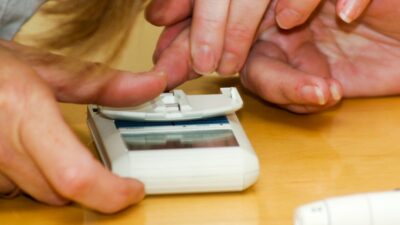
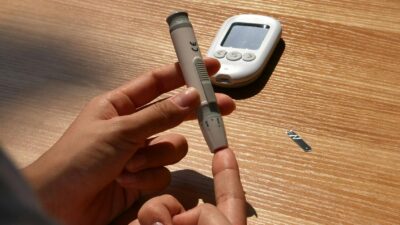
A no prick glucose monitor refers to a continuous glucose monitor (CGM), a small wearable that replaces most fingersticks by reading glucose in interstitial fluid through a thin under-skin filament. True fingerstick-free devices still involve a tiny filament that stays in for 10 to 15 days. Fully non-invasive glucose monitors, meaning no skin penetration at all, have not yet been approved by the FDA.
What “No Prick” Actually Means
“No prick” usually means no daily fingerstick. A CGM is applied once every 10 to 15 days, using an applicator that inserts a soft filament about the thickness of a hair just under the skin. Insertion is nearly painless for most users. Once the sensor is running, glucose readings stream to a smartphone or receiver every 1 to 15 minutes. Fully non-invasive glucose monitoring using light, heat, or sweat has been researched for two decades but is not yet reliable or approved for medical decision-making. Rumors of glucose monitoring via smart watches or rings are not accurate as of 2025.
Available Devices in 2025
| Device | Wear Time | Reading Frequency | Prescription Needed? |
|---|---|---|---|
| Dexcom G7 | 10 days | Every 5 minutes | Yes |
| Dexcom Stelo | 15 days | Every 15 minutes | No (OTC, adults without insulin) |
| FreeStyle Libre 3 | 14 days | Every 1 minute | Yes |
| Abbott Lingo | 14 days | Every 1 minute | No (OTC, adults without insulin) |
| Medtronic Guardian 4 | 7 days | Every 5 minutes | Yes |
How a CGM Actually Measures Glucose
The filament sits in interstitial fluid, the fluid between cells. A small enzyme on the sensor reacts with glucose, generating a tiny electrical current proportional to the concentration. An algorithm converts that signal into a reading calibrated against blood glucose. Because interstitial glucose lags behind blood glucose by about 5 to 15 minutes, CGM readings during a fast rise (after a sugary meal) or a fast drop (after insulin or intense exercise) may differ noticeably from a simultaneous fingerstick.
Accuracy in Plain Numbers
Manufacturers report mean absolute relative difference (MARD) between about 8 and 10 percent for current-generation sensors compared with lab blood glucose. That means a reading of 120 mg/dL could reflect actual blood glucose anywhere roughly between 108 and 132. Accuracy drops at the extremes, in the first day of wear, and during rapid change. The American Diabetes Association notes that CGMs are acceptable for most daily decisions but should be confirmed with a fingerstick when values do not match symptoms.
Who Benefits Most
- People with type 1 diabetes, where fingersticks can exceed 4 to 8 daily
- People with insulin-treated type 2 diabetes
- Adults with prediabetes who want to see food effects on glucose
- People with hypoglycemia unawareness (with clinician guidance)
- Athletes or metabolic-curious adults using OTC options
Because prediabetes is reversible for most adults with structured lifestyle change, CGM data can serve as a motivator rather than a diagnosis tool.
Common Situations You Still Need a Fingerstick
- The reading conflicts with clear symptoms (shakiness, sweating, confusion)
- First warm-up hour of a new sensor
- Very low readings below 70 mg/dL that need confirmation
- Rapidly changing glucose with active dosing of insulin
- Suspected sensor compression artifact from sleeping on the device
Wear and Care Tips
- Place the sensor on clean, dry skin on the back of the upper arm or abdomen
- Let the adhesive set for 10 minutes before activity
- Use a sensor overlay patch for sweat, water, or exercise
- Avoid lying directly on the sensor at night to reduce compression lows
- Follow the manufacturer’s calibration instructions if your device requires any
Compare options in our broader treatment overview and pair insights with nutrition strategies for better results.
What to Do With the Data
A CGM tells a story across days, not single snapshots. Useful metrics include time in range (typically 70-180 mg/dL for diabetes or 70-140 mg/dL for non-diabetics), daily average glucose, and glucose variability (standard deviation). A glucose management indicator (GMI) approximates A1C from 14 days of CGM data. Those numbers are most actionable when shared with your clinician during routine visits.
The Bottom Line
A no prick glucose monitor eliminates daily fingersticks by using a small under-skin sensor that reads glucose every few minutes for 10 to 15 days. Fully non-invasive devices do not yet exist at clinical quality. Current CGMs are excellent for seeing trends and food impacts, but accuracy limits mean fingersticks still have a role. Choose based on insurance, wear preferences, and your clinician’s guidance.
Medical Disclaimer: This article is educational. Discuss CGM choices and glucose trends with a licensed clinician before changing treatment.