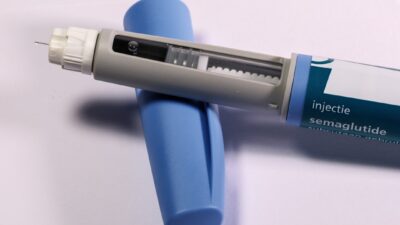
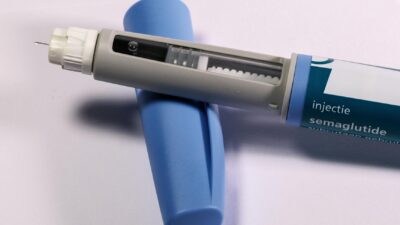
Semaglutide reaches peak blood levels 1-3 days after your first injection and starts reducing appetite within the first week. Meaningful weight loss usually appears within 4-12 weeks, and full A1C reduction takes 8-12 weeks at therapeutic doses. Because the drug requires a 16-week dose escalation period (for weight loss formulations), full effect is not reached until at least week 17. Individual response varies widely; some people see dramatic results in the first month, others see slower onset.
Phase 1: Days 1-7 (Appetite Reduction Starts)
After your first 0.25 mg starting dose, semaglutide reaches peak blood levels in 1-3 days. The drug crosses into brain regions that regulate hunger and starts signaling fullness through GLP-1 receptors. Most people report reduced appetite, smaller meal portions, and earlier satiety within the first 3-7 days.
Some people also notice food preference changes (sweet foods less appealing, alcohol less enjoyable) and reduced “food noise” — the constant background thoughts about food. These effects are subjective and not universal.
Side effects (nausea, mild GI upset) often appear in this same window, peaking 1-2 days after the injection.
Phase 2: Weeks 1-4 (Initial Weight Loss)
At the 0.25 mg starting dose, weight loss is modest — average 1-3 pounds in the first month. This early loss is primarily appetite-driven: you’re eating less without forcing it. Some loss may also be water weight as glycogen stores deplete with reduced carbohydrate intake.
A1C and fasting glucose start to drop in people with diabetes during this phase, though the changes are still building toward steady-state.
Phase 3: Weeks 4-16 (Dose Escalation)
The 16-week titration schedule for Wegovy increases the dose every 4 weeks (0.25, 0.5, 1, 1.7, then 2.4 mg). Each dose increase produces a renewed wave of appetite suppression and often a renewed wave of side effects.
By week 12, the average STEP-1 trial participant had lost about 6 percent of body weight on the path to higher doses. The average participant was not yet at the 2.4 mg maintenance dose at this point.
Phase 4: Weeks 17-68 (Maintenance Dose)
Once at the 2.4 mg maintenance dose, the drug reaches steady-state blood levels and maximum effect. Weight loss continues at a roughly linear rate for the next several months, then begins to plateau as the body adapts.
The STEP-1 trial showed average weight loss timelines at 2.4 mg:
| Week | Average Body Weight Lost |
|---|---|
| 12 | ~6% |
| 20 | ~10% |
| 36 | ~13% |
| 52 | ~14% |
| 68 | ~15% |
For Diabetes (Ozempic) Timeline
The diabetes dose escalation is faster — 0.25 mg for 4 weeks, then 0.5 mg for 4 weeks, then optional 1 mg or 2 mg. Full A1C effect typically appears by week 12-16 at the maintenance dose. Average A1C reduction is about 1.5-2 percentage points at the 1 mg dose.
Fasting glucose drops within the first week as the drug starts working; A1C lags because the test reflects average blood sugar over the prior 2-3 months.
Pharmacokinetics: Why It Takes Time
Semaglutide has a half-life of about 7 days. With weekly dosing, blood levels accumulate to steady state over approximately 5 weeks (4-5 half-lives). Until steady state, each weekly dose adds incrementally to total exposure.
This means even at a higher dose, the drug takes about 5 weeks to reach its full blood concentration. The body then adapts to the steady-state level over additional weeks, producing maximum appetite suppression and metabolic effects.
Why Individual Responses Vary
Several factors influence how quickly you’ll see results:
- Starting weight and metabolic profile: people with more weight to lose often see faster initial loss
- Dietary patterns: high-calorie liquids and snacking despite no hunger blunt the appetite-reduction effect
- Exercise: regular physical activity amplifies weight loss
- Sleep and stress: poor sleep raises cortisol and hunger hormones, working against the drug
- Genetics: some people are stronger or weaker responders for reasons not fully understood
- Comorbidities: hypothyroidism, PCOS, and certain medications can slow weight loss independent of semaglutide
About 14 percent of STEP-1 trial participants did not reach 5 percent weight loss at any point in 68 weeks. These “non-responders” exist for reasons not yet well characterized.
When to Reassess
Most prescribers reassess at three milestones:
- Week 4-8: tolerability — are side effects manageable enough to continue titration?
- Week 16-20: early efficacy — at maintenance dose, is weight loss progressing?
- Week 52: long-term efficacy — total weight loss meaningful enough to continue indefinitely?
If you’ve been at the 2.4 mg maintenance dose for 12-16 weeks without meaningful weight loss, your prescriber may discuss switching to tirzepatide or adding adjunct therapies. For diabetes, A1C should drop within 3 months at the 1 mg dose; if not, a dose increase to 2 mg or adding another agent is typically considered.
The Bottom Line
Semaglutide starts affecting appetite within days but takes weeks to produce meaningful weight loss and A1C reduction. The 16-week dose escalation schedule for weight loss means full effect doesn’t appear until at least week 17. Average weight loss is about 6 percent at week 12, 10 percent at week 20, and 15 percent at week 68 on the 2.4 mg maintenance dose. Individual responses vary widely; if you’ve been at maintenance for 12-16 weeks without response, talk to your prescriber. For more on treatment options, see our hub.