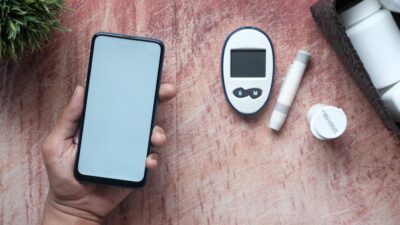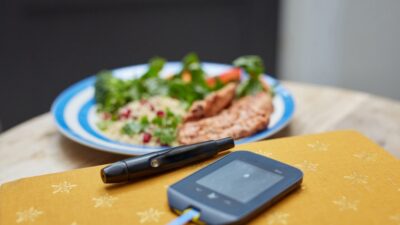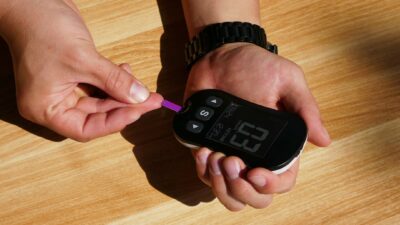
No — you cannot accurately check blood sugar with a phone camera in 2026. There is no FDA-cleared app or device that uses a smartphone camera to measure blood glucose, and the FDA has explicitly warned consumers not to trust any smartwatch, ring, or app that claims to do so noninvasively. The physics of light, skin, and glucose chemistry don’t allow it with current consumer hardware.
That doesn’t mean you’re stuck with fingersticks. Legitimate noninvasive and minimally invasive options exist — they just don’t rely on your phone’s camera. This guide explains why the camera myth persists, how to spot the scams, and what actually works if you want to monitor glucose without daily lancets.
Why the Idea Exists
The promise is appealing: open an app, point your phone’s camera or flash at your finger, and get a glucose reading. That convenience would transform diabetes care. Over the last decade, several startups have pitched versions of this idea — some claiming to analyze photoplethysmography (PPG) signals from the fingertip, others claiming AI can infer glucose from subtle skin-color changes.
None of those approaches have produced a device or app that meets FDA accuracy standards for glucose monitoring. The research continues, but nothing on the consumer market today delivers it.
The Physics Problem
Blood glucose sits at roughly 1 gram per liter (100 mg/dL) in the bloodstream. To detect it noninvasively you need to:
- Get light deep enough through skin to reach blood vessels.
- Use wavelengths that interact specifically with glucose — typically mid-infrared or Raman.
- Distinguish the tiny glucose signal from water, fat, hemoglobin, and dozens of other molecules.
- Maintain accuracy across skin tones, temperatures, hydration states, and ambient light.
Phone cameras only capture visible light plus a sliver of near-infrared. They lack the spectral precision for specific molecular identification. No consumer-grade phone hardware sold in 2026 can do this.
The FDA’s Explicit Warning
In 2024, the FDA issued a safety communication instructing consumers not to use smartwatches or smart rings that claim to measure blood glucose without piercing the skin. The agency stated clearly that “these devices have not been authorized, cleared, or approved by the FDA to measure blood glucose values.” The warning specifically called out the risks of false readings, leading to incorrect insulin dosing and potential injury.
Apple, Samsung, and Google have confirmed publicly that their current watches do NOT measure glucose, despite persistent rumors online. Any third-party band or app sold with such claims for those devices is unauthorized and likely fraudulent.
Common Scam Patterns
| Scam Type | How It Works | Why to Avoid |
|---|---|---|
| Fingertip photo apps | Claim to analyze skin-tone video | No scientific basis; no FDA clearance |
| Smartwatch sensor bands | Retail bands claiming PPG glucose | FDA-flagged; inaccurate and unregulated |
| AI “predictive” apps | Use diet/activity data to estimate glucose | Estimation is not measurement; high error |
| Flash-based meters | Claim your phone flash reads glucose | Impossible with current hardware |
| Subscription “labs” | Promise cheap glucose tracking via app upload | Often data harvesting; no clinical accuracy |
What Actually Works in 2026
Continuous Glucose Monitors (CGMs)
CGMs use a tiny filament under the skin to sense interstitial glucose. They connect to your phone via Bluetooth, so your phone is still the display — just not the sensor. As of 2026, the three main options in the United States are:
- Dexcom G7 / G7 15-Day (prescription) — MARD around 8.2%.
- Dexcom Stelo (OTC, non-insulin users) — 15-day wear.
- FreeStyle Libre 3 / Libre Rio (prescription and OTC) — 14-day wear.
Each provides readings every 1-5 minutes with clinical-grade accuracy — real-time glucose data your phone can display.
Traditional Fingerstick Meters
Still the most affordable option, especially for people with prediabetes who only check occasionally. Modern meters are inexpensive, accurate, and covered by most insurance.
A1C Testing
Lab-based A1C testing gives you a 3-month average glucose. It cannot replace daily monitoring but is a reliable big-picture snapshot.
How to Choose Wisely
When you see an ad for “painless” or “camera-based” glucose monitoring, run the following check:
- Search the FDA’s 510(k) or De Novo database for the product name. No listing = no clearance.
- Look for independent peer-reviewed studies, not testimonials.
- Check whether it requires ANY hardware touching your body. Accurate glucose still needs either a sensor or a blood sample.
- Confirm the seller’s return policy and business registration.
- If in doubt, ask your endocrinologist or pharmacist.
For broader background on legitimate monitoring, see our prediabetes 101 hub.
What the Future Might Hold
Research is progressing. Raman spectroscopy watches (Rockley Photonics, Samsung prototypes), tear-fluid contact lenses, and skin microwave sensors have all shown promise in early studies. Apple has been publicly working on noninvasive glucose monitoring for over a decade. But “promising” is not “FDA-cleared.” Until a product passes formal accuracy testing and clearance, it remains investigational.
The Bottom Line
Checking blood sugar with a phone camera is not possible today. Any app, watch, or ring promising camera-based or truly noninvasive glucose readings is either mistaken or fraudulent — the FDA has warned consumers directly about these products. If you want phone-friendly monitoring, stick with FDA-cleared CGMs like Dexcom Stelo, Dexcom G7, or FreeStyle Libre 3, which pair with your phone but use a real under-skin sensor. Discuss the right option for you with your diabetes treatment team.
This article is educational and not a substitute for personalized medical advice. Do not rely on unverified apps or devices to make medical decisions.