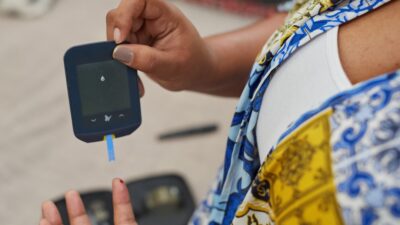
The most accurate blood sugar monitor depends on which type you need. Among fingerstick meters, the Contour Next One leads independent studies with a mean absolute relative difference (MARD) of 5.6%. Among continuous glucose monitors, the Dexcom G7 leads at 8.2% MARD. Both outperform FDA minimum standards.
How Accuracy Is Measured
The standard accuracy metric is mean absolute relative difference (MARD), the average percentage deviation of a meter’s readings from a laboratory reference. Lower is better. The FDA requires 95% of readings to be within 15% of lab values (or 15 mg/dL below 100 mg/dL), which translates to roughly 10% MARD in practice.
The Diabetes Technology Society runs an ongoing Blood Glucose Monitor System Surveillance Program that independently tests meters against ISO 15197:2013 standards and publishes which pass and fail.
Most Accurate Fingerstick Blood Sugar Monitors
| Meter | Published MARD | Notable Features |
|---|---|---|
| Contour Next One | 5.6% | Second-chance sampling; Bluetooth |
| Accu-Chek Guide | ~6.8% | Spill-resistant vial; strip port light |
| OneTouch Verio Reflect | ~7.8% | Blood Sugar Mentor feature |
| FreeStyle Lite | ~8.0% | Small sample size; no coding |
| ReliOn Premier BLU | ~9.5% | Low-cost option at major retailers |
All of these meters are FDA-cleared and meet the minimum standard. The practical differences show up in the extremes – at very low or very high glucose values – where leading meters hold their accuracy better than budget meters.
Most Accurate Continuous Glucose Monitors
| CGM | Published MARD | Wear Time |
|---|---|---|
| Dexcom G7 | 8.2% | 10 days + grace |
| FreeStyle Libre 3 | ~8.8% | 14 days |
| Dexcom Stelo | ~9.0% (non-insulin range) | 15 days |
| Medtronic Guardian 4 | ~10.6% | 7 days |
CGMs show slightly higher MARD than top fingerstick meters for single-point accuracy, but they generate 288 readings per day versus a handful from fingersticks. For pattern recognition and time-in-range tracking, CGM data is far more useful despite the slightly higher per-reading error.
What Actually Drives Accuracy
Device choice matters, but technique often matters more. Common reasons for inaccurate readings:
- Unwashed hands: fruit juice, lotion, or sweat can add 50-100 mg/dL.
- Insufficient blood sample: meters may still report but underestimate.
- Expired or heat-damaged strips: lose sensitivity.
- Incorrect coding: older meters that require code chips give wrong values if skipped.
- Altitude and hematocrit: very high altitude or unusual hematocrit skews results.
- Interfering substances: high-dose acetaminophen or vitamin C can affect some strips.
How to Choose the Most Accurate Blood Sugar Monitor for You
If you test once or twice a day
A fingerstick meter is probably your best fit. Pick the Contour Next One or Accu-Chek Guide for the best balance of accuracy and cost. Stock up on matching strips from a reliable supplier.
If you want pattern data and meal response insight
A continuous glucose monitor will show you far more than fingersticks. Dexcom G7 leads for accuracy; Dexcom Stelo is the best over-the-counter option for people not on insulin. Read our explainers on the detection of prediabetes and A1C levels to see how CGM data complements traditional measures.
If you are on insulin
A CGM is standard of care. Dexcom G7 or FreeStyle Libre 3 are both excellent. You will also want a fingerstick meter as backup.
If you are budget-conscious
The Contour Next One is inexpensive and leads accuracy tests. For CGM, the Dexcom Stelo subscription runs roughly $89 per month, making it the lowest-cost continuous option.
Verifying Your Meter’s Accuracy
- Run a control solution test weekly and after any drop or temperature extreme.
- Compare your meter against a lab venous glucose at your next blood draw. A difference under 15% is expected.
- Replace strip vials promptly after opening (most expire 90-180 days after first use).
- Store meter and strips between 50-104 degrees Fahrenheit; avoid hot cars and cold garages.
Accuracy Is Part of a Bigger Picture
Even the most accurate blood sugar monitor gives you a snapshot. A1C remains the standard for diagnosis and long-term tracking, and your clinician will interpret your meter data in context. Pair your device with a reliable nutrition plan and treatment strategy for the most actionable results.
The Bottom Line
The most accurate blood sugar monitor for single-point fingerstick testing is currently the Contour Next One at about 5.6% MARD. The most accurate continuous glucose monitor is the Dexcom G7 at 8.2% MARD. Match the device to how you plan to use it – occasional fingersticks versus continuous pattern tracking – and pay as much attention to technique and strip handling as you do to the model on the box.
Medical Disclaimer: This content is for educational purposes only and is not a substitute for professional medical advice, diagnosis, or treatment. Always consult your physician or qualified healthcare provider with any questions about a medical condition or treatment.