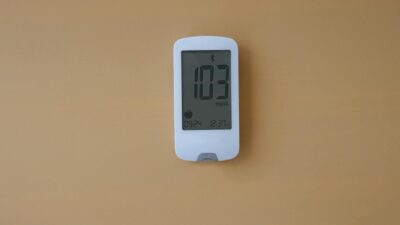
CGM for non diabetics is now widely available. In March 2024, the FDA cleared Dexcom’s Stelo as the first over-the-counter continuous glucose monitor, and Abbott’s Lingo followed. These sensors, worn on the upper arm for 14 to 15 days, let adults without diabetes see glucose trends in real time. The technology is educational and sometimes motivating, but accuracy limitations and overinterpretation are real risks.
How CGMs Work
A CGM uses a tiny filament inserted just under the skin to measure glucose in interstitial fluid, the fluid surrounding cells. It does not sample blood directly. A transmitter sends readings to a smartphone every 1 to 15 minutes, depending on the device. Stelo updates every 15 minutes, Lingo every minute. Because glucose takes 5 to 15 minutes to diffuse from blood into interstitial fluid, there is always a small lag, especially during rapid meals or exercise.
Who Can Now Buy a CGM Without a Prescription
Both Stelo and Lingo are cleared only for adults 18 and older who do not use insulin. They are not appropriate for type 1 diabetes, insulin-treated type 2, or anyone with frequent hypoglycemia, because the sensors can miss fast drops. People in the prediabetes range can use them, though the A1C test remains the clinical standard for diagnosis. Learn more in our prediabetes overview.
What Normal Glucose Looks Like Without Diabetes
| Scenario | Typical Glucose Range (mg/dL) |
|---|---|
| Fasting (overnight) | 70-95 |
| Pre-meal | 70-100 |
| 1 hour after meal | Peak usually <140 |
| 2 hours after meal | Back to <120 |
| During exercise | 80-140 depending on intensity |
| Sleep | 80-100 |
Research on non-diabetic volunteers has shown time in range (70-140 mg/dL) greater than 96 percent and occasional post-meal spikes up to 160 mg/dL after high-carbohydrate meals or stress. Seeing a single spike does not mean you have prediabetes.
Accuracy and Its Limits
CGM accuracy is measured by MARD, the mean absolute relative difference from a lab blood test. Current over-the-counter sensors have MARD around 8 to 12 percent. That means a reading of 100 mg/dL could represent a true blood glucose anywhere from about 88 to 112. Accuracy is worst at low glucose (under 70), during rapid changes, and in the first 12 to 24 hours after a new sensor is placed.
A high reading should always be confirmed by fingerstick or venous blood before triggering medical action. CGMs are excellent for trends, not diagnostic precision.
Legitimate Uses for Non-Diabetics
- Identifying personal food triggers, such as sweet drinks or refined grains
- Understanding how sleep, stress, or alcohol affect glucose
- Monitoring exercise recovery and fueling needs in endurance athletes
- Providing early trend data in people with a strong family history of diabetes
- Motivating dietary change through real-time feedback
Where CGMs Can Mislead
Many social-media CGM narratives flag normal physiological spikes as “damage.” The clinical CGM consensus guidelines define hyperglycemia for people with diabetes, not normal non-diabetics, so importing those thresholds onto a healthy user can create unnecessary alarm. Post-meal excursions to 140 mg/dL are part of normal digestion. Compression artifacts from sleeping on a sensor can cause false lows. Dehydration, temperature extremes, and acetaminophen (with some older sensors) can distort readings.
How to Use a CGM Well
- Log meals, exercise, and sleep alongside glucose for context.
- Pay attention to patterns across days, not single readings.
- Confirm unexpected readings with a blood glucose meter.
- Discuss trends with a clinician before changing medications or extreme diets.
- Remember A1C and fasting glucose remain the standards for diagnosis.
For broader context on food-glucose interactions, see our diet and nutrition hub.
Cost and Wear Practicalities
Stelo retails around 90 USD per month for two 15-day sensors; Lingo is similar. Neither is covered by insurance for non-diabetic use. Sensors are applied on the back of the upper arm and are generally showerproof and swim-resistant to about 2.4 meters. Warm-up periods of 30 to 60 minutes precede the first reliable reading. Adhesive can irritate some skin types, and occasional early sensor loss is reported.
The Bottom Line
CGM for non-diabetics offers a new window into glucose behavior, and it can highlight useful patterns. But the data are noisy, normal spikes are common, and no CGM replaces A1C or a clinician’s judgment. Treat it as a teaching tool, not a diagnostic device, and act on trends rather than single numbers.
Medical Disclaimer: This article is educational. Talk with a licensed clinician before making medical decisions based on CGM data.