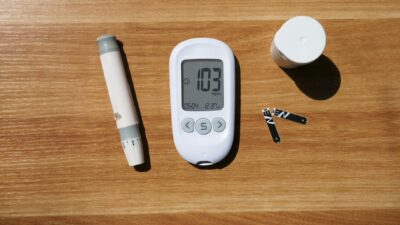
There is no FDA-cleared glucose meter without blood or an under-skin sensor as of 2026. Every glucose monitor authorized in the United States either requires a small drop of capillary blood or reads interstitial fluid through a tiny filament. If you have seen a watch, ring, or patch advertised as a fully bloodless meter, the FDA has issued clear warnings against relying on it.
What People Mean by a Glucose Meter Without Blood
When shoppers search for a glucose meter without blood, they usually want one of three things: no finger pricks, no needles at all, or no contact with body fluids. Each of these has a different technical reality. Finger-prick-free monitoring is possible today through a minimally invasive continuous glucose monitor. Completely needle-free, bloodless monitoring through intact skin is still a research target, not a consumer product.
The confusion matters because marketing language often blurs these categories. A device labeled needle-free may still need a sensor filament under the skin, while a device labeled non-invasive may not have any FDA clearance at all. Reading the 510(k) or De Novo summary before buying protects you from wasting money on unvalidated gadgets.
How Current FDA-Cleared Devices Actually Measure Glucose
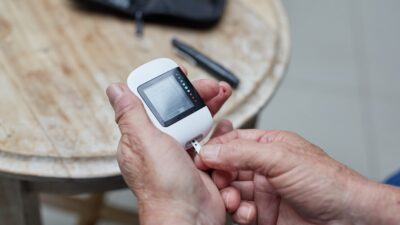
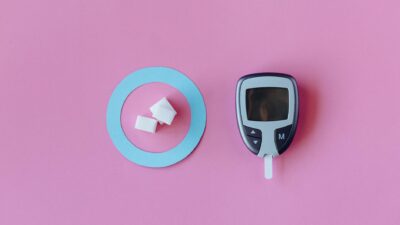
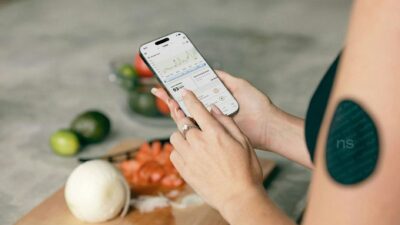
Today two cleared technologies dominate home glucose monitoring. Finger-stick meters apply a small drop of capillary blood to a test strip that uses an enzyme reaction and a tiny electrical current to estimate glucose. Modern lancets draw a drop that is roughly the size of a pinhead. CGMs such as Dexcom G7, FreeStyle Libre 3, and Stelo use a flexible filament thinner than a human hair. That filament sits in interstitial fluid just under the skin and reports readings every one to five minutes for 10 to 15 days.
Both approaches break the skin, but only briefly. Between finger sticks or between sensor insertions, there is no active wound. For many people, a CGM feels far less invasive than multiple daily finger pricks, which is why the term bloodless is often used loosely in consumer writing.
Devices Marketed as Bloodless: Claim vs. Reality
| Device Type | Marketing Claim | FDA Status |
|---|---|---|
| Smartwatch glucose sensor | Measures blood sugar through skin | Not authorized as of 2026 |
| Smart ring glucose tracker | Continuous non-invasive readings | Not authorized |
| Optical patch or laser pen | No needles, no blood | Research or unauthorized |
| Dexcom G7, Libre 3, Stelo | Minimally invasive CGM | FDA cleared |
| Eversense E3 implant | Long-wear CGM implant | FDA cleared, professionally placed |
This comparison shows why it pays to separate the idea of continuous monitoring from the idea of fully bloodless monitoring. Continuous is real and available. Bloodless through intact skin is still unproven in the consumer market.
What the FDA Has Said About Non-Invasive Claims
In February 2024 the FDA issued a safety communication warning consumers not to rely on any smartwatch or smart ring that claims to measure blood glucose through the skin. The agency noted that inaccurate readings could cause dangerous medication errors, especially for people on insulin. That guidance still stands.
A legitimate device will publish an FDA 510(k) number or De Novo decision, list intended use, and provide accuracy data against a laboratory reference. If a seller cannot produce any of this, the product is not a cleared glucose meter no matter what the packaging says.
Why You Still Need Reliable Data for Prediabetes
Many people exploring bloodless options are newly diagnosed with prediabetes and dislike the idea of daily finger pricks. Understanding your A1C levels and how meals shift glucose is useful, but the underlying numbers must be accurate. An unvalidated watch reading that is off by 30 or 40 mg/dL could push you toward unneeded medication or hide a problem that deserves attention.
If cost is a concern, a basic finger-stick meter still retails for less than a streaming subscription, and some insurers cover strips. If pricking bothers you, the over-the-counter Stelo CGM and prescription Libre or Dexcom systems remove repeated lancing. None of these options is bloodless in the strictest sense, but all of them produce readings you can trust.
How to Choose Between a CGM and a Finger-Stick Meter
Start with your clinical question. If you want a daily snapshot of fasting glucose, a finger-stick meter works well and costs little. If you want to see how specific meals, workouts, or sleep affect glucose, a CGM provides far richer data. People with type 1 diabetes, those on insulin, and many with type 2 diabetes benefit most from continuous data, but over-the-counter CGMs are increasingly used by people with prediabetes too.
Ask your clinician about wear time, alerts for highs and lows, app compatibility, share features for family members or care teams, and cost after insurance. A short trial of any device is more informative than marketing copy.
Red Flags When Shopping Online
If a listing avoids the words FDA cleared, names no 510(k) or De Novo number, claims no calibration is needed, and promises blood sugar in seconds through a watchband, treat the product as unvalidated. Social media ads and overseas retailers are common channels for these devices. Check the FDA Device Classification database, look at the manufacturer website, and search for independent clinical testing before you buy. Reporting suspicious products to the FDA MedWatch program helps protect other consumers.
The Bottom Line
A true glucose meter without blood that reads through intact skin does not yet exist in an FDA-cleared form. Minimally invasive CGMs are the closest available option and can eliminate routine finger pricks for many people. Do not trust watches or rings that promise bloodless readings. Work with a licensed clinician to choose a cleared finger-stick meter or CGM, and report misleading products to the FDA.
Medical disclaimer: This article is for educational purposes only and does not replace medical advice. Always consult a qualified healthcare provider before starting, stopping, or changing any medical device or therapy.